Marine Research Poster
Your study, understood in 60 seconds.
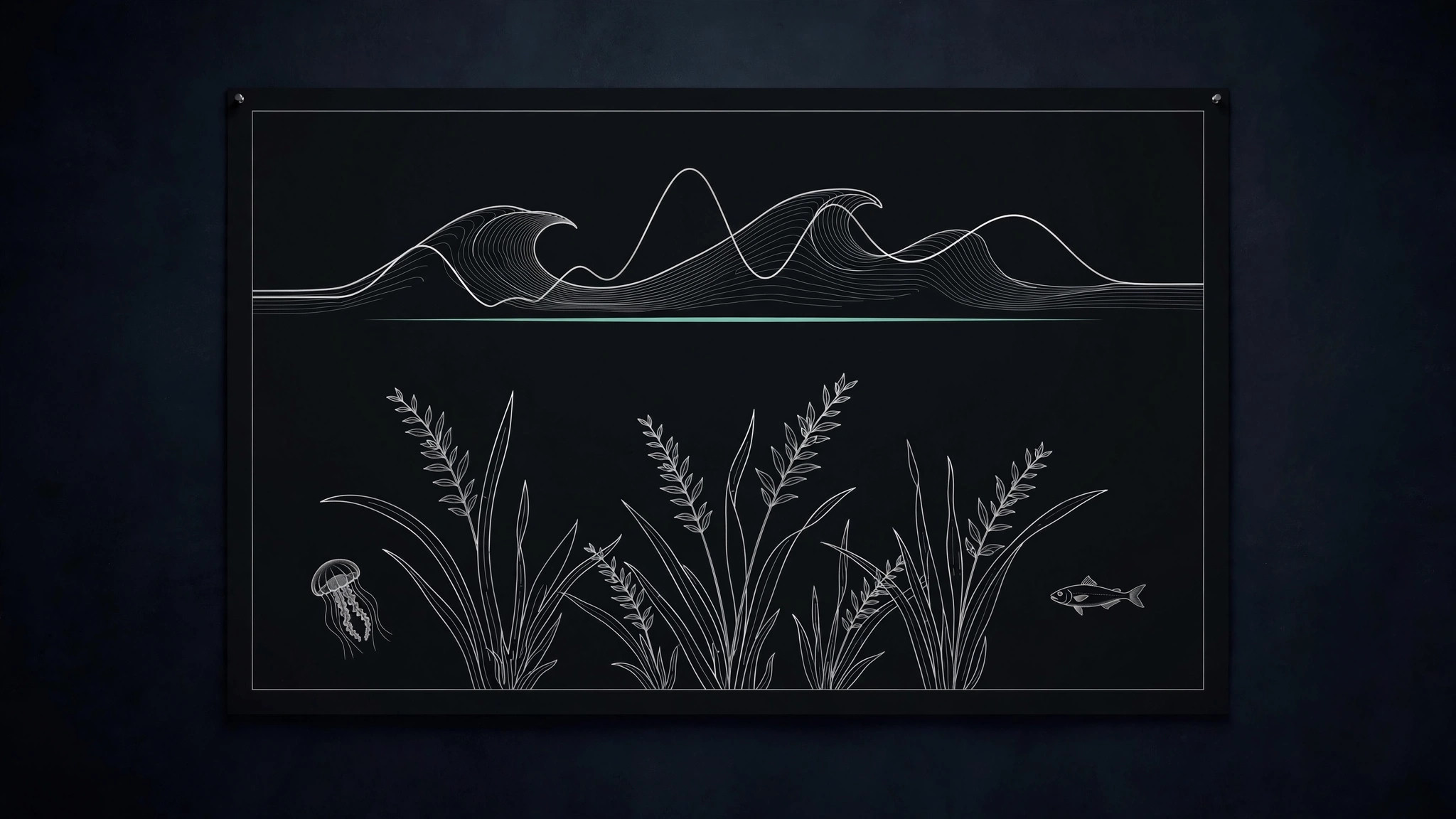
Turns your AI into a scientific poster designer for marine research — structures the question, methods, results, and takeaway into a clean, readable conference poster that a passerby can grasp in 60 seconds.
Install it in 3 steps
No sign-up. No CLI tools. Pick your AI, copy one line, paste it over.
Prefer doing it yourself? Buy the skill ($4.99), download the ZIP from your checkout confirmation, unzip it into the directory shown above, restart your AI session — same result. Already bought it? Your AI assistant can download it for you.
What’s inside
One SKILL.md (the playbook) + one starter template. A preview:
Marine Research Poster
When to use
- You are presenting marine biology, oceanography, fisheries, or coastal research at a conference and need a poster that communicates the study without you standing next to it
- A draft poster is a wall of dense paragraphs in 12-point type and nobody stops to read it during the poster session
- You need to turn a thesis chapter, journal paper, or field report into a single large-format poster (typically A0 or 36×48 in) for a symposium or department showcase
- A lab or research group wants a consistent poster template so every member's poster looks like it belongs to the same team
- You are preparing a public-outreach version of a marine study for an aquarium, museum, or school exhibit, where the audience is not specialists
Workflow
- Write the one-sentence story (input: paper/thesis/field report → output: question + answer in two sentences)
Before any layout, write two sentences: the question ("Do seagrass beds shelter more juvenile fish than bare sand?") and the answer ("Yes — 3× more juveniles, mostly at bed edges."). Everything on the poster must serve these two sentences. Any figure, paragraph, or method detail that doesn't serve them gets cut or moved to a handout/QR-linked supplement. - Plan the reading path (input: story → output: section plan with word budgets)
Lay out a top-to-bottom, left-to-right path a stranger can follow in 60 seconds: Title (≤15 words, states the finding, not just the topic) → Question & why it matters (≤60 words) → Methods in pictures (a diagram or 3-step strip, ≤60 words) → Results (1–3 figures, each with a takeaway caption) → Takeaway (one bold sentence, large type) → References + acknowledgements + contact/QR (small type, bottom strip). Assign a word budget per section and enforce it — posters fail from words, not from lack of words. - Build the figures first (input: data → output: 1–3 poster-ready figures)
Design figures for the poster, not for the paper: large axis labels (readable from 1.5 meters), high-contrast colors, no more than 3–4 data series per chart, and a takeaway title on each figure ("Juvenile fish concentrate at seagrass edges") instead of a neutral label ("Figure 2"). A map or field-site photo belongs here too — one strong image of the study site or organism earns more stops than any chart. If a figure needs a paragraph to explain it, redesign the figure.
Template preview
Marine Research Poster — Planning Template
Fill this in before any layout. The poster advertises the paper — it is not the paper.
The story (two sentences)
Question: {Do … ?} Answer: {Yes/No — …} Why it matters: {one sentence for a non-specialist}
Section plan (word budgets enforced)
Figures (design for the poster, not the paper)
Site/organism photo: {file} — {why it earns its space}
Layout
Size: [ ] A0 / [ ] 36×48 in / [ ] {other} Grid: {columns, reading path} Background: {white / very light} · Accent color: {name, hex} Typeface: {family} — title {80–120pt} · headings {36–48pt} · body {≥24pt} White space: ≥15% of area [ ]