Layered Material Cutaway
See inside anything layered — every layer labeled, in order.
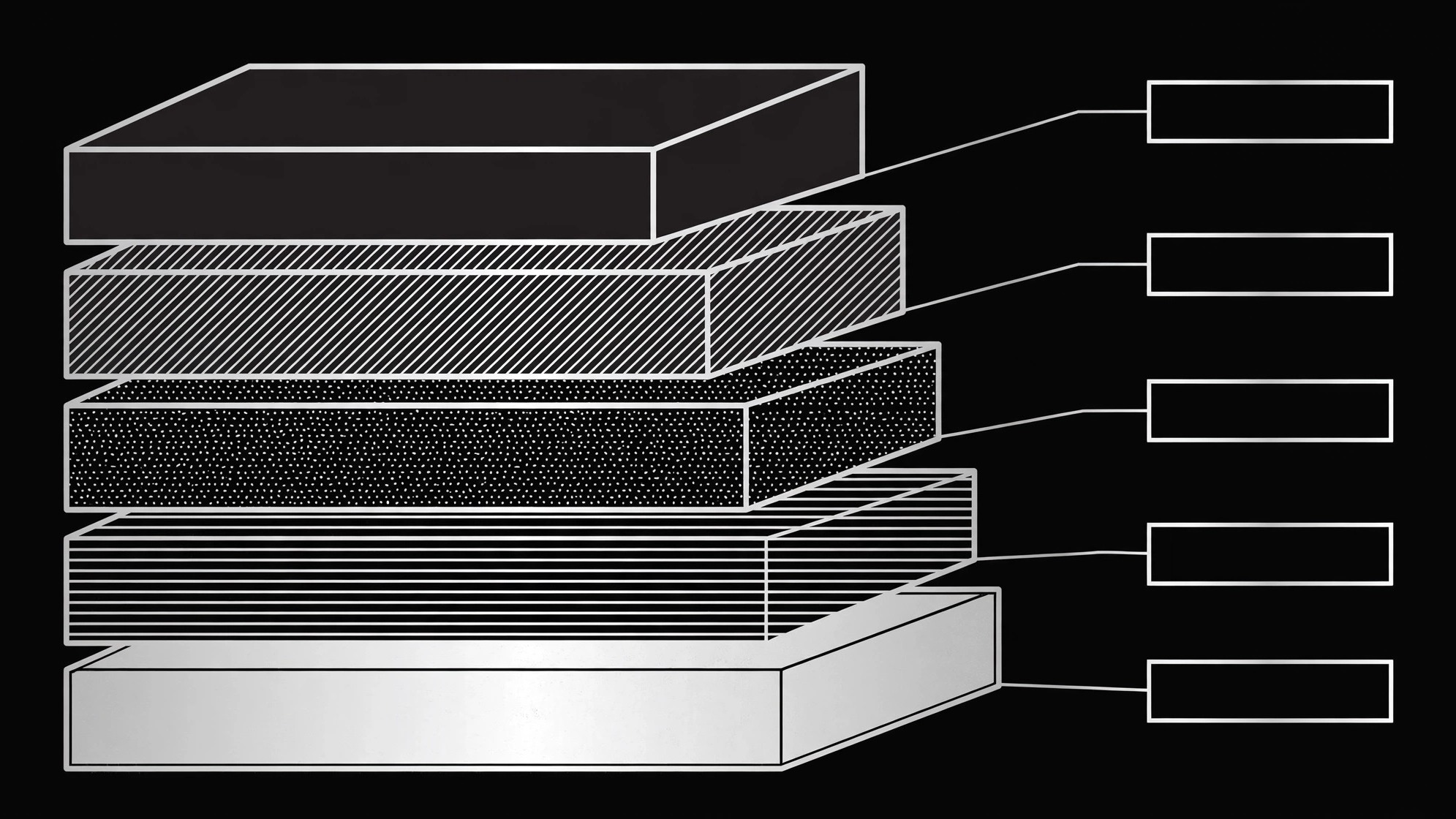
Turns your AI into a technical-illustration designer — draws a cutaway that reveals the real layers of a material or product, in order, with every layer labeled and its thickness or role stated.
Install it in 3 steps
No sign-up. No CLI tools. Pick your AI, copy one line, paste it over.
Prefer doing it yourself? Buy the skill ($4.99), download the ZIP from your checkout confirmation, unzip it into the directory shown above, restart your AI session — same result. Already bought it? Your AI assistant can download it for you.
What’s inside
One SKILL.md (the playbook) + one starter template. A preview:
Layered Material Cutaway
When to use
- A manual, datasheet, or lesson must show what is inside a layered thing — a wall assembly, a battery cell, a sandwich panel, a printed circuit board — and words alone keep failing
- A product page needs to explain why a product performs the way it does by showing its construction, layer by layer
- A training deck teaches assembly, repair, or inspection and the learner needs to picture the stack before touching the real thing
- A sales or pitch deck claims a material advantage that only makes sense once the audience sees the layers
- A museum label, exhibit, or explainer shows a cross-section of a natural or engineered layered structure
Workflow
- Get the real layer stack (input: spec sheets, teardown, or verified source → output: ordered layer list)
List every layer from outside to inside (or top to bottom), in the order they actually occur, with each layer's name, material, and thickness or relative proportion where known. Use the manufacturer's spec, a measured teardown, or a cited reference — never guess a layer's order, material, or thickness to make the drawing prettier. If a layer's thickness is unknown, say so and draw it as "not to scale" rather than inventing a proportion. One missing layer discovered after publication undoes the whole illustration's credibility. - Choose the cut (input: layer list → output: cut plan)
Decide how the cutaway reveals the stack: a straight cross-section slice, a stepped cut that exposes each layer like stairs, or a corner cut that shows two faces at once. Pick the cut that exposes the layers the reader most needs to see, and keep the cut geometry simple — one clean cut plane, not a puzzle. Show which direction the cut runs with a small orientation note ("cut through the panel's center, viewed from the front") so the reader knows what they are looking at. - Draw the layers in order (input: cut plan → output: cutaway illustration)
Draw every layer in the stack, in order, with a distinct fill or hatch per layer and a consistent scale within the drawing. Keep layer boundaries crisp and parallel where the real layers are parallel; where a real boundary is rough or wavy, draw it rough — the drawing should look like the thing, not like a striped flag. Include the surrounding context the reader needs: the outer surfaces, any fasteners or interfaces that cross layers, and nothing else. If the stack has more than about eight layers, group thin adjacent layers under one bracket and label the group, rather than drawing unreadable hairlines.
Template preview
Layered Material Cutaway — Build Template
A cutaway is a factual diagram. Every layer must come from a spec, a teardown, or a cited source.
The thing
Subject: {what is being cut open, e.g. "exterior wall assembly"} Source for the stack: {spec sheet / teardown / reference + date} Verified by: {name of someone who knows the thing}
Layer list (outside → inside, in true order)
Unknowns (mark, never guess): {layer + what is unknown} Thin-layer grouping: {layers grouped under one bracket, if more than ~8 layers}
Cut plan
Cut type: [ ] straight cross-section · [ ] stepped cut · [ ] corner cut Cut direction: {where the cut runs}