Bioactive Pathway Poster
Every arrow sourced, every effect labeled.
A scientific-poster playbook for a bioactive pathway: a verified node-and-edge table where every arrow carries its effect and source, laid out in labeled zones so a reader can trace the mechanism without a guide.
Install it in 3 steps
No sign-up. No CLI tools. Pick your AI, copy one line, paste it over.
Prefer doing it yourself? Buy the skill ($4.99), download the ZIP from your checkout confirmation, unzip it into the directory shown above, restart your AI session — same result. Already bought it? Your AI assistant can download it for you.
What’s inside
One SKILL.md (the playbook) + one starter template. A preview:
Bioactive Pathway Poster
When to use
- You're presenting a poster on a bioactive compound's mechanism and your current draft is a wall of text with a pathway diagram nobody can follow
- Your pathway has 8–30 interacting nodes (compounds, proteins, genes, cellular outcomes) and the relationships matter as much as the parts
- Readers keep asking "so what does it actually do?" because the diagram shows connections but not the direction of effects
- You're preparing a conference poster, a lab-meeting figure, or a review figure that must survive scrutiny from people who know the field
- You need a figure that a non-specialist can read at a glance and a specialist can check node by node
Workflow
- Define the pathway scope (input: research question + sources → output: scope statement)
One sentence: "This poster shows how {compound} affects {process} in {system}." List what's in scope and what's deliberately excluded. A poster that tries to show everything shows nothing — exclusion is a design decision, not a gap. - Build the node-and-edge table (input: primary literature → output: verified table)
Every node (compound, receptor, enzyme, gene, cellular outcome) gets: name, type, role in one phrase, source citation. Every arrow gets: from → to, effect (activates / inhibits / converts / upregulates / downregulates), evidence strength, source citation. No arrow without a source. If you can't source it, it doesn't go on the poster. - Lay out the flow (input: node-and-edge table → output: layout plan)
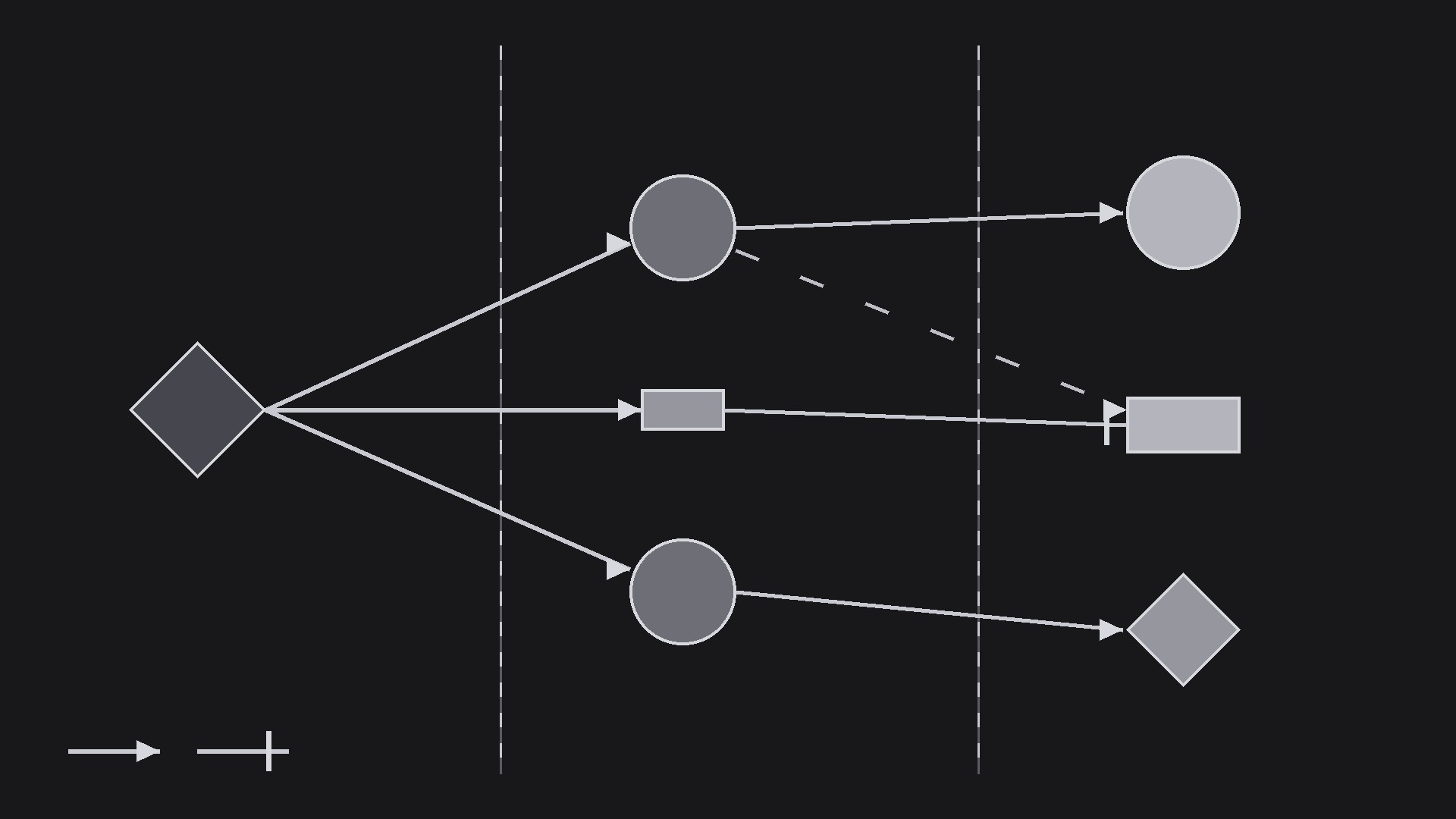
Read left-to-right or top-to-bottom: trigger → mediators → cellular outcomes. Group related nodes into labeled zones (e.g., membrane, cytoplasm, nucleus). Keep arrow crossings minimal — if arrows tangle, split the pathway into two panels rather than drawing spaghetti. - Label for two audiences (input: layout plan → output: label set)
Every node labeled with its standard name; every arrow labeled with its effect; a one-line takeaway per zone; a legend defining arrow types, colors, and symbols; abbreviations defined on the poster, not assumed. A reader should be able to trace the mechanism without you standing next to them. - Review for accuracy (input: full draft → output: checked poster)
Check every node name, every arrow direction, every effect against its source. Have a colleague in the field review it. Fix or remove anything you can't source — an unsourced arrow on a conference poster is a question you don't want.
Output spec
Template preview
Bioactive Pathway Poster — Planning Template
Fill this in before drawing anything. No arrow goes on the poster without a row in the tables below.
Poster title: {…}
Scope sentence: "This poster shows how {compound} affects {process} in {system}." In scope: {…} Deliberately excluded: {…}
Node table
Edge (arrow) table
Layout plan
- Reading direction: {left-to-right / top-to-bottom}
- Zones: {e.g. Membrane → Cytoplasm → Nucleus}
- Panels: {one panel / split into two — reason: …}
- Takeaway per zone:
- {Zone 1}: {one line}
- {Zone 2}: {one line}
Legend
- Solid arrow = {direct activation}
- Blunt line = {inhibition}