Story-World Continuity Bible
Keep a fictional universe coherent when its makers change
Build a continuity bible for a story world that outlives its original studio: canon tiers, character and timeline rules, and a change process, so a TV adaptation, a sequel, or a new team does not contradict the world fans love.
Install it in 3 steps
No sign-up. No CLI tools. Pick your AI, copy one line, paste it over.
Prefer doing it yourself? Buy the skill ($4.99), download the ZIP from your checkout confirmation, unzip it into the directory shown above, restart your AI session — same result. Already bought it? Your AI assistant can download it for you.
What's inside
One SKILL.md (the playbook) + one starter template. A preview:
Story-World Continuity Bible
The situation it fits
A studio closes, but its world does not. After BioWare closed in October 2026, the next Mass Effect game was cancelled — yet Amazon MGM Studios' live-action Mass Effect series stayed in development, with its showrunner and writers still attached. The question stopped being "what happens next in the game" and became "who decides what is true about this world now?" A continuity bible answers that question in writing, before the arguments start.
Workflow
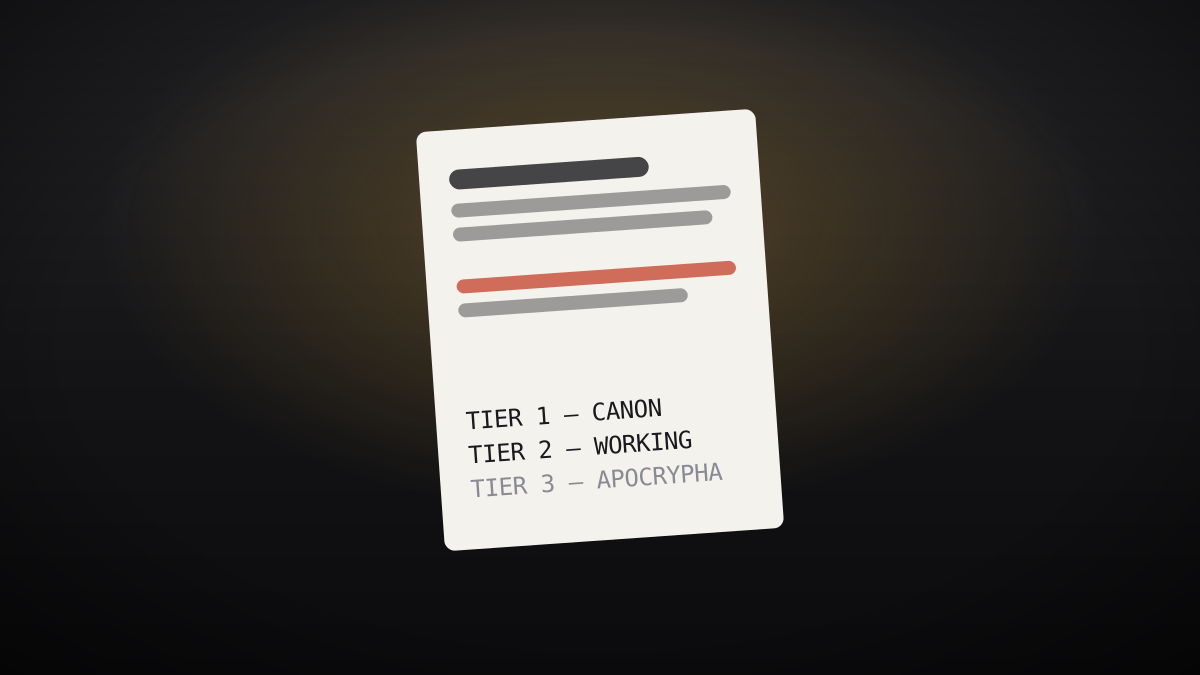
- Canon tiers (input: all released + announced material -> output: 3 tiers).
Tier 1 — settled canon: released works, on the record, not negotiable
without a formal change. Tier 2 — working canon: announced or in
development, true until contradicted by Tier 1. Tier 3 — apocrypha:
cut content, early drafts, fan theories, and anything a departed team
member said in an interview. Every fact in the bible carries its tier.
A fact without a tier is a future argument. - Timeline spine (input: dated events -> output: one timeline).
Build a single timeline of the world's history with dates (or date
ranges where the work is vague) and a source per event. Mark gaps
explicitly: "no established date" is a fact, and it is better than a
guessed date that a later writer treats as gospel. - Character rules (input: main cast -> output: one card per character).
Each card: what the character would never do, what they want most, what
they do not know, and what changed them last. "Would never do" is the
most valuable line — it is what keeps a new writer from writing a
stranger with a familiar name. - Open questions register (input: unresolved threads -> output: a list with owners).
Every dangling thread (an ending choice, a missing character, a
promised return) gets: the question, who may answer it, and whether it
is open by design or by accident. Open by design is a feature; open by
accident is a debt, and the register says which is which. - Change process (input: a proposed contradiction -> output: a decision record).
Any change to Tier 1 canon requires: a written proposal, the reason,
what breaks if it changes, and a named decider. Changes are logged
with dates. A bible that cannot say "we changed this on purpose, here
is why" is a museum, not a tool.
A note on respect
A continuity bible is not a leash. Its job is to let new creators move fast inside the world without accidentally breaking what fans carry in their heads — and to make the deliberate breaks visible, so audiences can tell a choice from a mistake.
Template preview
Continuity Bible Worksheet
1. Canon tiers
2. Timeline spine
3. Character cards
- Character:
- Would never:
- Wants most:
- Does not know:
- Last changed by: