AI Services Market › Skills factory › Docs › Meeting Notes
$4.99 · No sign-inv1.0.0– views
Meeting Notes
Drop in the chat log — every task gets an owner and a deadline
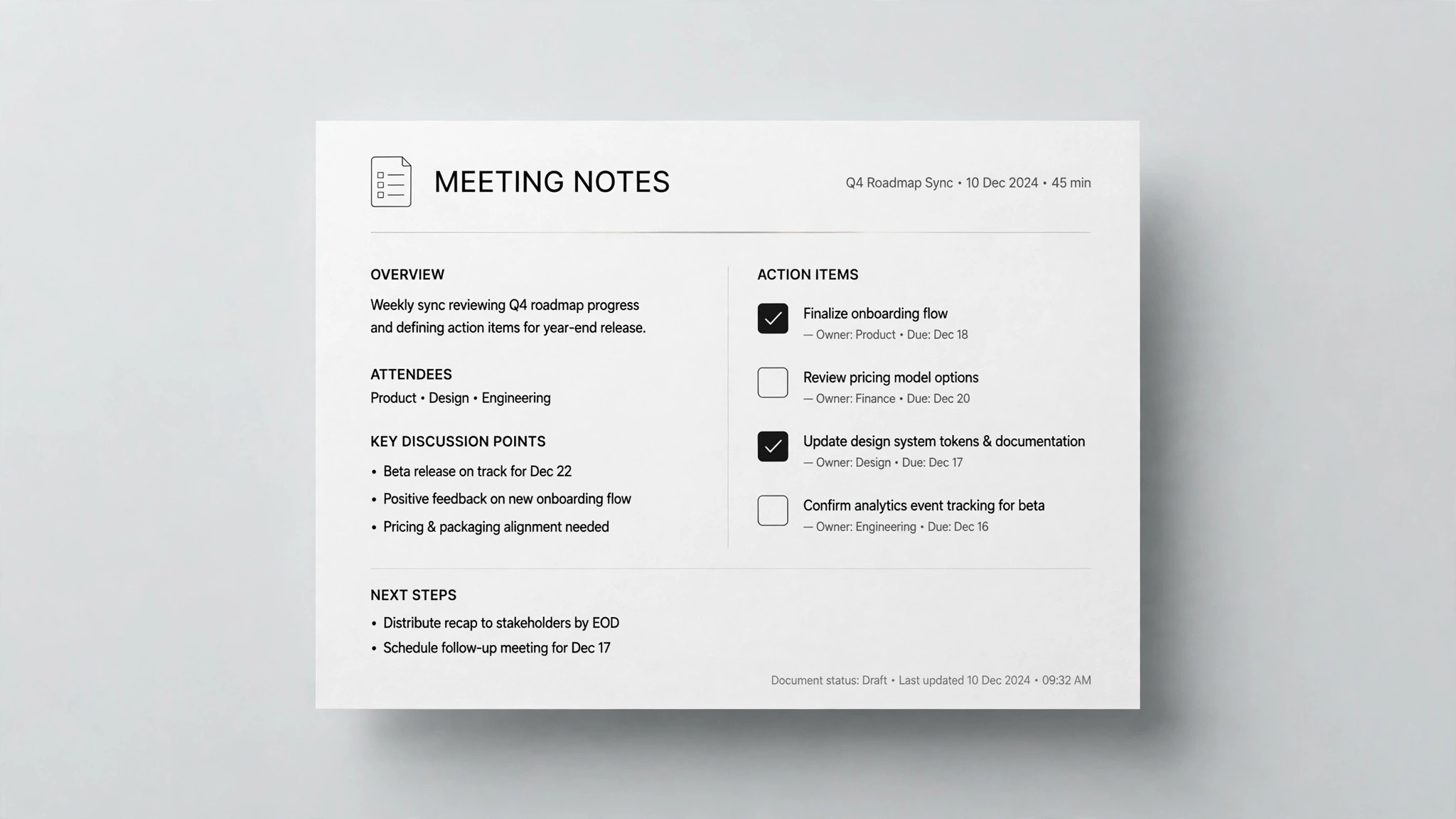
Turn chat logs or transcripts into structured notes: decisions, tasks (owner + deadline, no exceptions), discussion summary, next agenda.
Best for
Team members, meeting organizers
Time needed
~5 min per doc
Level
Beginner-friendly
Install it in 3 steps
No sign-up. No CLI tools. Pick your AI, copy one line, paste it over.
Prefer doing it yourself? Buy the skill ($4.99), download the ZIP from your checkout confirmation, unzip it into the directory shown above, restart your AI session — same result. Already bought it? Your AI assistant can download it for you.
Real-world proof
Real people did this exact job with AI agents.
Use case
Turn voice notes into Linear tickets and review analytics
Read case →Use caseRecord meetings and suggest answers live from uploaded files
Read case →Use caseNegotiate hotel rooms by phone call
Read case →What’s inside
One SKILL.md (the playbook) + one starter template. A preview:
Meeting Notes
When to use
- The meeting is over and all you have is a transcript or a chat log that needs to become readable minutes
- The discussion sprawled and "what we talked about" needs compressing into "what we decided and who's doing what"
- A cross-team meeting needs its conclusions synced so absentees get it in 3 minutes
- The boss or client wants a "one-pager" on the meeting outcome
- A long-running project needs a paper trail: when it was decided, who called it, and why
Workflow
- Read everything, grab the conclusions first
- Input: the full chat log / transcript, attendee list if available
- Action: find every decision, approval, rejection, and open item; ignore small talk and tangents
- Output: conclusion list, one sentence each, noting who called it (e.g. "Called by Ana: …")
- Extract action items
- Input: conclusion list + source text
- Action: break each action into "what to do" and find its owner and deadline; where the source is silent, mark "to confirm" instead of guessing
- Output: action list, each with task, owner, and deadline
- Compress the discussion
- Input: the discussion passages behind each conclusion
- Action: keep only the key disagreements, rationale, and data that shaped the conclusion; cut repeated and emotional remarks
- Output: 3–8 discussion bullets, each stating who argued what and on what basis
- Collect next-time topics
- Input: "let's revisit" / "decide later" type remarks in the source
- Action: list them separately as next-time topics, noting where each got stuck
- Output: next-time topic list, one line each + what's blocking it
- Assemble the final draft from the template
- Input: conclusions + actions + discussion summary + next-time topics
- Action: assemble per template.md: header info → conclusions → action table → discussion summary → next topics, with 1–3 key source quotes
- Output: markdown minutes ready to forward
Output spec
- The first 3 lines must state: what meeting, when, who attended, and the core conclusions — no scrolling to find the point
- Action items in a table with columns: task / owner / deadline / status; each item executable and verifiable
- Deadlines as concrete dates (e.g. Oct 15), never fuzzy words like "next week" or "ASAP"
- Names consistent throughout: full name or one fixed short form, never switching mid-document
- Discussion summary covers only conclusion-relevant disagreements and rationale, not the whole play-by-play
- Key conclusions carry a source quote (speaker + the gist of their words) for traceability
- Title format "date + topic" (e.g. 1011-Q4 Campaign Review) for easy archiving and search
- For minutes being broadcast, add a "sent to" line after the action table stating who received it
Template preview
Meeting Notes
Header
- Topic:
- Time:
- Attendees:
- Notetaker: