Slides Skills
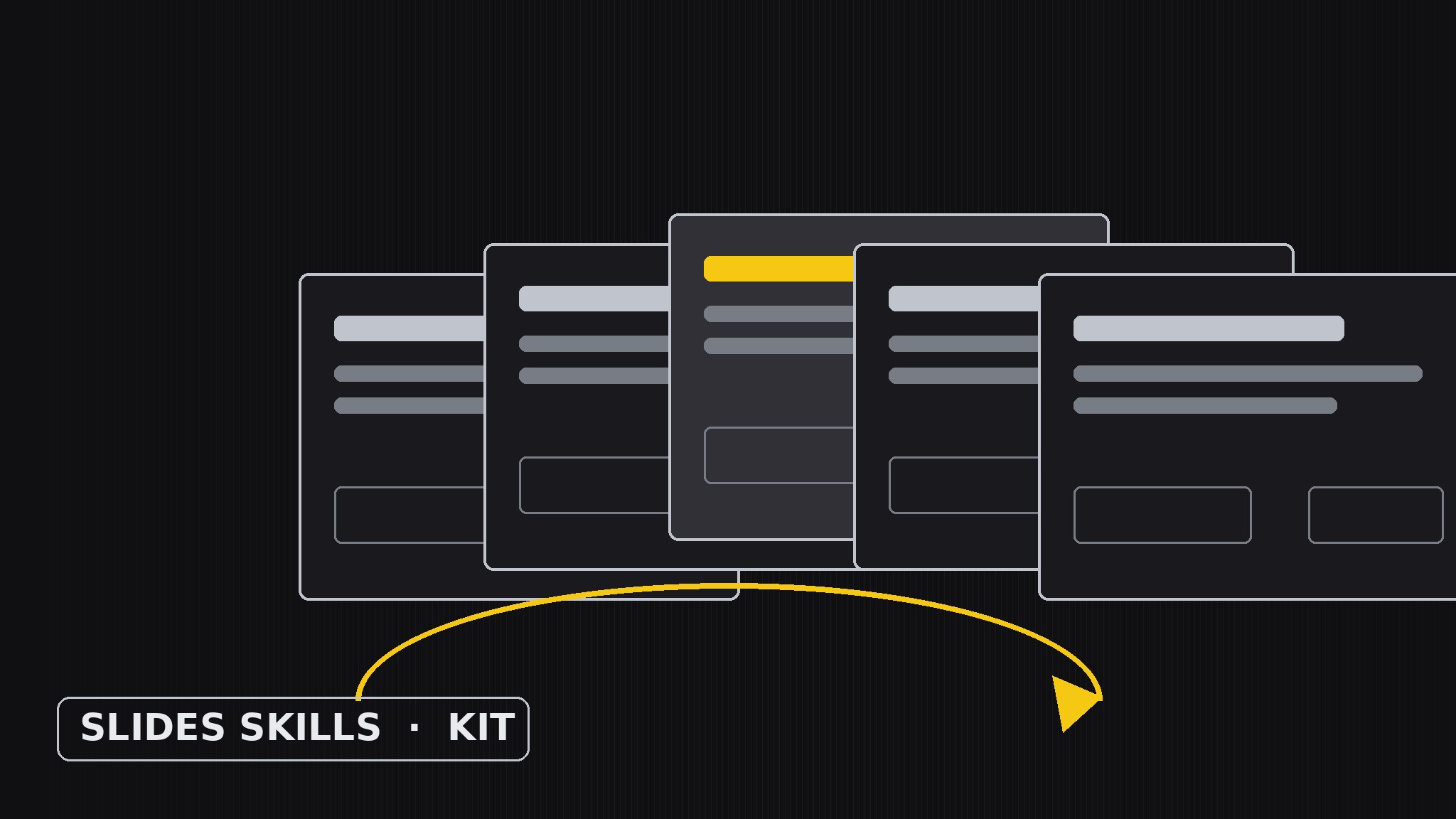
The arc is the kit — decks that end somewhere.
Turns your AI into a deck-kit builder — scopes, writes, and assembles a coherent kit of deck skills that ship real presentations: one skill per deck type and slide pattern (pitch, report, editorial, keynote, and more), each held to the same quality bar, composing into decks with a clear arc from first slide to last.
Install it in 3 steps
No sign-up. No CLI tools. Pick your AI, copy one line, paste it over.
Prefer doing it yourself? Buy the skill ($4.99), download the ZIP from your checkout confirmation, unzip it into the directory shown above, restart your AI session — same result. Already bought it? Your AI assistant can download it for you.
What’s inside
One SKILL.md (the playbook) + one starter template. A preview:
Slides Skills
When to use
- You need several decks (pitch, report, keynote) and want them to feel like one organization's voice
- A team keeps rebuilding decks from a blank file, with every deck inventing its own structure
- You want a reusable kit: pick the deck type, assemble its arc from proven slide patterns, ship
- A talk, board report, or editorial presentation needs a clear arc, not just good-looking slides
- You are standardizing how your AI builds decks so every deck has one idea per slide and a real ending
Workflow
- Define the deck jobs (input: the talks and meetings on your calendar → output: kit brief)
Start audience-and-occasion-first: list the real decks this kit must produce and, for each, name the audience, the occasion, and the one outcome ("investors decide to take a meeting", "the board approves the budget", "the audience repeats the idea tomorrow"). Build the kit brief around those occasions — a pitch deck and a board report are different jobs and need different arcs, even if they share slide patterns. A kit with no named occasions drifts into generic templates; a kit built for three real occasions gets used on the fourth. - Inventory the skills (input: kit brief → output: deck inventory)
Give the kit two layers. Deck-type skills, one per occasion: Pitch (problem → solution → proof → ask), Report (question → evidence → recommendation), Editorial (story → tension → resolution), Keynote (hook → turns → takeaway), Workshop (concept → exercise → debrief). Then slide-pattern skills, the reusable building blocks every deck type draws on: Claim Slide (one sentence, one visual), Comparison (two options, one verdict), Evidence (one chart, one reading), Quote (one voice, large type), Agenda (the arc, in advance), and Closer (the ask, repeated). Keep the inventory small — if a pattern appears in only one deck, it may not deserve a skill. - Write each skill to the bar (input: deck inventory → output: skill specs)
Every skill gets the same spec shape: when to use it, its inputs (the content it needs — e.g. Pitch needs the problem, the solution, the proof, and the ask), its output (the deck or the slide, ready to present), and the shared quality bar. The bar is arc-honest: one idea per slide, headlines written as full-sentence claims (not labels), every deck has an arc with a beginning, a turn, and an ending, no slide survives if removing it changes nothing, and numbers are always sourced. Write the specs so a new deck type can join the kit by reusing the slide patterns, not by reinventing them.
Template preview
Slides Skills — Kit-Building Template
The arc is the kit. Headlines alone must tell the argument.
Kit brief — decks this kit must produce
Deck inventory
Deck-type skills (one per occasion):
Slide-pattern skills (reusable blocks):
Skill spec (copy per skill)
Skill: {name} When to use: {___} Inputs: {___} Output: {the deck / the slide, ready to present} Quality bar: one idea per slide / headlines as full-sentence claims / real arc (beginning, turn, ending) / no passengers / numbers always sourced
Deck assembly
Deck: {name + type} Headline arc (read alone — tells the whole argument?):
- {claim headline}
- {claim headline}


