Image Skills
One message, every size — a set, not a pile.
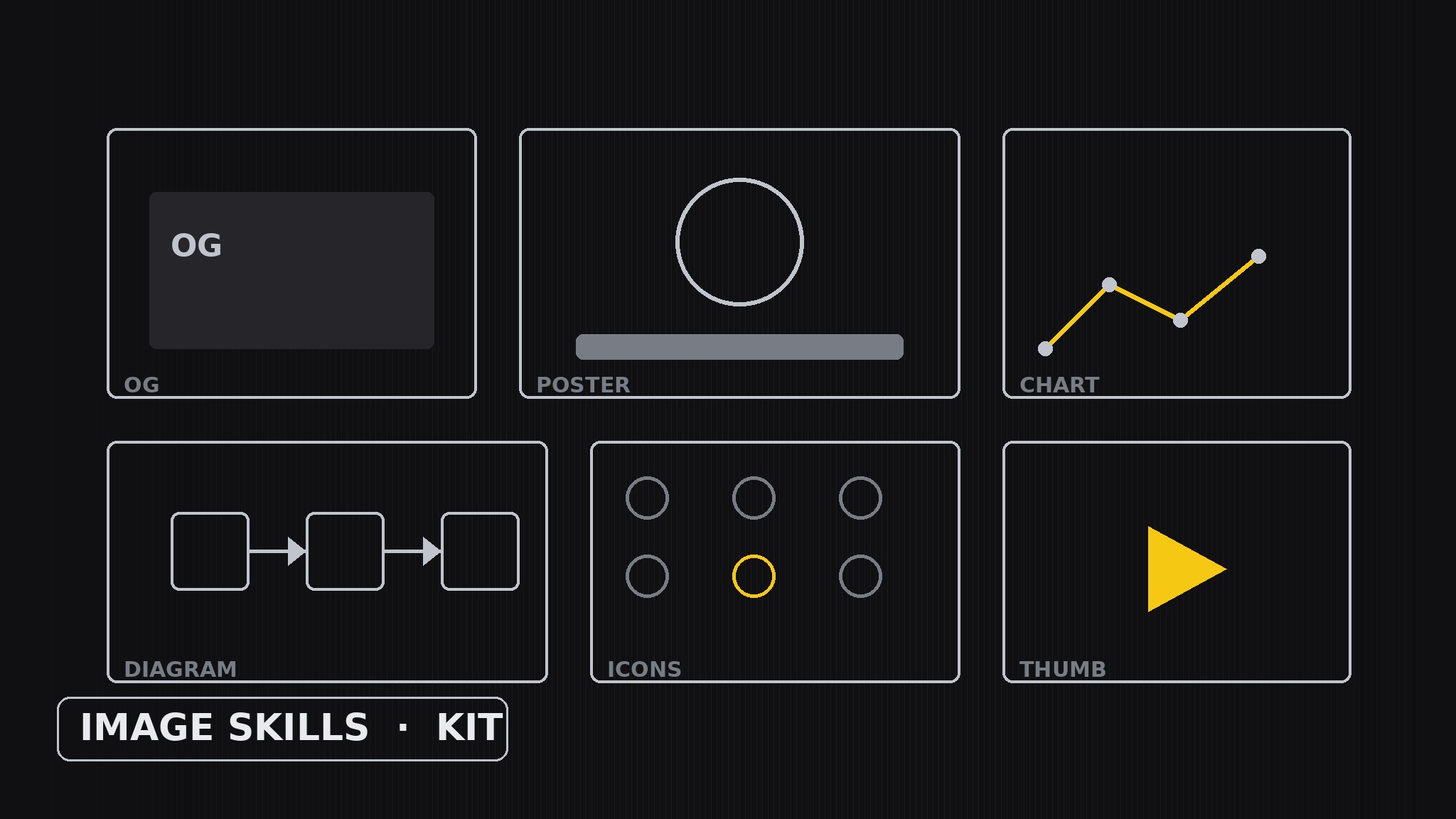
Turns your AI into an image-kit builder — scopes, writes, and assembles a coherent kit of visual-asset skills that produce a matching set of images: one skill per asset type (OG image, chart, poster, diagram, and more), each held to the same quality bar, composing into a campaign set that looks like one hand made it.
Install it in 3 steps
No sign-up. No CLI tools. Pick your AI, copy one line, paste it over.
Prefer doing it yourself? Buy the skill ($4.99), download the ZIP from your checkout confirmation, unzip it into the directory shown above, restart your AI session — same result. Already bought it? Your AI assistant can download it for you.
What’s inside
One SKILL.md (the playbook) + one starter template. A preview:
Image Skills
When to use
- You need a matching set of images for one launch, post, or report — not a series of unrelated one-offs
- The same message has to appear as an OG image, a poster, a chart, and a thumbnail, and they should look related
- A team keeps regenerating images that clash: different type, different palette, different density
- You want a reusable kit: pick the assets a campaign needs, produce them to one standard, ship
- You are standardizing how your AI makes images so every asset is readable at its real display size
Workflow
- Define the asset jobs (input: where the images will appear → output: kit brief)
Start size-first: list every surface the kit must serve — the social share card (small, crowded feed), the poster (large, viewed at distance), the chart inside a report (medium, read closely), the diagram in a doc (medium, studied), the thumbnail (tiny, must read in a list). For each surface, record its display size, its viewing distance, and its one job ("make someone stop scrolling", "make the trend obvious"). A kit scoped by real surfaces produces assets that work where they live; a kit scoped by vibes produces pretty images that fail at thumbnail size. - Inventory the skills (input: kit brief → output: asset inventory)
Give the kit one skill per asset type, each named for what it produces. A typical kit holds: OG Image (one message, readable at thumbnail size), Chart (one trend, every value labeled), Poster (one idea at distance, big type, one image), Diagram (how something works, labeled parts in order), Icon Set (small marks in one style), and Thumbnail (the hook frame, bold and simple). Cut any asset type no surface actually needs — a kit with a "brochure cover" skill nobody uses is clutter — and keep each skill to one asset type so quality stays checkable. - Write each skill to the bar (input: asset inventory → output: skill specs)
Every skill gets the same spec shape: when to use it, its inputs (the content it needs — e.g. Chart needs the data table and the one trend it must show), its output (the finished asset at its real size), and the shared quality bar. The bar is size-honest: type must read at the actual display size (test at that size, not zoomed in), one message per asset (an OG image with three messages has none), a shared palette and type system across the kit, no invented data (a chart plots only the numbers given; a diagram labels only what is known), and alt text describing the asset's message for every image. Write the specs so a new asset type can join the kit without breaking the look.
Template preview
Image Skills — Kit-Building Template
Scope by real surfaces. Proof at real size.
Kit brief — surfaces this kit must serve
Asset inventory (one skill per asset type)
Cut: {any asset type no surface actually needs — remove it}
Skill spec (copy per skill)
Skill: {name} When to use: {___} Inputs: {___} Output: {finished asset at its real size + alt text stating its message in one sentence} Quality bar: type reads at actual display size / one message per asset / shared palette + type / no invented data / alt text included
Campaign set — one message, many assets
The one sentence every asset must carry: {sentence}


