Brand Identity Kit
One system, so every asset looks like one company.
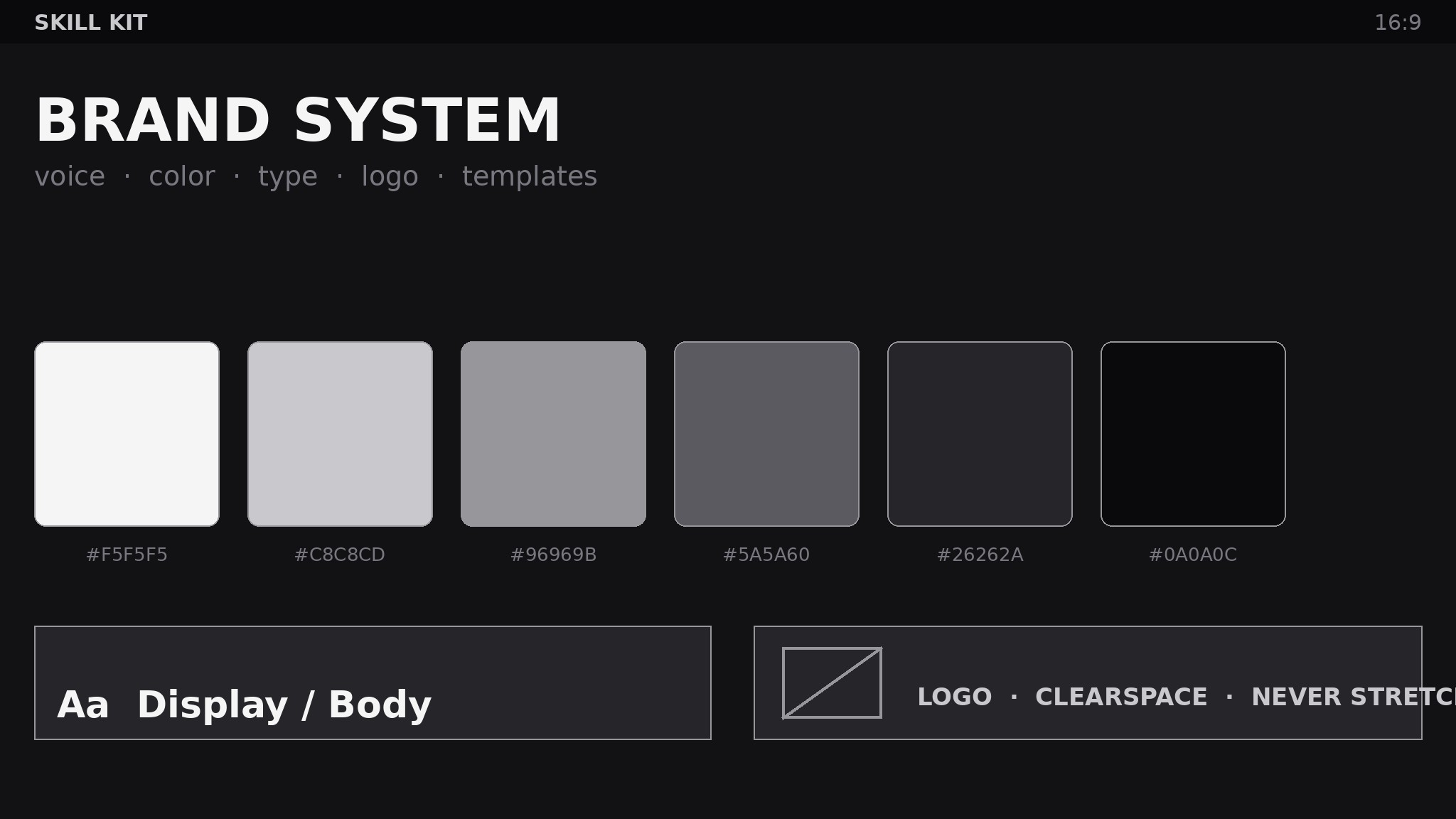
Turns your AI into a brand-system kit builder — scopes a coherent identity kit (voice, color, type, logo usage, templates), assembles the skills that define and enforce it, and sets the bar each must clear so every asset looks like it came from the same company.
Install it in 3 steps
No sign-up. No CLI tools. Pick your AI, copy one line, paste it over.
Prefer doing it yourself? Buy the skill ($4.99), download the ZIP from your checkout confirmation, unzip it into the directory shown above, restart your AI session — same result. Already bought it? Your AI assistant can download it for you.
What’s inside
One SKILL.md (the playbook) + one starter template. A preview:
Brand Identity Kit
When to use
- Your logo, site, decks, and social posts each look like they came from a different company
- You keep re-deciding colors, fonts, and tone for every new asset
- You want to hand design work to someone else (or to your AI) without the brand drifting
- Your brand exists as a logo file and a vibe, not as rules anyone can follow
- A rebrand, a new product line, or a first hire made the inconsistencies impossible to ignore
Workflow
- Scope the kit (input: your existing assets and audience → output: kit scope sheet)
Gather every asset currently in use — logo files, site, decks, invoices, social posts — and audit them against each other: which colors actually appear, which fonts, which tone. The scope sheet names what the kit covers (logo usage, color, type, voice, templates), the one audience the brand must read clearly to, and the brand's one-sentence personality ("precise but warm, never corporate"). A kit built without the audit just adds new rules on top of old contradictions. - Inventory the identity skills (input: scope sheet → output: skill inventory)
List the skills the kit needs, one per identity job: Voice (turns the personality sentence into do/say and don't/say lists with sentence patterns), Color (turns the audit into a locked palette — primaries, neutrals, one accent — with usage ratios and contrast rules), Type (turns the palette's mood into a type system: display face, body face, sizes, line-heights, and what never pairs), Logo usage (turns the logo files into clearspace, minimum-size, background, and misuse rules), Templates (turns the system into ready-to-use layouts for deck, document, social post, and email), Asset check (turns any finished asset into a pass/fail verdict against the whole system). If the kit has no asset-check skill, the system is a suggestion, not a standard. - Write the contract for each skill (input: skill inventory → output: per-skill input/output contracts)
For every skill, write the input, the output, and the pass bar. The pass bars are specificity bars: Voice — "a stranger can tell a brand sentence from a generic one in a blind test"; Color — "every color has a hex value, a job, and a maximum share of the page; no off-palette colors anywhere"; Type — "two faces maximum, sizes from a fixed scale, never stretched or outlined"; Logo usage — "misuse examples shown (don't stretch, don't recolor, don't crowd), each with the corrected version beside it"; Templates — "a new asset starts from a template, never from a blank page." Vague rules ("use colors tastefully") are how brands drift.
Template preview
Brand Identity Kit — System Pack
If it is not in this document, it is not the brand.
1. Kit scope sheet
Audience the brand must read clearly to: {one sentence} Brand personality (one sentence): {e.g. precise but warm, never corporate} Kit covers: logo usage / color / type / voice / templates Asset audit summary: {what actually appears today — colors, fonts, tone — and where they contradict each other}
2. Voice
Do / say: {pattern 1} | {pattern 2} | {pattern 3} Don't / say: {pattern 1} | {pattern 2} | {pattern 3} Sentence patterns: {example brand sentence} / {example brand sentence}


