Wording Choice
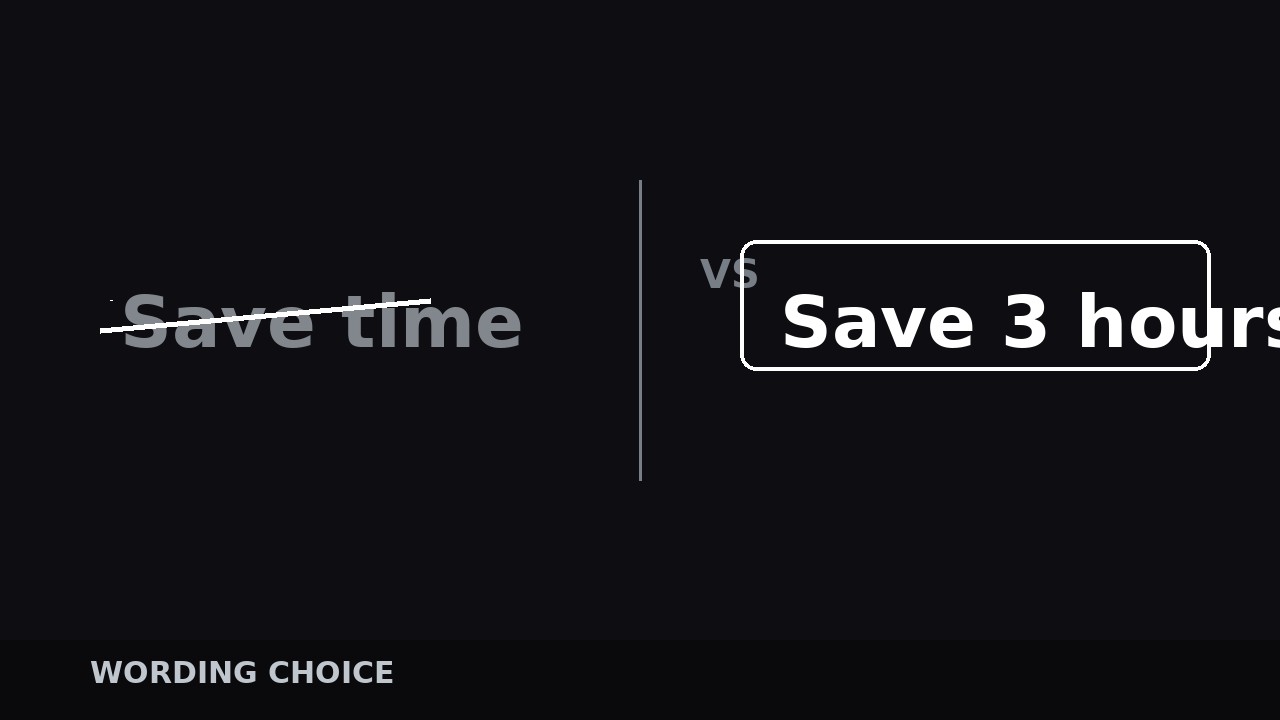
Two wordings duel — the weaker one is crossed out, the stronger one locks in.
Stages copy decisions as side-by-side duels: both options start equal, the loser is struck through, the winner locks in, and the one-line reason names the mechanism. Covers pair selection, verdict timing, reason lines, and chaining pairs into a lesson.
Install it in 3 steps
No sign-up. No CLI tools. Pick your AI, copy one line, paste it over.
Prefer doing it yourself? Buy the skill ($4.99), download the ZIP from your checkout confirmation, unzip it into the directory shown above, restart your AI session — same result. Already bought it? Your AI assistant can download it for you.
What’s inside
One SKILL.md (the playbook) + one starter template. A preview:
Wording Choice
When to use
- Your video teaches writing, naming, messaging, or communication, and the lesson lives in the difference between two phrasings
- You are deciding a headline, a button label, a title, or a slogan on camera and want the audience to see the reasoning, not just the verdict
- A script review, a copy teardown, or a brand-naming session needs a visual language for "this one, not that one"
- The difference between two options is subtle — one word, one verb, one framing — and spoken explanation alone would blur it
- You want a repeatable comparison beat: the same side-by-side duel can run through a whole video, one pair at a time
Workflow
- Find the real pairs (input: draft copy / script → output: 3–7 wording pairs)
Pull genuine alternatives from the actual draft — pairs you really debated, not straw men you invented to knock down. Each pair must differ in exactly one decision: one verb ("Get" vs "Unlock"), one framing ("Save time" vs "Stop wasting time"), one specificity ("Better results" vs "12% more signups"), one audience ("For teams" vs "For solo founders"). If a pair differs in three ways at once, split it into three pairs or the audience cannot tell which change mattered. Aim for 3–7 pairs per video: fewer than 3 is not a pattern, more than 7 turns the video into a list. For each pair, write the one-sentence reason the winner wins — not "it sounds better", but the mechanism: "specific number beats vague promise", "active verb beats passive noun", "the reader's word beats the company's word". - Stage the duel (input: wording pairs → output: side-by-side layout)
Lay the two options out as a duel, not a list: Option A on the left, Option B on the right, same typeface, same size (6–8% of frame height), same neutral color at the start, separated by a thin divider or a "VS" marker. Keep each option to 1–6 words — longer lines wrap, break the symmetry, and turn the duel into a paragraph comparison. Both options start equal: no color, no size advantage, no hint which one wins. The audience should feel the tension of a fair fight for the first beat. If the options are different lengths, center each in its own half so the layout stays balanced — never let the longer option look more important just because it takes up more space.
Template preview
Wording Choice — Build Template
One decision per duel. Fill in the pairs from the real draft before staging anything.
Video: {title} | Pairs: {3–7}
Pairs (each differs in EXACTLY ONE decision)
Straw-man check: every pair is a real alternative debated in the draft? [ ] Order: {clearest win first → subtlest in the middle → most important last}
Staging (identical for every pair)
Layout: {side by side / stacked for vertical} | Divider: {thin line / VS marker} Typeface: {one family} | Size: {6–8% of frame height} | Start color: {same neutral for both} Option length: {1–6 words each} | Halves balanced: [ ] (center each in its half)


