Tiered Pyramid Notes
Loose notes that stack themselves into one clear hierarchy.
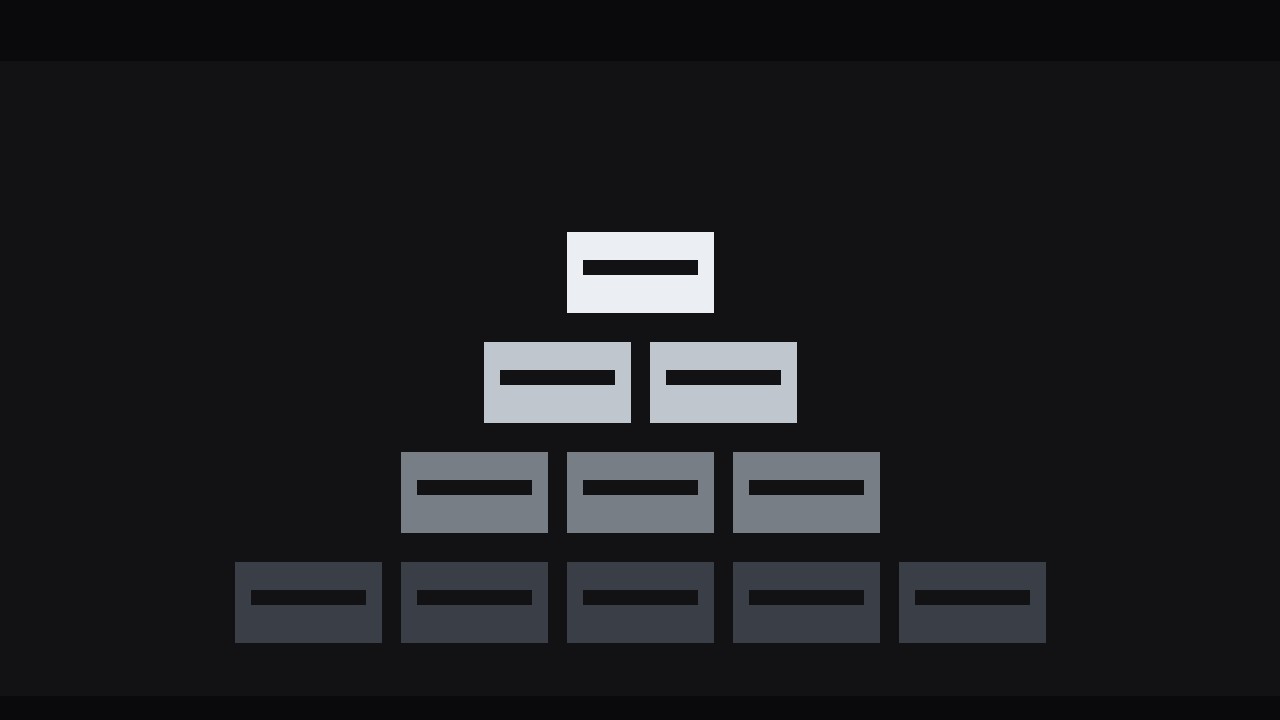
Notes fly in row by row and assemble into a pyramid — broad evidence at the base, one takeaway at the peak — turning a pile of ideas into a structure the audience can remember.
Install it in 3 steps
No sign-up. No CLI tools. Pick your AI, copy one line, paste it over.
Prefer doing it yourself? Buy the skill ($4.99), download the ZIP from your checkout confirmation, unzip it into the directory shown above, restart your AI session — same result. Already bought it? Your AI assistant can download it for you.
What’s inside
One SKILL.md (the playbook) + one starter template. A preview:
Tiered Pyramid Notes
When to use
- The end of an explainer, when scattered points need to resolve into one structure the audience can remember
- A framework video: principles, layers, or priorities that naturally stack from broad base to single peak
- A meeting recap or lecture summary where the notes taken during the session become the takeaway diagram
- A pitch or proposal where the argument builds from evidence (wide) to recommendation (one point)
- A study or revision video where a mass of facts compresses into a hierarchy worth memorising
Workflow
- Sort the notes into tiers (input: raw notes or script points → output: 3–5 tiers, each with 1–6 notes)
Group every note by its level of generality. The bottom tier holds the foundation: facts, evidence, raw observations — the widest group. Each tier above it holds fewer, more abstract notes: patterns, principles, conclusions. The top tier holds exactly one note: the single takeaway. Aim for 3–5 tiers total; two tiers is barely a pyramid, six turns into a staircase nobody can read. A workable shape is 5–3–2–1 or 6–4–2–1. If a tier ends up with more notes than the one below it, your grouping is upside down — re-sort. Write each note as a short phrase (≤5 words); a note that needs a sentence is a paragraph, and paragraphs do not stack. - Design the pyramid (input: tiered notes → output: static pyramid layout with note cards)
Draw the pyramid as rows of note cards. The bottom row is the widest, each row above it narrower and centred, until the single top card caps the peak. Keep every card the same height; let widths vary slightly by row so the pyramid silhouette reads even before the text does. Leave a small, consistent gap between cards (8–12 px at 1080p) — cards that touch merge into stripes; cards too far apart float. Style the cards like notes, not buttons: a paper-like fill, a 1 px edge, a subtle shadow, and a small marker per tier (a colour tab, a number, a tiny icon) so the audience can tell tiers apart at a glance. The top card gets the strongest treatment — the darkest fill, the accent colour, or the boldest type — because it is the destination of the whole graphic.
Template preview
Tiered Pyramid Notes — Build Template
Fill this in before animating. One pyramid per argument.
The argument
Topic: {topic} Single takeaway (top card): {one phrase, ≤5 words}
Tiers (bottom-up, each row narrower than the one below)
Tier count: {3–5} | Shape check: {e.g. 5–3–2–1, each row narrower}
Pyramid design
- Card height: {uniform, px} | Gap: {8–12 px}
- Card style: {paper fill / 1 px edge / subtle shadow}
- Tier markers: {colour tab / number / tiny icon} per row
- Top card treatment: {darkest fill / accent colour / boldest type}
Fly-in timing
Total build: {~3–5 s}


