Resume Screener
Drop in resumes, get back a ranked shortlist — you read the best.
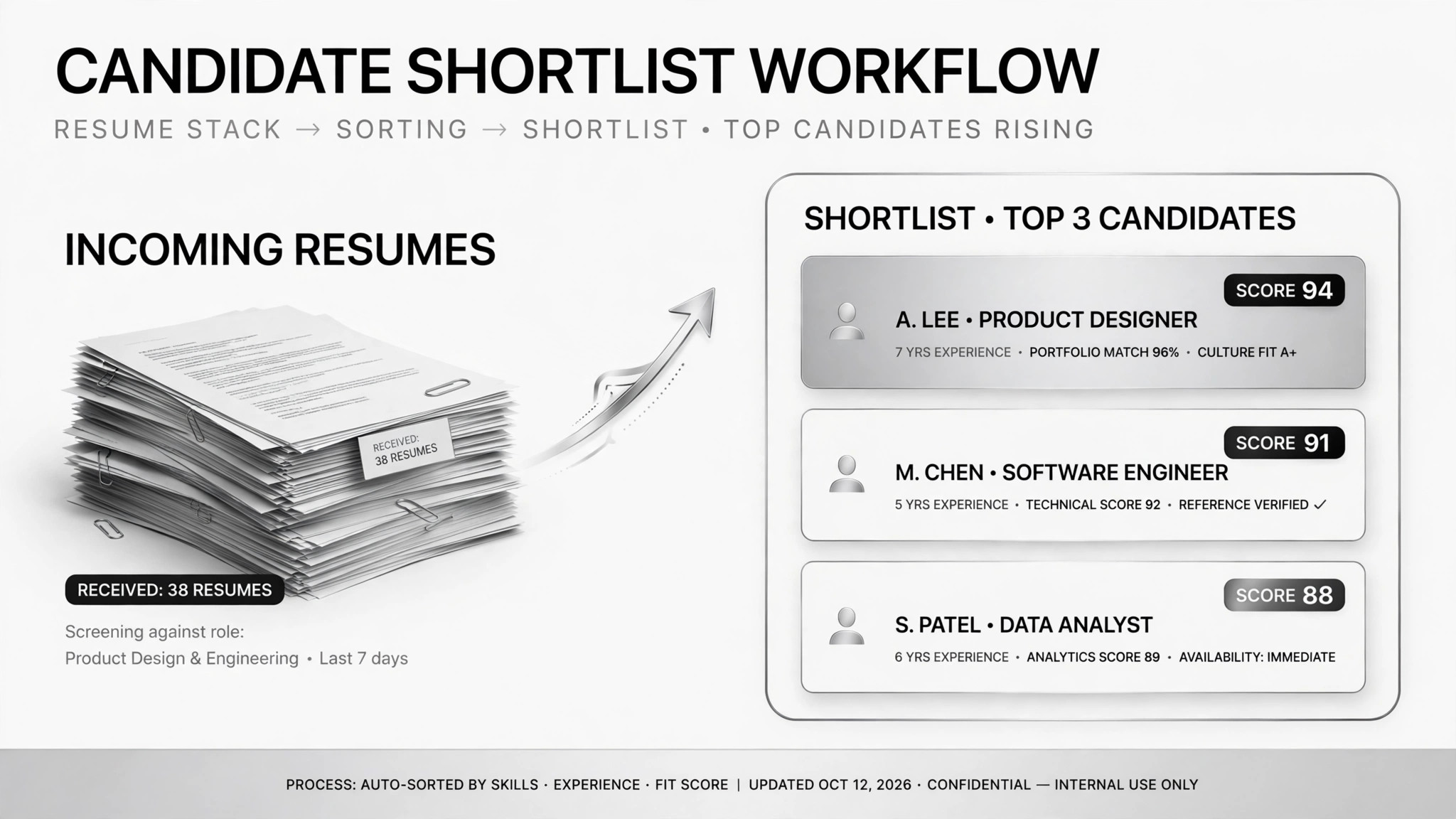
Drop in a pile of resumes, get back a ranked shortlist with scored reasons — you only read the finalists, and you make the final hiring call.
Install it in 3 steps
No sign-up. No CLI tools. Pick your AI, copy one line, paste it over.
Prefer doing it yourself? Buy the skill ($4.99), download the ZIP from your checkout confirmation, unzip it into the directory shown above, restart your AI session — same result. Already bought it? Your AI assistant can download it for you.
Real-world proof
Real people did this exact job with AI agents.
Screen candidates and summarize resumes with AI
Read case →Use caseScreen job applications and summarize in a digest
Read case →Use caseScreen 115 job candidates with parallel agents
Read case →What’s inside
One SKILL.md (the playbook) + one starter template. A preview:
Resume Screener
When to use
- You have 50+ applications for one role and no time to read them all
- You need a consistent, written scoring rubric applied to every candidate equally
- Hiring runs on a schedule and you want a digest of new applicants each cycle
- You want public evidence (GitHub, portfolios, published work) checked against resume claims
- Your team needs a defensible shortlist with reasons attached to each name
Workflow
- Write the rubric (input: job description → output: scoring rubric)
Turn the job description into must-have and nice-to-have criteria with weights — e.g. "5+ years backend: required; fintech experience: nice-to-have." This is the most important step: a sloppy rubric produces a sloppy shortlist. Include how borderline cases should be flagged, not just how winners score. - Collect the pile (input: applications → output: resume set)
Gather all resumes into one place: a folder, an inbox, or a scheduled pull from your ATS. One candidate, one file or record — name them consistently so nothing gets lost or double-counted. - Score every candidate (input: rubric + resume set → output: scored candidates)
Parse each resume for name, years of experience, and key skills, then score it against your rubric. Where public evidence exists (GitHub, portfolio, writing), check the claims against it — a resume line with evidence behind it scores higher than one without. Every score carries a one-line reason. - Challenge the top (input: scored candidates → output: defended ranking)
Before finalizing, pressure-test the top of the list: have a second pass argue against the highest scores. Is the evidence real, or is the resume just well-written? Force a real score distribution so "everyone looks good" can't happen. This step is what separates a ranking from a rubber stamp. - Flag the uncertain (input: ranked list → output: shortlist + flags)
Deliver a ranked shortlist where every candidate has a score and a reason. Borderline cases get explicit flags — "strong portfolio, but only 3 years experience vs. required 5" — so you can decide whether the rule bends. Nothing ambiguous gets silently dropped or silently promoted. - You decide (input: shortlist → output: interview list)
You review the shortlist and make the interview call. The AI never contacts candidates directly — interview invites and rejection notes get your approval first. Final hiring decisions stay with humans, always.
Output spec
Template preview
Resume Screener — Rubric & Shortlist Template
Write the rubric before reading a single resume. The rubric decides the shortlist, not your mood on page 60.
Job: {title} — {date}
Scoring rubric
Borderline rule: {e.g. strong portfolio can bend the years requirement — flag, don't drop}
Scored candidates
Ranked shortlist
Flagged (borderline) — decided by me, not the machine
- {name} — {score}: {why uncertain, e.g. "strong portfolio but 3 yrs vs. 5 required — decide if the bar bends"}
Interview list
- {name} — {reason invited}
- {name} — {reason invited}