Ratio Between Two Sides
Two sides, one sliding divider — feel the imbalance before you read it.
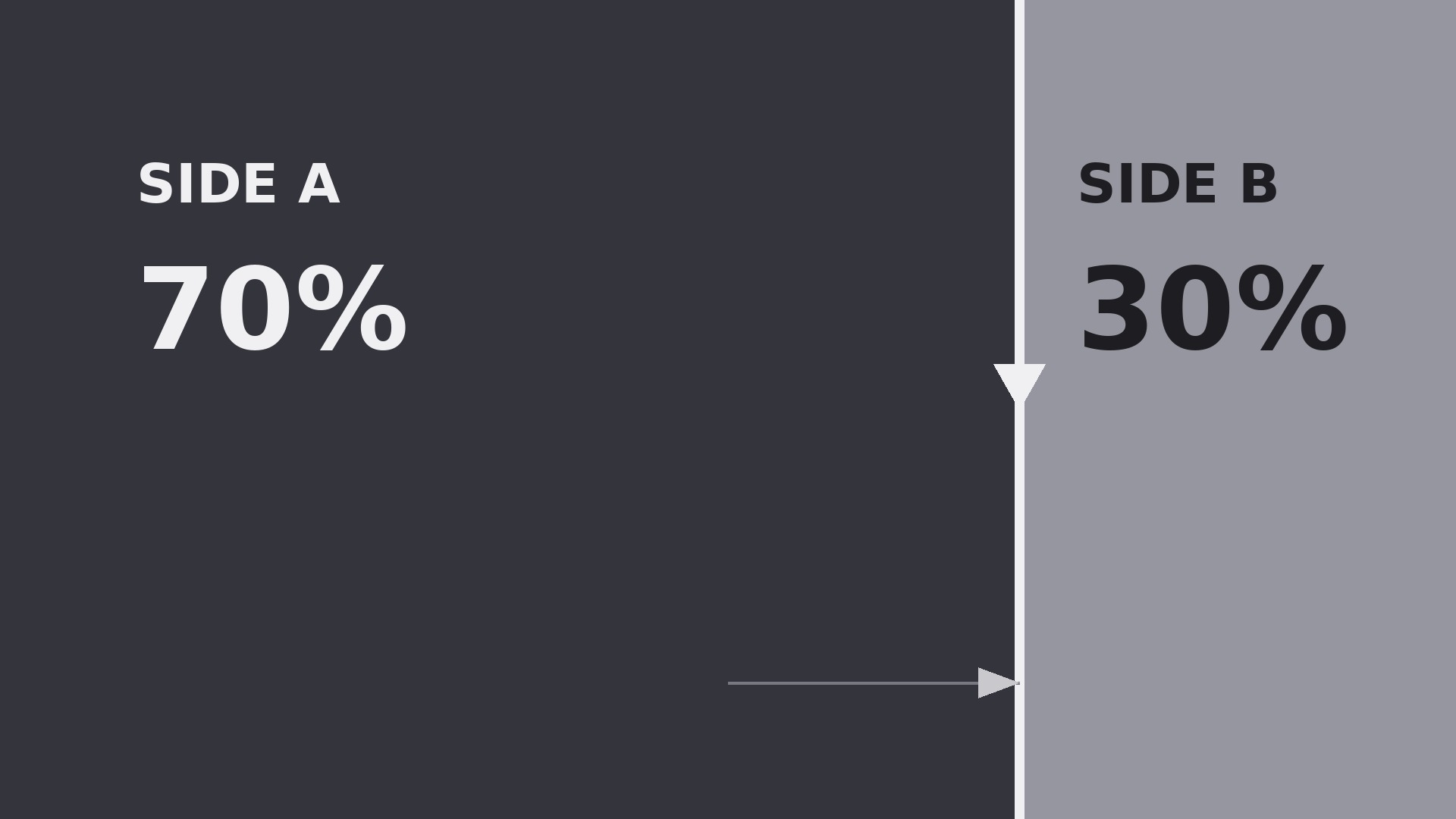
A ratio staged as a two-sided face-off: two halves, one divider that slides from even to the true split, so the balance or imbalance is felt before it is read.
Install it in 3 steps
No sign-up. No CLI tools. Pick your AI, copy one line, paste it over.
Prefer doing it yourself? Buy the skill ($4.99), download the ZIP from your checkout confirmation, unzip it into the directory shown above, restart your AI session — same result. Already bought it? Your AI assistant can download it for you.
What’s inside
One SKILL.md (the playbook) + one starter template. A preview:
Ratio Between Two Sides
When to use
- The comparison has exactly two sides (this vs that, yes vs no, new vs old, us vs them) and the ratio between them is the story
- A single bar or a sentence ("70/30") states the ratio but doesn't make the audience feel the imbalance
- You are framing a decision, a debate, a split vote, or a before/after where two states oppose each other
- The clip is a 12–25 second opener for a discussion, a pitch slide, or a lesson beat — the visual is the argument
- The two sides have distinct identities (colors, labels, icons) that deserve equal visual dignity, even when the numbers are lopsided
Workflow
- Name the two sides (input: comparison → output: two labeled sides + ratio)
Give each side a 1–3 word name and, if it helps, one icon or color. Write the ratio in its simplest honest form: "70 : 30" (keep the raw numbers too — 70:30 is not the same story as 7:3 rounded from 68:32 if the gap matters). Decide the reading: is this a contest (one side winning), a balance (two parts of one whole), or a tension (two forces pulling)? The reading decides the staging in step 3 — pick it deliberately. - Stage the split (input: sides + ratio → output: split-screen layout)
Divide the frame into two halves at the ratio: for 70:30, side A owns 70% of the width, side B 30%. The divider sits at the ratio point, not the center — the asymmetry IS the message. Each side gets its label, its value, and its color; the larger side gets more room but not more visual noise. Center the divider line clearly (2–4 px, high contrast) so the split reads even at thumbnail size. Vertical split (left/right) is the default; use a horizontal split (top/bottom) only for vertical formats where it reads better. - Animate the face-off (input: layout → output: divider + side keyframes)
Start at 50:50 — a neutral, even split — and animate the divider to the true ratio over 1.0–1.4 s with ease-in-out. The movement from even to lopsided is what makes the audience feel the imbalance; starting at the final ratio skips the drama. As the divider moves, each side's value counts up/down to its final number in sync (0.0 → final, same duration). Optional: the winning/larger side's color subtly deepens as it gains ground; keep it subtle or it reads as cheering.
Template preview
Ratio Between Two Sides — Template
Fill in the blanks, then build the clip from the SKILL.md workflow.
The two sides
Ratio (simplest honest form): {e.g. 70 : 30} Reading: [ ] Contest (one side winning) / [ ] Balance (two parts of one whole) / [ ] Tension (two forces pulling)
Layout
Split: [ ] Vertical (left/right) / [ ] Horizontal (top/bottom) Divider at: {ratio point — NOT center, unless ratio is 50:50} Divider style: {2–4 px, high-contrast line} Footnote (if needed): {e.g. "12% undecided — not shown as a side"}
Animation
Divider: 50:50 → true ratio over 1.0–1.4 s, ease-in-out Values: count up/down in sync with divider (same duration)


