Question List to Audience
From your list to their answers
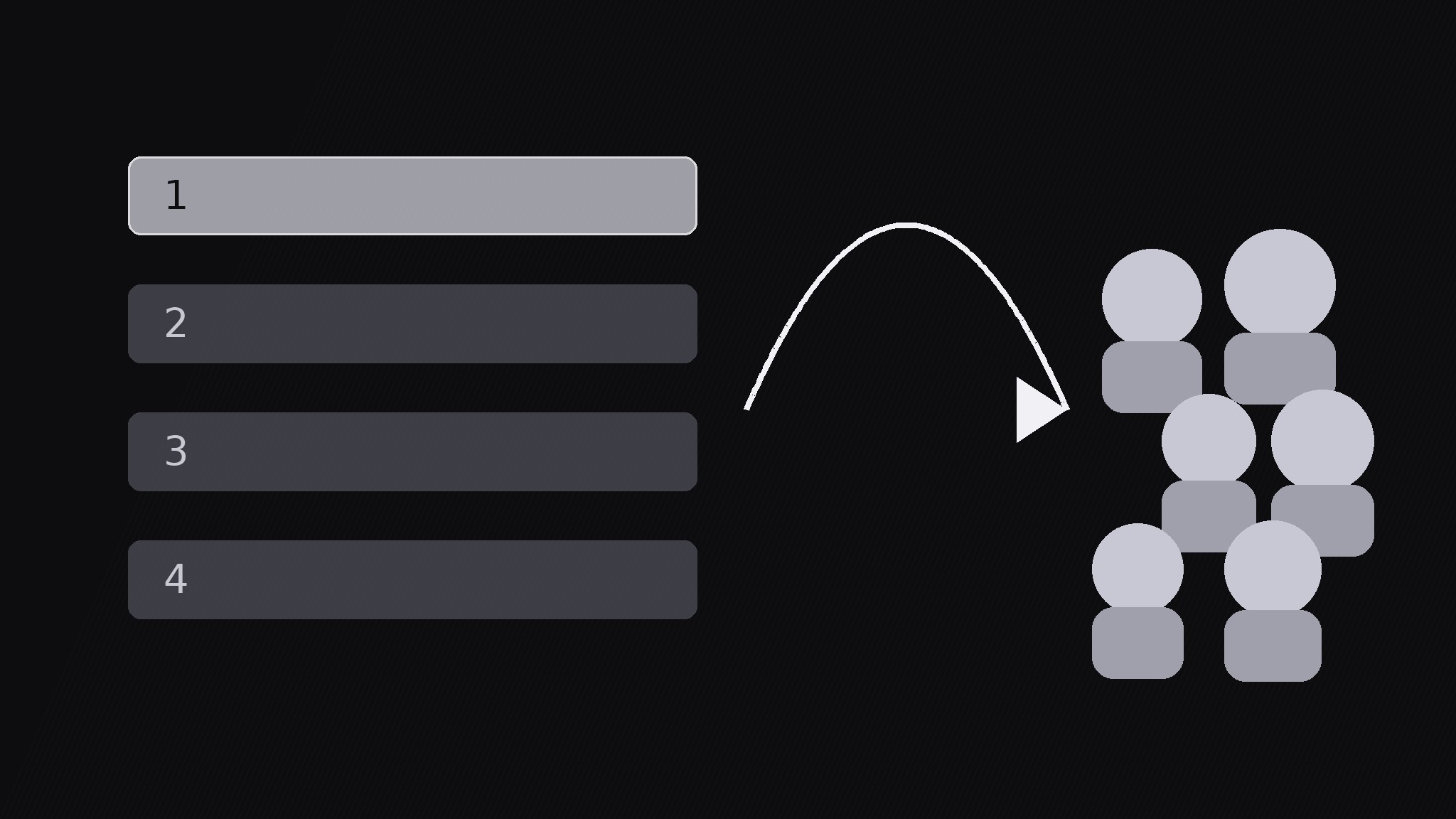
Turns your AI into a motion-graphics director for the question list to audience pattern — builds a short list of questions on screen, then hands the list to the audience with a call to answer, so a monologue turns into participation.
Install it in 3 steps
No sign-up. No CLI tools. Pick your AI, copy one line, paste it over.
Prefer doing it yourself? Buy the skill ($4.99), download the ZIP from your checkout confirmation, unzip it into the directory shown above, restart your AI session — same result. Already bought it? Your AI assistant can download it for you.
What’s inside
One SKILL.md (the playbook) + one starter template. A preview:
Question List to Audience
When to use
- A video that should end (or pivot) with audience answers, not just a sign-off
- A community post or lesson where the creator wants 3–5 specific questions answered in the comments
- A live or recorded Q&A setup where the audience needs to see the questions before answering them
- A survey-style segment where the questions are the content and the answers become the next video
- A classroom video where learners pause and answer the list before the lesson continues
Workflow
- Write the list (input: topic → output: 3–5 questions)
Write 3–5 questions, each max 12 words, each answerable in one sentence. Mix the types: one opinion question, one experience question, one prediction or preference question, and the rest as fits the topic. Order them easiest first — the first question should be answerable in five seconds so viewers start, not stall. If a question needs context, cut it or fold the context into the question itself; the list must stand alone when handed over. - Reveal the list progressively (input: questions → output: built list)
Reveal the list one question at a time: each row slides in from the left over 280ms with an ease-out curve, 0.5s apart, with a number badge (1, 2, 3) on each row. Hold the full list on screen for at least 2s after the last row lands so viewers can read all of it. Keep rows to one line each at ≥48px type — if a row wraps to two lines, shorten the question. Never reveal the whole list at once; a block of five questions reads as homework. - The handoff (input: built list → output: audience-facing frame)
Hand the list over with a visible gesture: the list panel slides or tilts toward the camera over 400ms, a "Your turn" header fades in above it, and the frame composition shifts from presenter-led to audience-facing (presenter shrinks or steps aside). Say the handoff out loud in one line: "Your turn — answer these." The handoff must be unmistakable: a viewer scrubbing through should be able to spot the exact frame where the video stops talking and starts asking. - The answer window (input: handoff frame → output: response moment)
Hold the handoff frame with the full list visible for 3–5s — long enough for a viewer to pick a question and start typing, or to pause the video. Show exactly how to answer: one line under the list naming the place ("Answer in the comments", "Reply to this post", "Pause and write yours down"). If the format is comments, show the comment box graphic; if it is a live session, show the countdown or queue. Do not introduce new content during the window — the list is the content now.
Template preview
Question List to Audience — Build Template
Build the list, hand it over, hold the window, harvest the answers.
The list (3–5 questions, each ≤12 words, one sentence to answer)
Standalone check: every question makes sense with no extra context: [ ]
Reveal
- One row at a time, 280ms slide-in from left, ease-out, 0.5s apart
- Number badge on each row | Row type: one line, ≥48px
- Full list hold after last row: ≥2s
Handoff (the scene change)
- List slides / tilts toward camera: 400ms
- Header fades in above list: "Your turn"
- Presenter: {shrinks / steps aside}
- Spoken handoff line: "Your turn — {answer these / pick one and answer it}."


