Proactive Morning Brief Designer
A morning brief worth opening — and nothing it should not have sent
Design the daily brief a proactive agent sends before you ask: which sources it may read, how it ranks urgency, what it drafts but never sends, and the one-tap corrections that teach it your priorities.
Install it in 3 steps
No sign-up. No CLI tools. Pick your AI, copy one line, paste it over.
Prefer doing it yourself? Buy the skill ($4.99), download the ZIP from your checkout confirmation, unzip it into the directory shown above, restart your AI session — same result. Already bought it? Your AI assistant can download it for you.
What's inside
One SKILL.md (the playbook) + one starter template. A preview:
Proactive Morning Brief Designer
The idea in one paragraph
A proactive agent is only as good as its brief. If it surfaces everything, you stop reading it; if it surfaces too little, you stop trusting it. This skill designs the brief before the agent writes one: which sources it may read, how it decides what counts as urgent, what it is allowed to draft but never send, and how a single correction ("not this, ever") retrains its ranking.
What it is built on
Proactive agents (Anthropic's Claude Duet, OpenAI's Dots, Meta's Muse) check connected apps on a schedule — Duet sends a morning brief, then re-checks every few hours — and ask approval before sending, paying, signing, or deleting. That schedule is the design constraint: anything urgent can sit until the next check-in, and anything the agent misunderstands becomes a draft you did not ask for. The brief must therefore say what it checked, when it last checked, and how sure it is — not just what it found.
Workflow
- Source charter (input: your apps -> output: a read list with reasons).
List every connected app and mark it Brief / Draft-only / Never read.
Email and calendar are usually Brief; payments are Draft-only (invoice
reminders drafted, never sent without approval); personal messages are
Never read unless you explicitly opt them in. Write one sentence per
source explaining why — the charter is what you show a colleague who asks
"what does it see?" - Urgency ladder (input: last week's real items -> output: 4 rungs).
Sort 20 real items from last week into: Act today / Act this week /
FYI / Never surface. The ladder must have a test for each rung, e.g.
"Act today = money moves, a person is waiting on me, or a deadline is
inside 24 hours." Anything that fails all tests is FYI at most. If a rung
holds more than 7 items on a normal day, your tests are too loose. - Brief template (input: ladder -> output: the fixed shape).
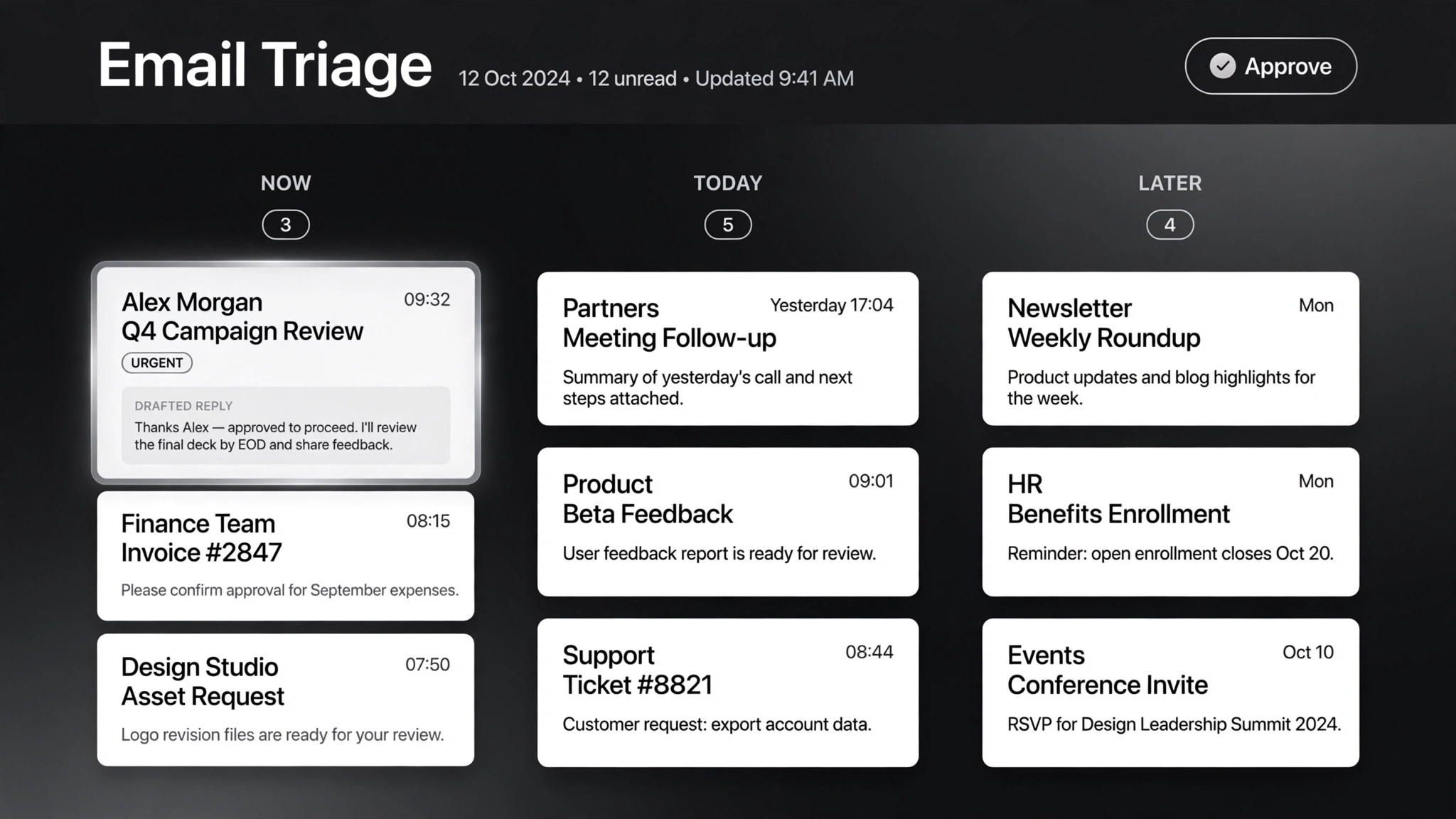
Every brief has exactly five blocks, in order: (a) Needs you today (max
5 items, each with source + why it is urgent), (b) Drafts waiting for
approval (never auto-sent), (c) Done while you were away, (d) Missed
check-ins (apps it could not reach, with times), (e) One-line confidence
note ("checked 06:00–06:40; Slack unreachable"). No block may grow
without shrinking another. - Correction loop (input: your edits -> output: a rule, not a grudge).
Every time you demote, dismiss, or rewrite a brief item, turn it into a
written rule: "invoices under $50 are FYI, not Act today" or "never
surface social mentions before 9am." Keep the rule list under 20; prune
monthly. A brief that cannot explain its own ranking is a brief you
will stop reading. - Approval gates (input: action types -> output: send/pay/sign/delete matrix).
For each action type, write: auto-allowed / draft-for-approval / never.
Default: sending to anyone outside your team, any payment, any signature,
and any deletion are draft-for-approval or never. Test the matrix with
three uncomfortable examples before you switch the agent on.
Template preview
Morning Brief Worksheet
Fill this in with your AI, one section at a time. The output is your brief spec.
1. Source charter
2. Urgency ladder
- Act today (test):
- Act this week (test):
- FYI (test):
- Never surface (test):
3. Brief shape (5 blocks, max items per block)
- Needs you today (max 5):
- Drafts waiting:
- Done while away:
- Missed check-ins:
- Confidence note:
4. Correction rules (keep under 20)
1. 2. 3.