Image Tiles Hero
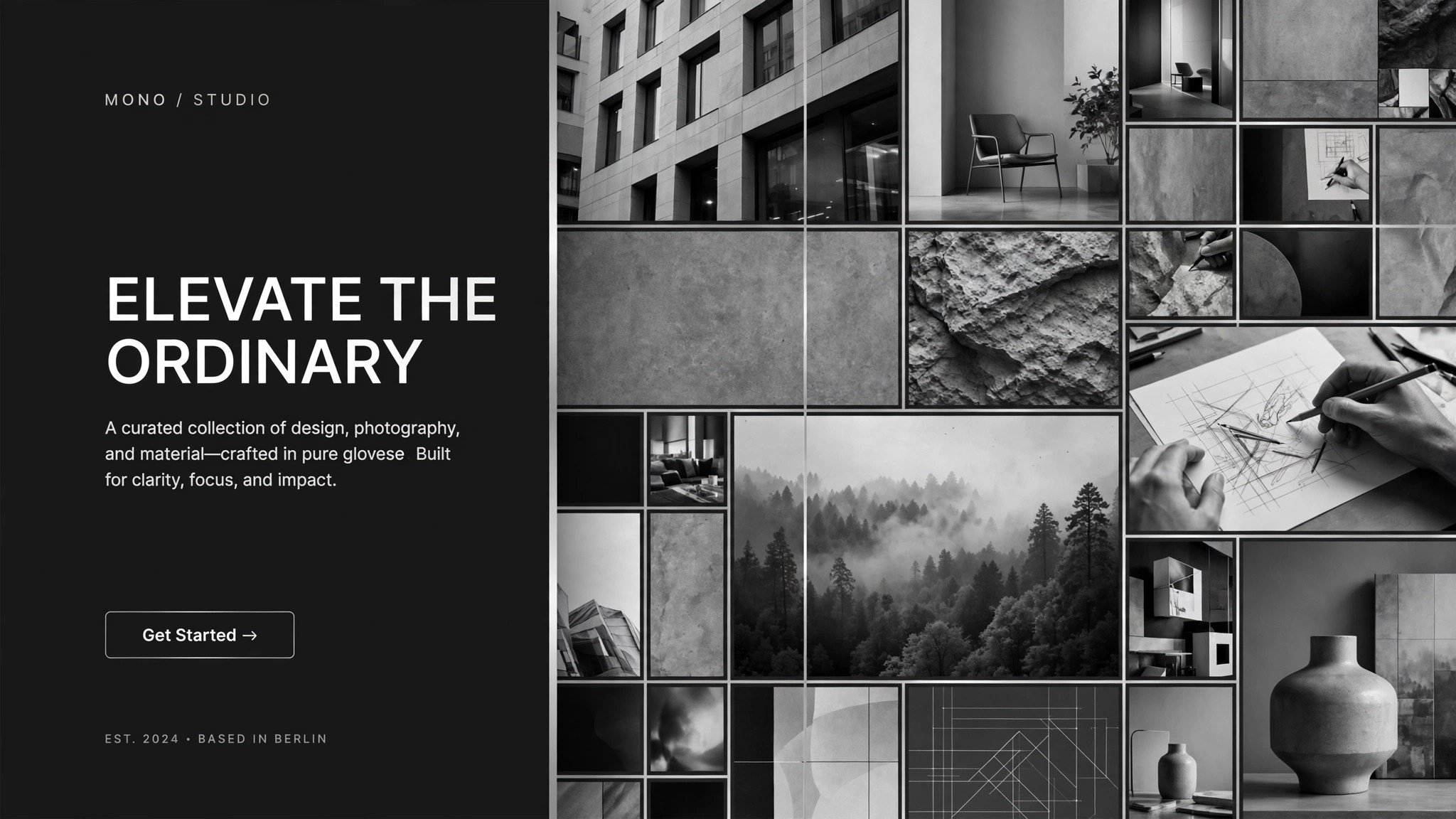
A hero section made of image tiles that snap into a mosaic.
Turns your AI into a hero-section designer that builds a landing-page hero from a mosaic of image tiles — gridded photos, a clear headline slot, and responsive rules that keep the mosaic intact on every screen.
Install it in 3 steps
No sign-up. No CLI tools. Pick your AI, copy one line, paste it over.
Prefer doing it yourself? Buy the skill ($4.99), download the ZIP from your checkout confirmation, unzip it into the directory shown above, restart your AI session — same result. Already bought it? Your AI assistant can download it for you.
What’s inside
One SKILL.md (the playbook) + one starter template. A preview:
Image Tiles Hero
When to use
- Your landing page hero needs to show range — many products, places, dishes, or faces — instead of betting everything on one photo
- A single stock-style hero image makes your product look generic, and you want a mosaic that feels curated
- You have 6–20 good photos but no design system for turning them into a first-screen composition
- Your hero has to work as hard on mobile as on desktop, without the collage collapsing into a random stack
- You are redesigning a homepage and the headline keeps fighting the background photo for attention
Workflow
- Pick the story the tiles tell (input: your photos and one headline → output: tile brief)
Decide what the mosaic must communicate in three seconds: range, craft, people, or place. Choose 6–20 photos that each show one clear subject with breathing room around it — busy photos blur into noise at tile size. Write the headline first (≤8 words) and the subhead (≤20 words); the mosaic exists to earn attention for those words, not to replace them. One tile brief, one story, no mixed messages. - Set the grid (input: tile brief → output: grid spec)
Choose a grid that fits your tile count: 4 columns × 2 rows for 8 tiles, 5 × 2 for 10, 6 × 3 for a dense showcase. Vary tile sizes on purpose — one or two double-width feature tiles for the strongest images, the rest uniform — and keep gutters tight (8–16px) so the grid reads as one picture, not a scattered gallery. Specify the aspect behavior: tiles crop to fill, never stretch, and the focal point of each photo is marked so cropping never cuts off a face or a product. - Place the headline (input: grid spec + headline → output: hero layout)
Reserve one tile position — or a full overlay band — for the headline, and protect it: no busy photo sits behind the text. If the headline overlays tiles, it sits on a solid or scrim-backed panel with contrast checked against the darkest tile beneath it. The call to action goes directly under the headline, inside the same protected zone, so the eye lands on words first and the mosaic second. - Define the motion (input: hero layout → output: motion spec)
Give the mosaic one quiet behavior: tiles fade or rise in on load in a staggered sequence (top-left to bottom-right, ≤600ms total), or a slow Ken Burns drift on the feature tiles. Never animate every tile independently — a mosaic that wriggles looks broken. On reduced-motion settings, everything renders static; the layout must look finished without any animation at all.
Template preview
Image Tiles Hero — Build Template
Fill this in before building the hero. One hero = one completed template.
Hero: {page / product} — {one-sentence story the mosaic tells}
Headline (≤8 words): {headline} Subhead (≤20 words): {subhead} Primary CTA: {button text → destination} Secondary CTA (optional): {button text → destination}
Tile inventory (6–20 tiles, one clear subject each)
Alt text (one sentence per tile):
- {alt text}
- {alt text}
Grid spec
- Desktop: {columns} × {rows}, gutter {8–16}px, feature tiles at {positions}
- Tablet: {columns} columns, feature tiles {kept / dropped}
- Mobile: {2} columns, headline {above grid / overlay}


