Grading Assistant
Papers graded against your rubric, with feedback per student.
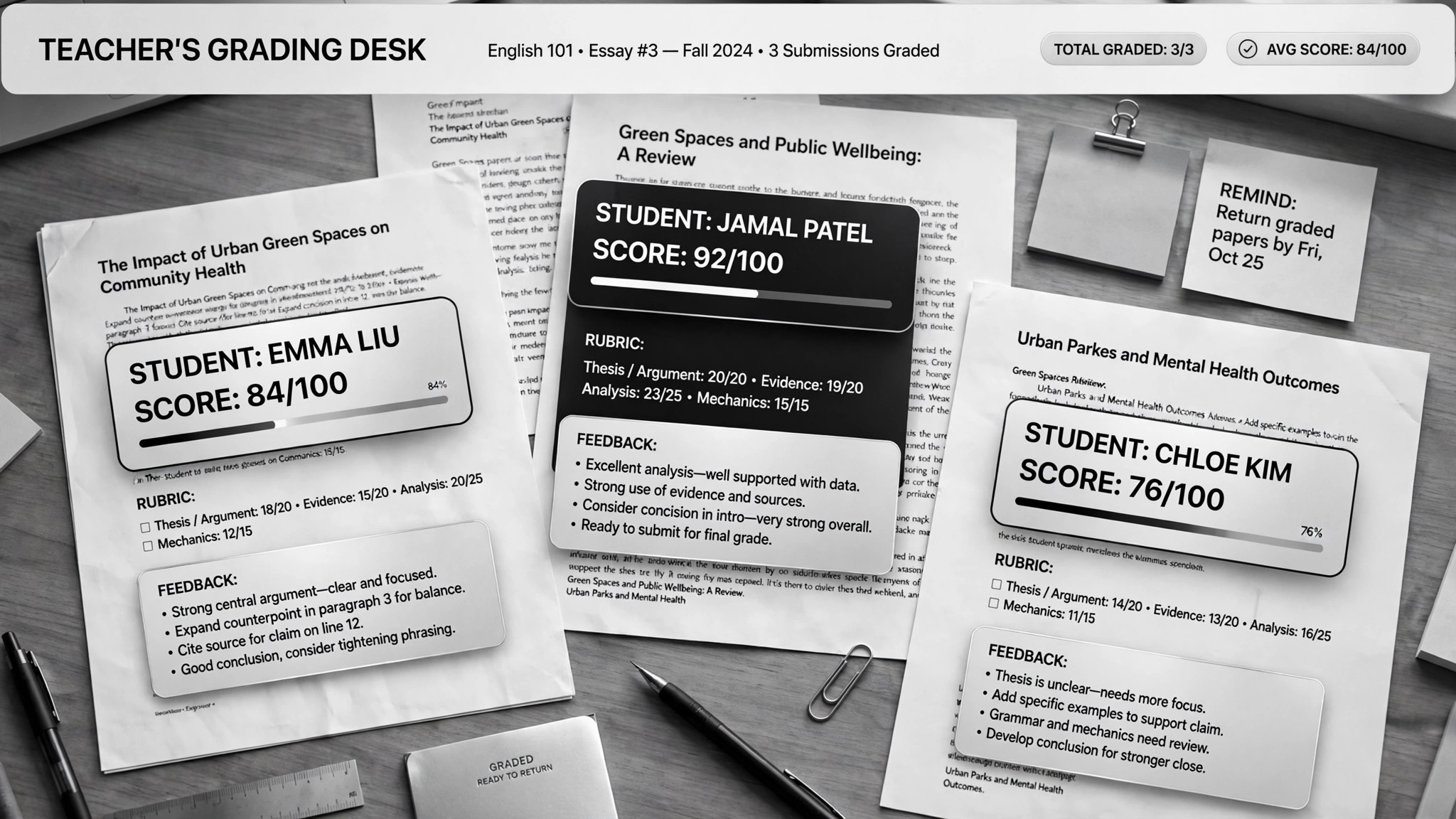
Helps AI grade papers against your rubric and write personalized feedback for every student — plus generate review materials from the most common mistakes. For teachers drowning in essays who still want every kid to get useful feedback.
Install it in 3 steps
No sign-up. No CLI tools. Pick your AI, copy one line, paste it over.
Prefer doing it yourself? Buy the skill ($4.99), download the ZIP from your checkout confirmation, unzip it into the directory shown above, restart your AI session — same result. Already bought it? Your AI assistant can download it for you.
Real-world proof
Real people did this exact job with AI agents.
Grade papers and build lessons with Claude Cowork
Read case →Use caseGrade papers and build lesson plans for teachers
Read case →What’s inside
One SKILL.md (the playbook) + one starter template. A preview:
Grading Assistant
When to use
- You have 30+ essays to grade against a rubric and the weekend is disappearing
- Every student should get real feedback, not a score and a "good job"
- You want to spot what the whole class got wrong and turn it into next week's review
- You teach the same course across sections and need grading to stay consistent
- You need lesson plans or review slides built from actual student mistakes, not your memory of them
Workflow
- Build the grading project (input: syllabus, rubric, sample answers → output: per-course project)
Set up one AI project per course and feed it the syllabus, your rubric, past exams, model answers, and course materials. One real case keeps a separate project per course so the grading stays anchored to that course's standards. A rubric written for a colleague, not for yourself, is the bar — the AI grades what it says, not what you meant. - Anonymize the submissions (input: student work → output: numbered, ID-free batch)
Strip names before grading: student papers get anonymous numbers. This keeps the grading honest and protects student privacy. Feed readable digital files — scans need to be legible or the grading degrades silently. - Grade criterion by criterion (input: rubric + submissions → output: scored batch + flagged borderlines)
The AI scores each submission against every rubric criterion separately, with a short justification per criterion. It doesn't invent the rubric as it goes — every score points at a criterion. Borderline and low-confidence grades get flagged for your review; the easy agreements flow through. - Write real feedback (input: graded batch → output: per-student feedback)
Each student gets personalized comments: what they did well (citing their actual words), what cost them points (citing the criterion), and one concrete thing to fix next time. A feedback comment that could apply to any student applies to none of them — send it back. - Mine the mistakes for teaching (input: full batch results → output: class trends + review materials)
Aggregate the criterion scores across the class to find the hot spots: the two rubric rows where everyone bled points. Turn those into next week's review — slides or a lesson plan built from the actual wrong answers, not from what you remember being hard. Never touch the original submission files; scores live in a separate sheet. - You set the final grades (input: scored batch → output: confirmed grades)
Review the flagged borderlines, spot-check a handful, then approve. The AI proposes; you dispose. Educational responsibility doesn't delegate — final grades are always the teacher's call.
Output spec
Template preview
Grading Assistant — Rubric & Batch Template
One project per course. Anonymize first, grade second, approve last.
Course project
- Course: {name / term}
- Fed to the AI: [ ] syllabus [ ] rubric [ ] past exams [ ] model answers [ ] course materials
- Submissions format: {digital docs / legible scans}
The rubric (written for a colleague, not for yourself)
Grading scale: {e.g. A ≥ 90, B ≥ 80 …} | Late policy: {…} | Academic integrity notes: {…}
Batch tracking
Student feedback format (one per student)
Feedback — Student {anonymous #}
- What worked: {quote their actual words — "…"}