Format-Shift Argument Film
The old format had its reasons. They expired.
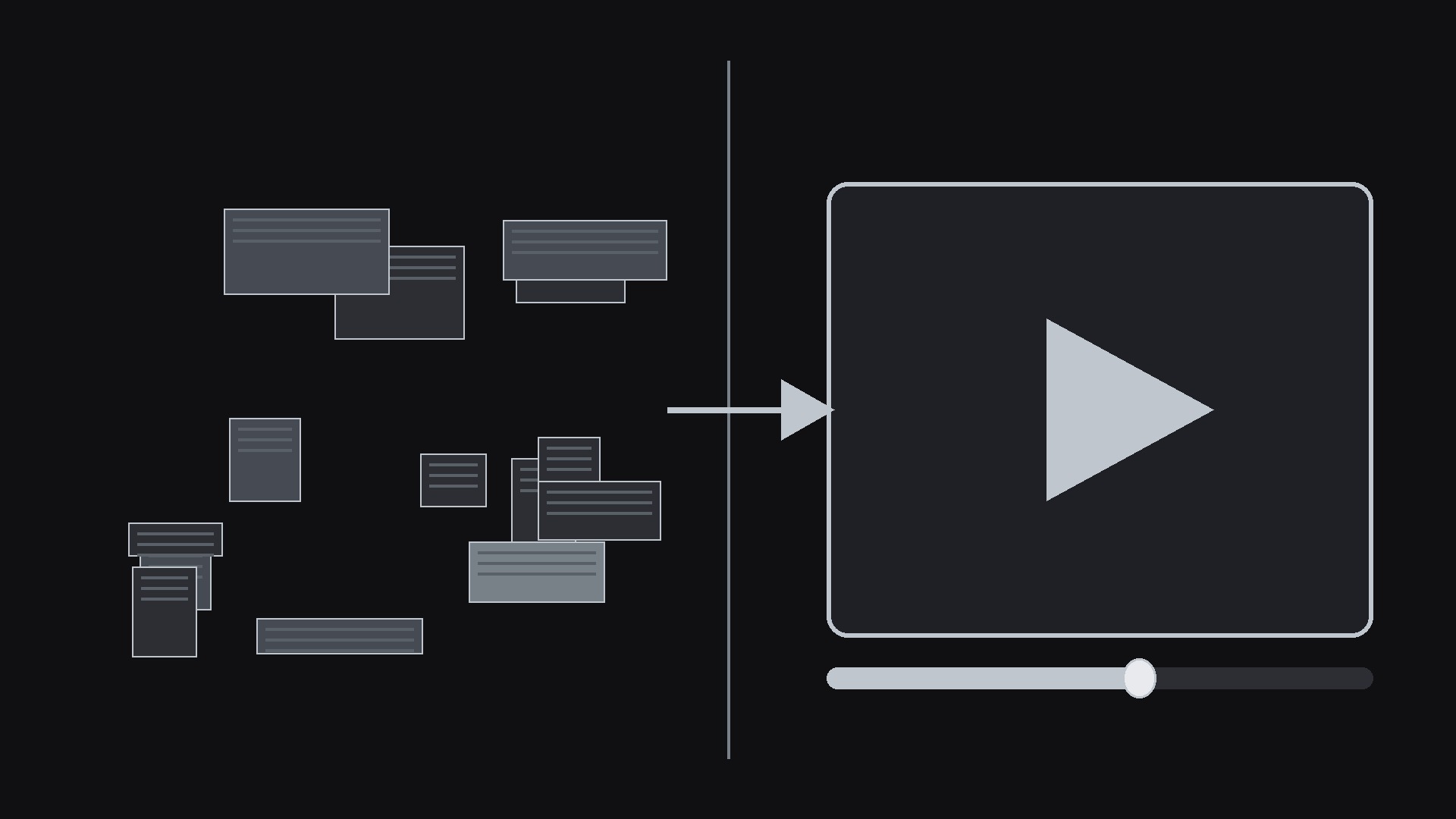
A launch-video structure built around a format-shift argument: name the old constraint and the new condition, show the old way failing, demo the new way on the same task, and close with one switch — all in 90 seconds or under, edited to work muted.
Install it in 3 steps
No sign-up. No CLI tools. Pick your AI, copy one line, paste it over.
Prefer doing it yourself? Buy the skill ($4.99), download the ZIP from your checkout confirmation, unzip it into the directory shown above, restart your AI session — same result. Already bought it? Your AI assistant can download it for you.
What’s inside
One SKILL.md (the playbook) + one starter template. A preview:
Format-Shift Argument Film
When to use
- Launching a product whose real pitch is "the old format is broken"
- Viewers say "why not just use [incumbent]?" after watching your demo
- You need a launch video under 90 seconds for a product page or social post
- Your demo alone looks like a feature list, not a reason to switch
- Pitching a format change (docs → video, static → interactive, manual → automated)
Workflow
- Name the shift in one sentence (input: product + incumbent format → output: shift thesis)
Write the argument as "X used to be [old format] because [old constraint]. Now [new condition], so X should be [new format]." If you can't name the old constraint and the new condition, you don't have a format-shift argument — you have a feature list. The thesis decides every shot that follows. - Show the old way failing (input: thesis → output: old-way sequence)
10–15 seconds of the old format doing its worst, concretely: the 40-tab spreadsheet, the PDF nobody opens, the manual copy-paste. Use real screens or realistic reconstructions, not caricatures. The viewer should recognize their own workflow, not laugh at a strawman. - State the shift, then demo the new way (input: thesis + product → output: new-way sequence)
One line states the thesis on screen, then 30–40 seconds of the product doing the same job in the new format — the same task as the old-way sequence, so the comparison is apples to apples. Show the outcome, not the settings panel: the finished thing, not the configuration. - Close with the switch (input: new-way sequence → output: ending + CTA)
Last 10 seconds: one line restating what changes for the viewer, the product name, and one action ("Try it free", "Watch the full demo"). The end card holds for at least 3 seconds so the CTA is readable on a phone. - Edit for mute + captions (input: rough cut → output: final cut)
Most viewers watch muted: every argument beat must land with on-screen text or visuals alone. Burn in captions or ship a caption file; check the cut at 1x on a phone, muted, before calling it done.
Output spec
- Shift thesis: one sentence, old constraint + new condition + new format
- Script: old-way (10–15s) → thesis line → new-way demo (30–40s) → ending + CTA (10s); total 90s or under
- Shot list: each shot with visual + on-screen text + voiceover line (if any)
- Comparison parity: old-way and new-way sequences cover the same task
- Captions: full caption file + mute-check pass
Good vs. bad examples
Template preview
Format-Shift Argument Film — Script Template
Total runtime: 90 seconds or under. Same task in the old way and the new way.
Shift thesis (one sentence)
Old format: {format} — because {old constraint}. New condition: {what changed}. New format: {format}. Thesis line (as it appears on screen): {one line}
Sequence 1 — Old way failing (10–15s)
Task shown: {the job the viewer recognizes}
Duration: {seconds}
Sequence 2 — Thesis + new way (30–40s)
Thesis on screen: {thesis line} — held for {seconds}
Outcome shown (not settings): {the finished thing} Manual steps hidden by cuts: {none — list every click shown}


