Evidence Wall Summary
Scattered clues pin to a wall — then the verdict lands.
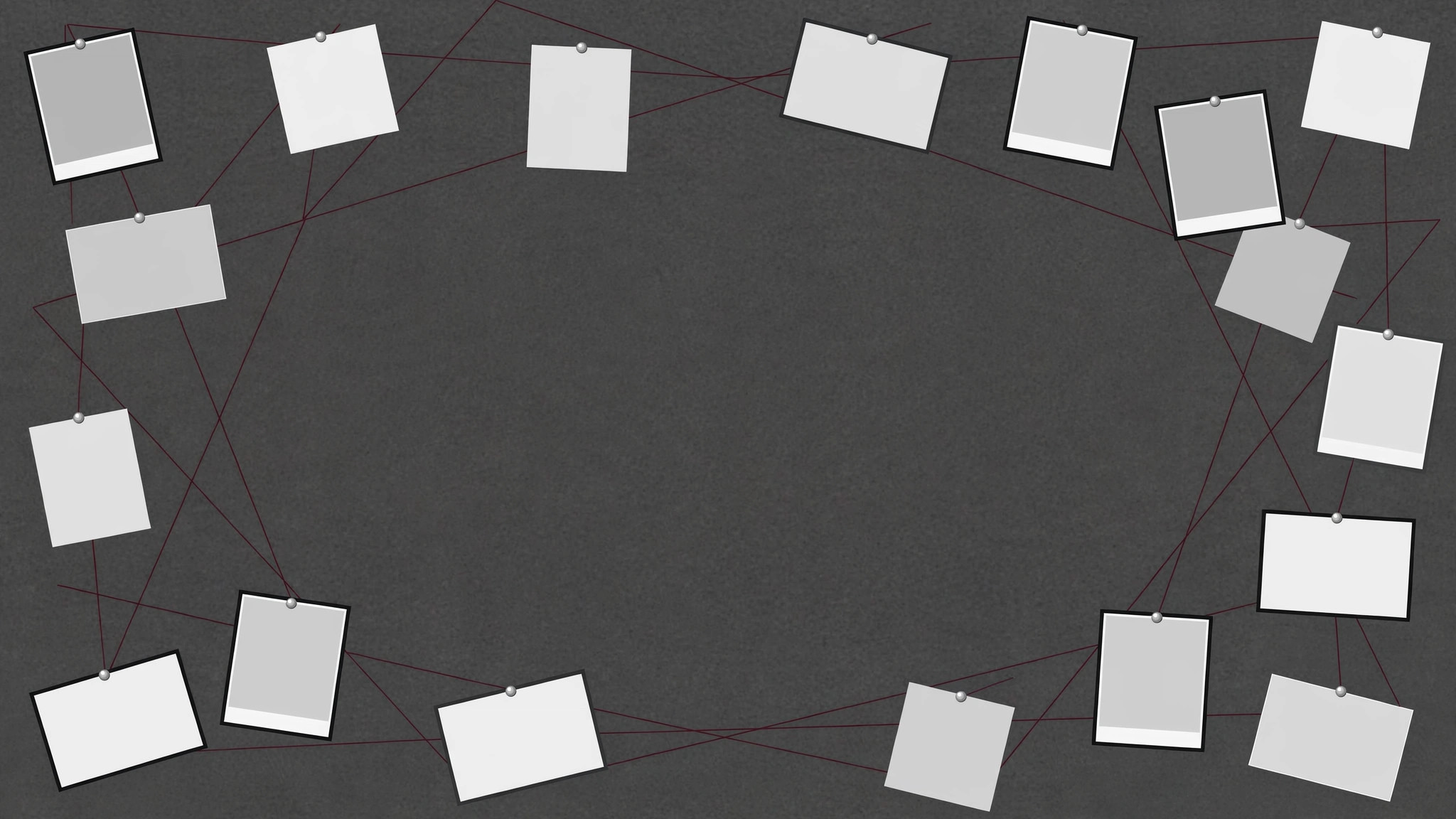
Photos, notes, and documents pin onto a corkboard one at a time, red string connecting the related ones, before the camera pulls back and the summary verdict lands in the empty centre. Built for investigations, explainers, and recaps where the pieces click into one picture.
Install it in 3 steps
No sign-up. No CLI tools. Pick your AI, copy one line, paste it over.
Prefer doing it yourself? Buy the skill ($4.99), download the ZIP from your checkout confirmation, unzip it into the directory shown above, restart your AI session — same result. Already bought it? Your AI assistant can download it for you.
What’s inside
One SKILL.md (the playbook) + one starter template. A preview:
Evidence Wall Summary
When to use
- A true-crime or investigation video needs to recap scattered clues as one connected picture
- An explainer must show how five separate facts add up to one conclusion
- A season recap or case-study video summarises the evidence before delivering the verdict
- A documentary segment moves from "here is what we found" to "here is what it means"
- A pitch or research video shows the trail of sources behind a recommendation
- You have 4–8 discrete pieces of evidence and one takeaway they jointly support
Workflow
- List the evidence and the conclusion (input: your script → output: evidence list + verdict line)
List 4–8 evidence items, each one concrete: a photo, a document, a quote, a date, a screenshot. Each item gets a 3–6 word label ("Hotel receipt — Oct 12") and one source line. Then write the verdict line: one sentence, ≤15 words, stating what the evidence jointly proves. The verdict is the destination of the whole motion — everything pins toward it. If two items prove the same sub-point, merge them; a wall of duplicates is clutter, not evidence. - Pin the wall (input: evidence list → output: wall layout)
Lay the items out like a corkboard: cards at slight rotations (−6° to +6°, never more — a 20° tilt reads as mess), overlapping edges by 10–20px, with visible pin/tape at one corner of each card. Background is a dark board or muted wall texture; cards are off-white or light grey so they pop. Keep the centre of the wall empty: that is where the verdict will land. Space cards so no two labels overlap and every card stays ≥80% visible — a card buried under three others is evidence the viewer never sees. - Draw the string connections (input: wall layout → output: string map)
Connect related cards with red string: thin 1.5–2px lines in a muted red, running pin-to-pin in 1–2 straight segments (a slight sag is fine if it stays consistent, but never a curve that wanders). Draw only connections that mean something — same person, same date, cause-and-effect. Cap at 6 strings; beyond that, the wall becomes a spiderweb. Each string connects exactly two pins; a string that touches three cards claims a link you have not argued for. - Reveal the wall piece by piece (input: string map → output: reveal choreography)
Reveal in story order, not grid order: one card at a time, each pinning on with a 200ms drop (translateY −12px → 0, ease-out) plus a 120ms pin pop (scale 0 → 1.2 → 1) at its corner, 400–600ms apart. Each string draws in right after its second endpoint card lands: stroke draw 300ms, ease-in-out, starting 100ms after the card settles. The viewer should be able to follow the chain as it builds — never pin three cards at once, never draw a string before both its cards exist.
Template preview
Evidence Wall Summary — Starter Template
Fill in every {placeholder}. Every card must be evidence for the verdict — decoration cards get cut.
Evidence + verdict
- Verdict line (≤15 words): {what_the_evidence_jointly_proves}
- Evidence count: {4–8} · Reveal order (story order): {e.g. 3 → 1 → 4 → 2 → 5 → 6}
Wall layout
- Background: {dark_board | muted_wall_texture} · Card colour: {off-white | light_grey}
- Card rotation: {−6° to +6°} each · Overlap between cards: {10–20px}
- Pin / tape style (one style only): {pin | tape} at {one_corner} of each card
- Centre of wall: {left_empty_for_verdict}
- Every card ≥80% visible: [ ]


