Dual Tendency Scales
When one side rises, the other falls — make the trade-off physical.
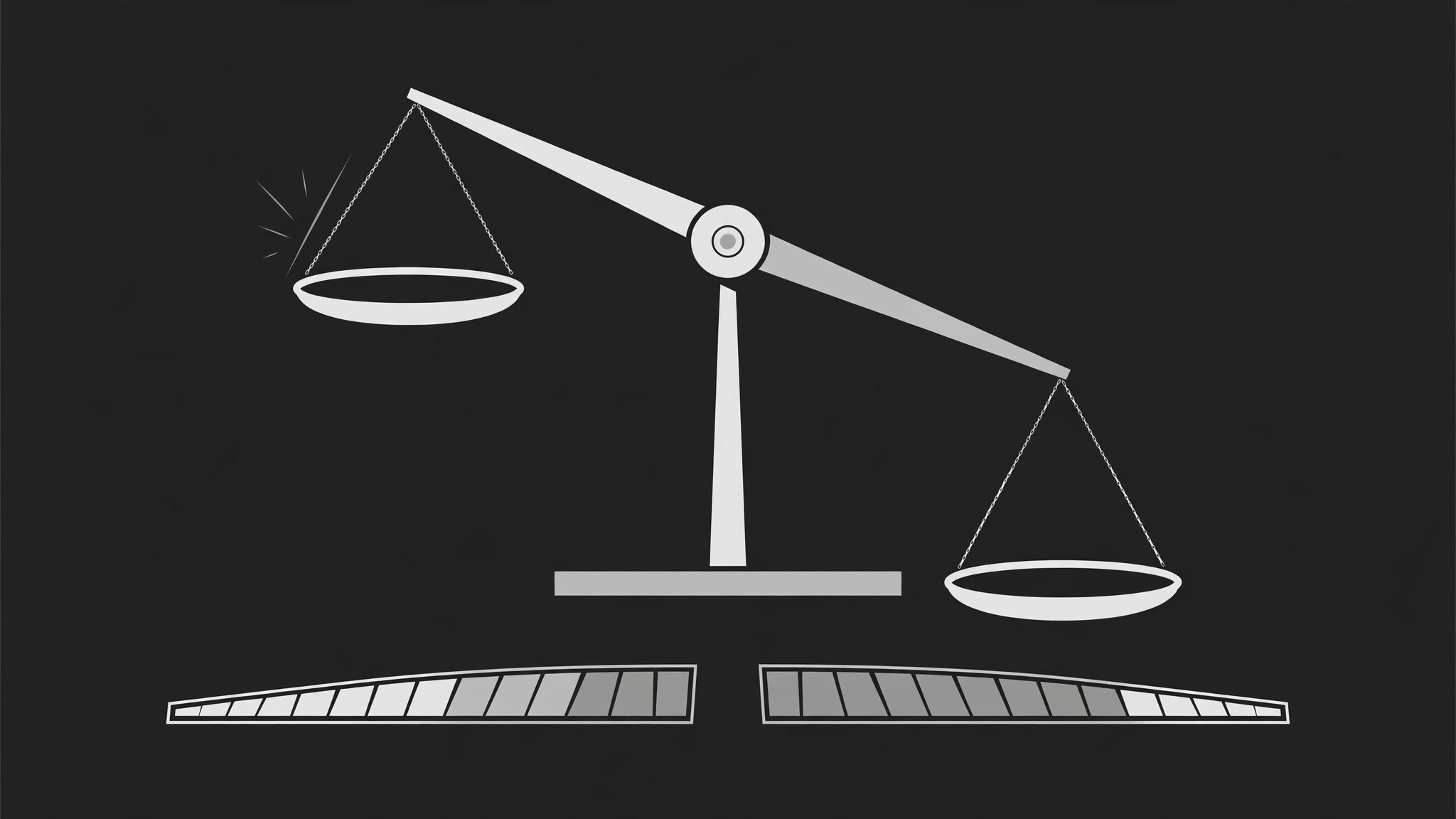
Shows two opposing tendencies as linked scales that move against each other in the same beat, with an optional full-range sweep and a verdict hold. Built for trade-offs where both sides cannot win at once.
Install it in 3 steps
No sign-up. No CLI tools. Pick your AI, copy one line, paste it over.
Prefer doing it yourself? Buy the skill ($4.99), download the ZIP from your checkout confirmation, unzip it into the directory shown above, restart your AI session — same result. Already bought it? Your AI assistant can download it for you.
What’s inside
One SKILL.md (the playbook) + one starter template. A preview:
Dual Tendency Scales
When to use
- An explainer presents a trade-off (speed vs. quality, cost vs. control, risk vs. reward) and a bullet list makes it sound like both sides can win
- A decision video shows what happens as one priority grows — the other must visibly shrink
- A comparison needs the audience to feel the tension between two tendencies, not just read two labels
- A "you can't have both" argument needs a visual that proves the constraint
Workflow
- Name the two tendencies (input: your trade-off → output: tendency pair)
Write each tendency as a 1–3 word label with a direction: "{Tendency A} ↑" and "{Tendency B} ↓", or neutral labels with the motion doing the talking. The pair must be genuinely opposed — raising A must plausibly lower B in the world you're describing. If both can rise together, this is the wrong pattern; use a side-by-side comparison instead. Give each tendency a short example ("Speed: ship in a week", "Quality: zero-defect review"). - Build the scales (input: tendency pair → output: scale composition)
Two scales, one per tendency, presented as a pair: balance beams, vertical gauges, or opposing sliders on one shared axis. Both scales share one visual language (same bar style, same scale length) so their positions are directly comparable. Start both at a neutral midpoint — the "before" state where neither tendency dominates. Keep the composition symmetric; asymmetry before any motion starts reads as a conclusion you've already drawn. - Move them against each other (input: scales → output: opposed motion)
The core move: as scale A rises, scale B falls by the same amount, in the same beat. Animate both in one keyframe block (~0.8–1.0s, ease-in-out) so the opposition is simultaneous — sequential moves (A up, pause, B down) read as two separate facts, not one trade-off. The linkage must be visible: a shared pivot, a connecting beam, or a center marker that stays fixed while both ends move. End positions must be readable at a glance — no squinting to tell which side is up. - Show the range (input: opposed motion → output: sweep pass)
Optionally, sweep the balance from one extreme to the other and back: A-dominant → midpoint → B-dominant, one continuous sweep (~2–2.5s, ease-in-out at each turn). This is the "feel the whole trade-off" beat. Use it when the video's point is that the balance is a choice, not when the video argues for one specific balance — a sweep that ends mid-argument undercuts the argument.
Template preview
Dual Tendency Scales — Motion Brief Template
Two tendencies, one constraint. Fill this in before keyframing.
Trade-off: {what is being traded, one line}
Genuinely opposed check: raising {A} plausibly lowers {B} because {reason}. If both can rise together, use a side-by-side comparison instead — not this pattern.
Tendency pair
Linkage ratio: {1:1 equal-and-opposite / 1:{n} — a little more {A} costs a lot of {B}}
Scales
- Form: {balance beams / vertical gauges / opposing sliders on one axis}
- Shared language: same bar style, same scale length — positions directly comparable
- Start: both at neutral midpoint, symmetric composition


