Decompose and Scan
Break it apart, scan it, name every part.
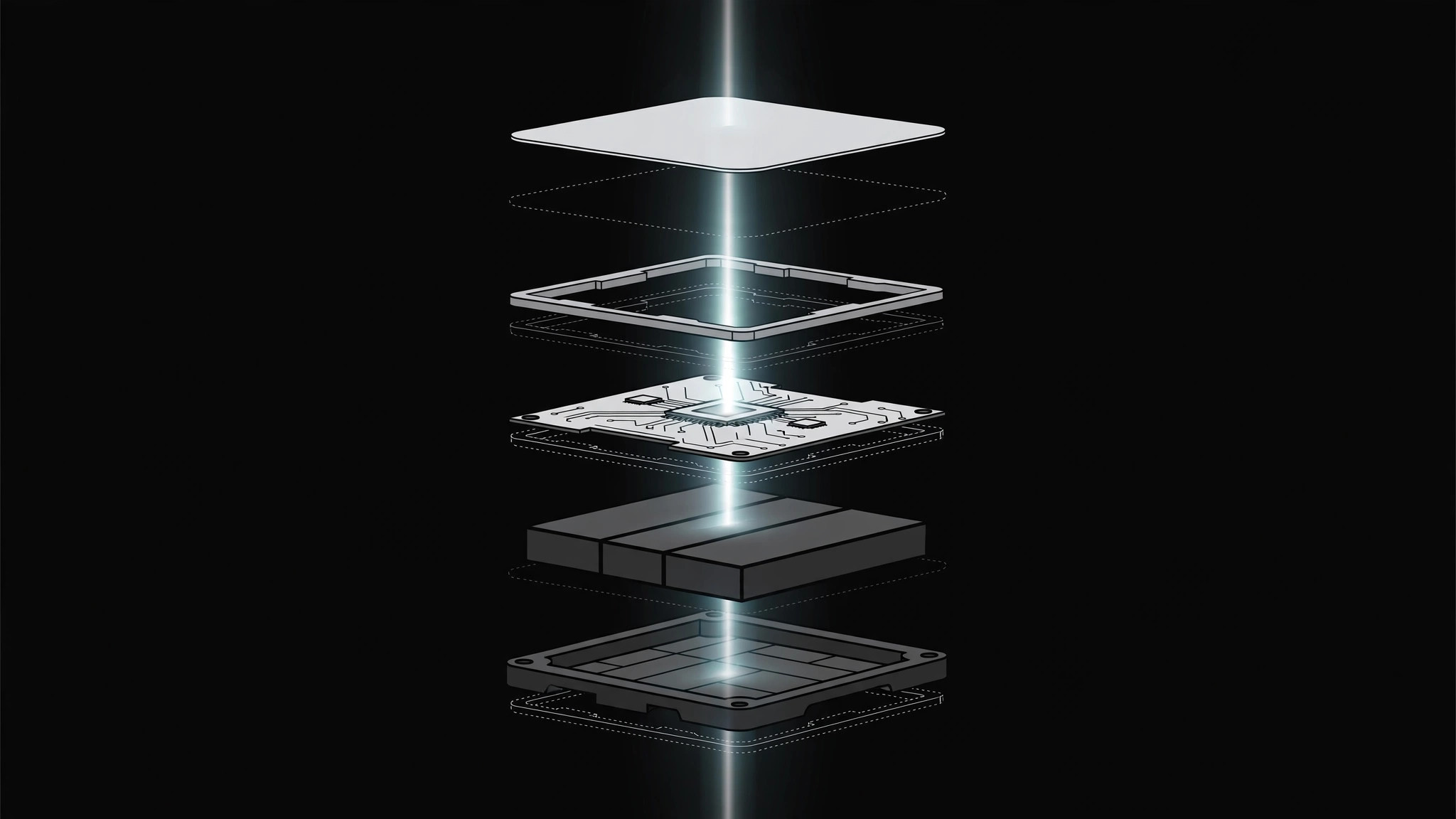
Breaks an object or system into its parts with a staggered exploded view, then sweeps a scan line across them so each part is labeled in order. Ends with a full reassembly or a clean hold on the exploded view.
Install it in 3 steps
No sign-up. No CLI tools. Pick your AI, copy one line, paste it over.
Prefer doing it yourself? Buy the skill ($4.99), download the ZIP from your checkout confirmation, unzip it into the directory shown above, restart your AI session — same result. Already bought it? Your AI assistant can download it for you.
What’s inside
One SKILL.md (the playbook) + one starter template. A preview:
Decompose and Scan
When to use
- An explainer must show what a product, system, or concept is made of — and a static exploded view gets skimmed past
- A teardown-style segment names parts one by one (a device, a workflow, a budget) and viewers need to track which part is which
- A diagram is too dense: breaking it apart and scanning it is the only way each layer gets seen
- A reveal needs a "let's look inside" beat before the parts come back together
Workflow
- Define the parts (input: your object/system → output: part list, 3–7 parts)
List the parts in the order they will be scanned — left to right, top to bottom, or outside-in. Give each part a 1–3 word name and one line of function ("housing — protects the internals"). If you have more than 7 parts, group the minor ones into a single "assembly" part; the scan should feel like a tour, not an inventory. - Decompose (input: whole object → output: exploded layout)
Animate the object breaking apart along one axis at a time (vertical first, then horizontal if needed). Each part drifts outward from its assembled position with a staggered start (0.08–0.12s between parts) and ease-out over ~0.5s. Parts keep their relative orientation — nothing rotates unless the rotation itself shows how parts fit. End with clear gaps between parts and faint connector lines or ghost outlines showing where each part came from. - Scan (input: exploded layout → output: scan pass)
A scan line (thin bright bar, or a soft highlight band) sweeps across the parts in list order at a steady pace — this is the one moment constant speed is correct, because the scan is a measuring instrument, not a character. As the line reaches each part, that part brightens to full opacity and its label fades in; parts the scan has passed settle to ~70% opacity so the current part stays the focus. Scan duration: ~0.6s per part. - Hold and name (input: scan pass → output: labeled exploded view)
After the scan completes, hold the fully labeled exploded view for 1.5–2.5s so viewers can re-read it. Labels sit in a consistent position per part (above or beside, never overlapping another part). If a part needs more than a name, its one-line function appears in a fixed caption zone, not crammed next to the part. - Reassemble or exit (input: labeled view → output: finished motion)
Choose one ending and commit: reassemble (parts glide back in reverse stagger, ease-in-out, ~0.6s total, landing exactly on the original silhouette — a satisfying "it all fits" beat) or exit on the exploded view (scan line fades, labels stay, cut to next scene). Never half-reassemble — parts drifting vaguely inward reads as a mistake.
Output spec
Template preview
Decompose and Scan — Motion Brief Template
Break it apart, scan it, name every part. Fill this in before keyframing.
Object / system: {what gets decomposed}
Scan direction: {left → right / top → bottom / outside → in} | Total parts: {3–7}
Part list (in scan order)
Grouping note: minor parts grouped into "{assembly}" because {reason}.
Decompose
- Axis order: {vertical first, then horizontal / single axis: ___}
- Stagger: {0.08–0.12}s between parts | Drift duration: {~0.5}s, ease-out
- Rotation: {none / {part} rotates {angle} to show fit}
- Origin traces: {ghost outlines / faint connector lines} — on


