Code-Change Explainer Film
Turn a big pull request into a 3-6 minute film reviewers will actually watch.
Produces a short explainer film about a code change — a pull request, migration, or refactor — following a fixed spine: before, problem, change, after, risks. Comes with a timestamped script, visual notes per section, chapter timestamps, captions, and a link pack, so reviewers and teammates get the story instead of a bare diff.
Install it in 3 steps
No sign-up. No CLI tools. Pick your AI, copy one line, paste it over.
Prefer doing it yourself? Buy the skill ($4.99), download the ZIP from your checkout confirmation, unzip it into the directory shown above, restart your AI session — same result. Already bought it? Your AI assistant can download it for you.
What’s inside
One SKILL.md (the playbook) + one starter template. A preview:
Code-Change Explainer Film
When to use
- A large pull request is about to land and reviewers need the story, not just a 400-line diff
- A migration or refactor touches code half the team depends on and nobody has the full picture
- You're onboarding a new developer onto a codebase with history that only exists in people's heads
- You're handing a service over to another team and the handover doc alone won't carry it
- A post-incident fix needs explaining: what broke, what changed, and why it won't break the same way again
Workflow
- Pick the change and the audience (input: PR / branch / diff link, who watches → output: one-sentence change summary + audience line)
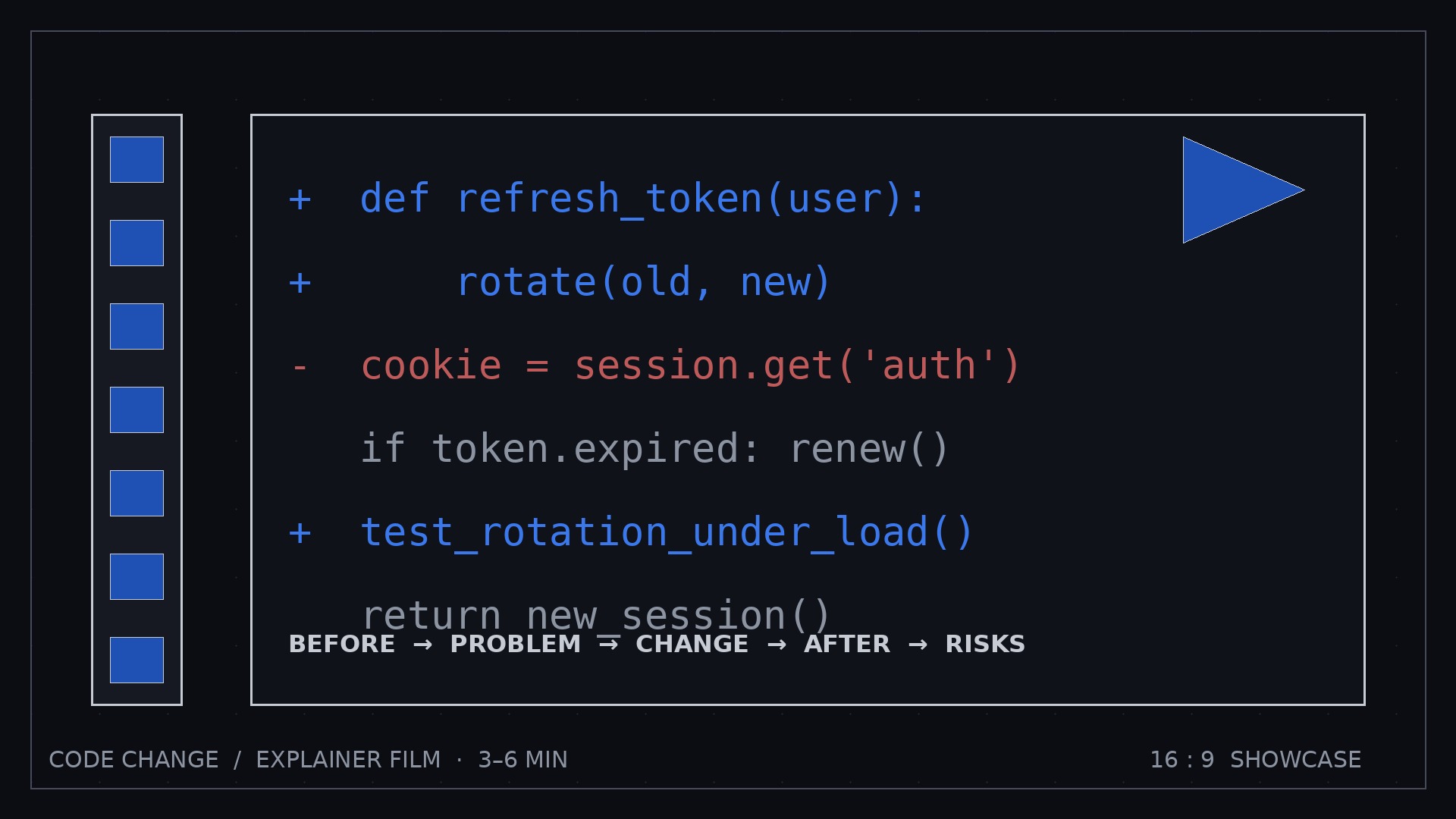
Name the change in one sentence — "Replace session cookies with rotating refresh tokens" — and name the audience: reviewers, new joiners, or the owning team. The audience decides the depth: reviewers need risks and trade-offs, new joiners need the why and the map. One film, one audience; a film for everyone explains nothing to anyone. - Outline the story (input: diff + PR description → output: story outline — before → problem → change → after → risks)
Fixed spine: Before (how it worked), Problem (what was wrong, with the concrete symptom), Change (what you did, at the level of "moved X, split Y, deleted Z"), After (how it works now), Risks (what could still go wrong, what you checked). Read the actual diff while outlining — the outline must match the code, not the PR description's hopes. - Script and visuals (input: outline → output: script with timestamps + visual notes per section)
Write for the ear: short sentences, one idea per line, jargon explained on first use. Every section gets a visual note: screen capture of the relevant diff hunk, a small diagram for the before/after, a live demo for the behavior change. Show the code that matters and skip the rest — a film that reads the whole diff aloud is a punishment, not an explanation. - Record and edit (input: script + visuals → output: 3–6 minute film with chapters and captions)
Record in one pass per section, then cut to the script's timestamps; if a section runs long, trim the section, not the structure. Keep the film to 3–6 minutes: longer than that and it stops being watched. Add chapter timestamps, captions (word-accurate), and a title card with the PR number and date. Blur or crop anything the camera shouldn't have caught — secrets, tokens, personal data.
Template preview
Code-Change Explainer Film — Template
One film, one audience, one change. Read the actual diff before scripting.
The change
PR / branch: {link} One-sentence summary: { } Audience: {reviewers / new joiners / owning team} Length target: {3–6 minutes}
Script (one idea per line, timestamps mandatory)
Visual notes
Link pack
- PR: { }
- Design doc: { }
- Related issues: { }
- Chapter timestamps: { }
Pre-publish checklist
[ ] Every claim checked against the actual code [ ] No secrets, tokens, passwords, or private data on screen — final export checked [ ] 3–6 minutes; chapters + captions added [ ] Published on the PR / wiki / handover doc where the audience looks


