Card Row Status Badges
One badge at a time turns a board into a story.
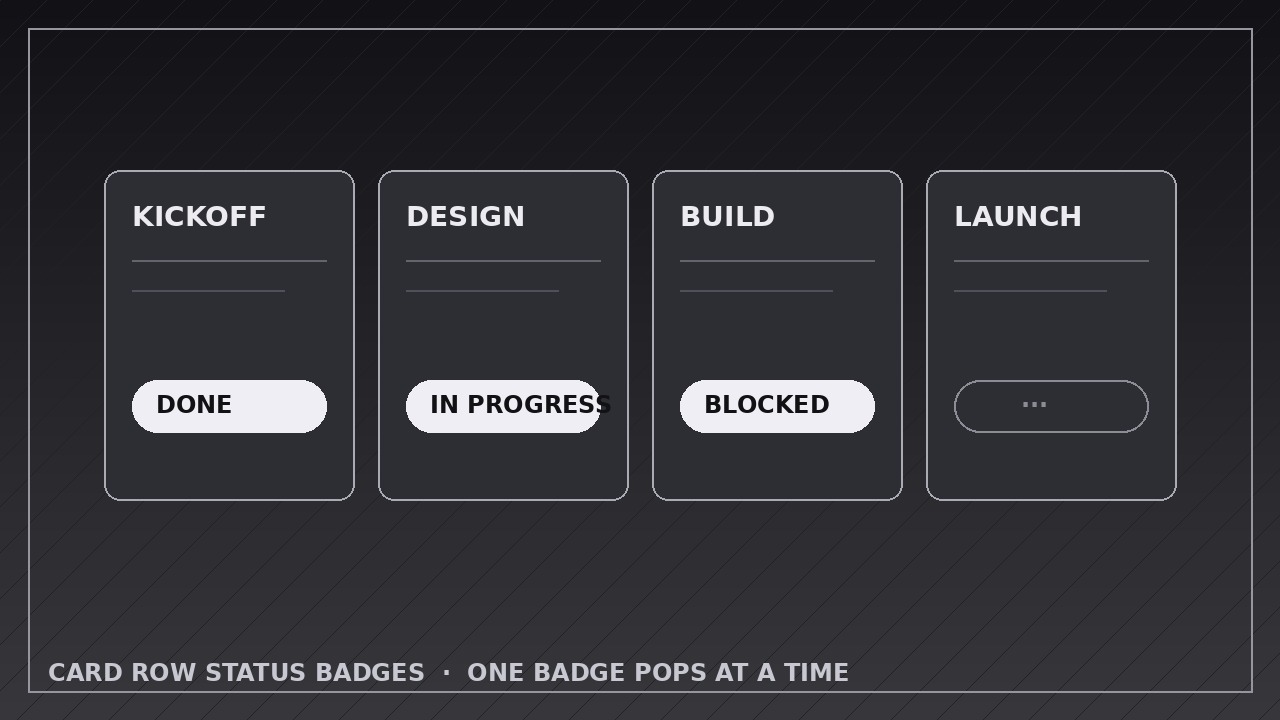
Teaches your AI to animate a row of cards whose status badges flip or pop in sequence, with one card reacting at a time and a summary beat that lands the takeaway.
Install it in 3 steps
No sign-up. No CLI tools. Pick your AI, copy one line, paste it over.
Prefer doing it yourself? Buy the skill ($4.99), download the ZIP from your checkout confirmation, unzip it into the directory shown above, restart your AI session — same result. Already bought it? Your AI assistant can download it for you.
What’s inside
One SKILL.md (the playbook) + one starter template. A preview:
Card Row Status Badges
When to use
- Summarizing a sprint, project, or pipeline: a row of task cards, each landing on done, in-progress, or blocked
- Walking through a checklist or approval flow where each item's status resolves one by one
- Presenting a sales or hiring pipeline where each deal or candidate moves to its current stage
- Showing order tracking: placed, packed, shipped, delivered — each card's badge updating in sequence
- Reporting team or system health: each service card resolving to operational, degraded, or down
- Turning a static dashboard screenshot into a narrated status story
Workflow
- Define the cards and their final statuses (input: your items → output: card list with title, final status, and reveal order)
List every card: a short title (1–5 words), its final status, and its position in the reveal order. Use a small fixed status set — three to four statuses maximum (e.g. Done, In Progress, Blocked) — each with one color and one icon that never changes meaning mid-video. Reveal order is a storytelling choice: lead with the headline result (the big win or the blocker), then the rest in logical order. Cap the row at 6 cards; beyond that, use two rows or split the video. - Build the card row stage (input: card list → output: card row with neutral placeholder badges)
Lay out the cards in a single row (or a tidy grid for two rows) with identical size, spacing, and typography. Each card shows its title and a neutral placeholder where the badge will land — an outlined pill or a faint dashed badge reading "…" — so the badge slot is visible before anything resolves. Hold this unresolved row for 1 second: the viewer must see the "before" (all unknown) to feel the sequence of reveals. - Pop or flip each badge in sequence (input: staged row → output: per-badge reveal keyframes)
Reveal one badge at a time, in the order from step 1. Two reveal styles, pick one and use it for every card: pop (scale 0.6→1.0 with a fade over 0.35 seconds, ease-out with a slight overshoot) or flip (3D Y-rotation 90°→0° over 0.45 seconds, ease-in-out, badge face changing mid-flip). Never mix pops and flips in one row — one motion language per video. After each badge lands, hold 0.5–0.7 seconds so the viewer reads the card-plus-badge pair before the next one arrives.
Template preview
Card Row Status Badges — Animation Spec Template
Fill in the cards, the fixed status legend, and the reveal order before animating. One badge at a time.
Board: {title — e.g. "Sprint 12 status"}
Canvas: {1920×1080 / 1080×1080 / 1080×1920} | Frame rate: 30 fps | Export: H.264 Layout: {single row / two rows} | Cards per row: {≤6} Reveal style (one for the whole row): {pop — 0.35 s, scale 0.6→1.0, ease-out + overshoot / flip — 0.45 s, Y-rotation 90°→0°, ease-in-out} Hold after each badge: {0.5–0.7 s} | Card reaction on landing: {2–3 px lift / shadow deepen / 2% pulse, 0.3 s, settles to rest}


