Accumulation Blocks
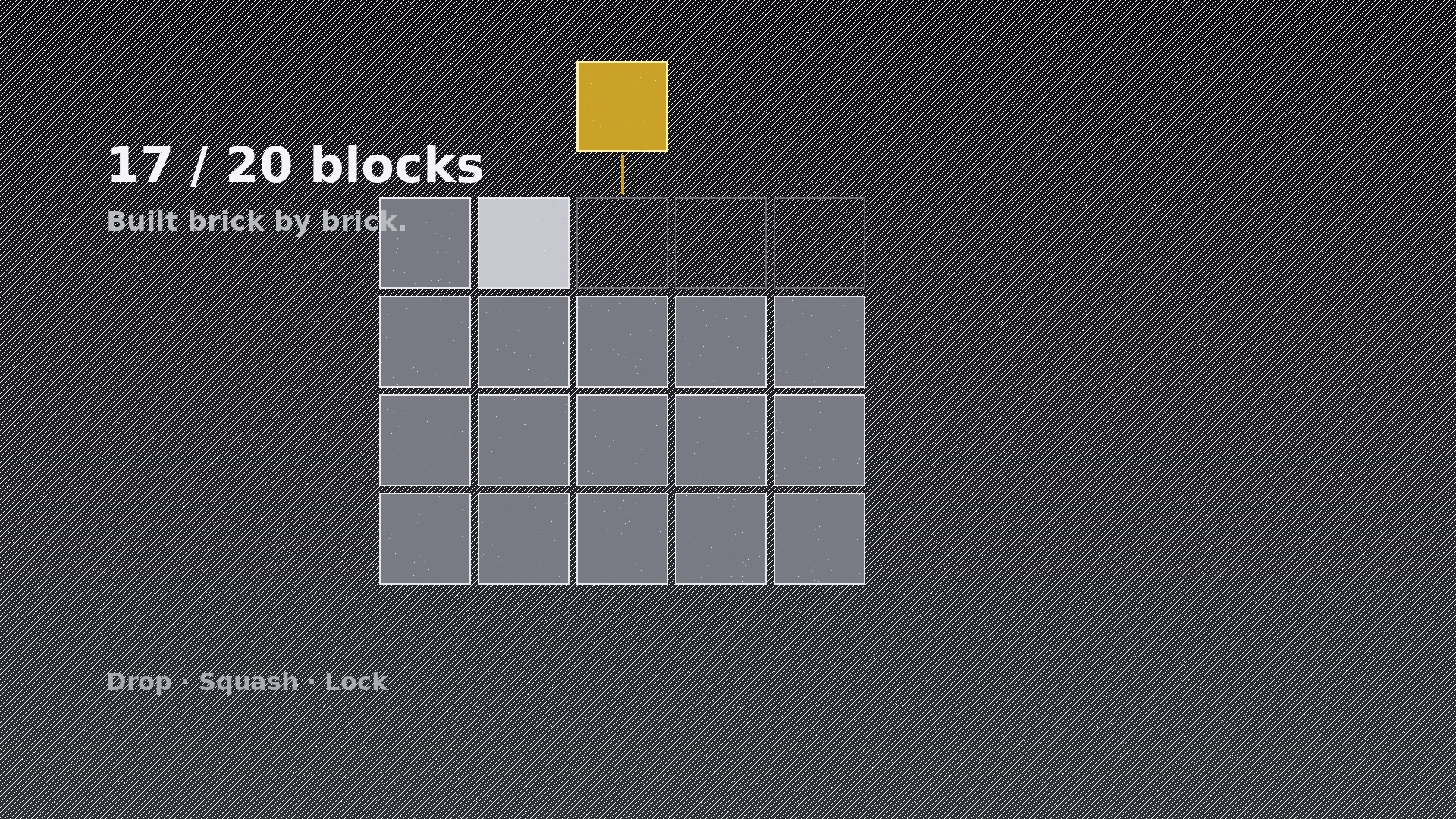
Blocks drop, lock, and build the shape brick by brick.
Teaches the AI to produce one specific motion pattern: identical blocks drop with weight and snap into a grid to build a bar, outline, or comparison — drop physics, squash-and-settle keyframes, and a completion payoff included.
Install it in 3 steps
No sign-up. No CLI tools. Pick your AI, copy one line, paste it over.
Prefer doing it yourself? Buy the skill ($4.99), download the ZIP from your checkout confirmation, unzip it into the directory shown above, restart your AI session — same result. Already bought it? Your AI assistant can download it for you.
What’s inside
One SKILL.md (the playbook) + one starter template. A preview:
Accumulation Blocks
When to use
- You need a progress bar that feels built, not drawn — blocks stacking to fill a goal
- A comparison video needs two columns of blocks growing side by side to show the gap
- A "built brick by brick" brand story needs a logo, letter, or shape assembled from blocks
- An explainer must show parts adding up to a whole — budget, team, ingredients, features
- A fundraising or milestone tracker needs blocks that visibly complete a target shape
- You want a satisfying construction moment where the final block clicks the shape complete
Workflow
- Define the shape and the unit (input: your total + story → output: block plan)
Decide what the finished shape is before animating anything: a rising bar, a filled outline (e.g. a battery, a jar, a letter), a grid, or a comparison pair. Then fix the unit: each block is one equal share (one week, one $1k, one team member). Unlike a card stack, blocks are identical in size and snap to a grid — the shape must be fully determined by the block count. Sketch the final shape as a grid on paper first; if you can't draw it as blocks, pick a simpler shape. - Choreograph the build order (input: block plan → output: build sequence)
Blocks build in a legible order the eye can follow: bottom-up, left-to-right, row by row — never random. Set the pace: one block every 120–180ms for a fast energetic build, every 250–350ms when each block carries a label the viewer should read. Every 4th or 5th block, insert a micro-pause (80ms) so the eye registers progress in chunks. The final block gets a distinct treatment: a different accent colour, a click, and a 300ms settle — it completes the shape, and the audience must feel the completion. - Design the grid and block look (input: build sequence → output: layout)
Blocks are solid, uniform, with a 2–4px gap between them so each unit stays countable. The incomplete shape shows as a faint outline or ghost grid — viewers must see where blocks are going, not just where they are. The growing shape sits centre-frame with the running total or percentage beside it in plain type (the number is a label here, not the star — the shape is the star). One colour for standard blocks, one accent for the final block, one ghost tone for the outline.
Template preview
Accumulation Blocks — Starter Template
Fill in every {placeholder}. Sketch the final shape as a grid before animating — if you can't draw it as blocks, pick a simpler shape.
Block plan
- Final shape: {rising_bar | filled_outline | grid | comparison_pair}
- Shape description / grid sketch: {rows × columns, or outline shape, e.g. battery 5×4}
- Unit: one block = {unit_definition, e.g. one week / $1k / one team member}
- Block count: {5–40} · Labelled total: {total} (= block count × unit value ✓)
- Comparison second column (if any): {column_B_shape + count} — same unit scale as column A
Build sequence
- Order: {bottom_up_left_to_right, row by row}


