AI Services Market › Skills factory › Decks › Consulting Storyline Deck
$4.99 · No sign-inv1.0.0– views
Consulting Storyline Deck
Answer first, evidence last — a deck that drives decisions.
Structure a sharp, hypothesis-driven storyline deck that leads executives from situation to recommendation in 12–20 slides.
Best for
Consultants, analysts, and strategy leads
Time needed
~30 min for a first draft
Level
Beginner-friendly
Install it in 3 steps
No sign-up. No CLI tools. Pick your AI, copy one line, paste it over.
Prefer doing it yourself? Buy the skill ($4.99), download the ZIP from your checkout confirmation, unzip it into the directory shown above, restart your AI session — same result. Already bought it? Your AI assistant can download it for you.
What’s inside
One SKILL.md (the playbook) + one starter template. A preview:
Consulting Storyline Deck
When to use
- You need to recommend a decision to executives — a market entry, a cost cut, a reorganisation — not just present findings
- Your deck has 60 slides of analysis and the meeting still ends with "so what do you recommend?"
- You're writing a proposal or a steering-committee update where the audience has 20 minutes and low patience for background
- Your analysis is solid but the story is missing — findings don't build to a conclusion
- You need a deck that works both presented live and read alone afterwards
- You're preparing a case interview, a board update, or an internal strategy review
Workflow
- Frame the storyline (input: situation + audience + decision needed → output: SCQ + answer)
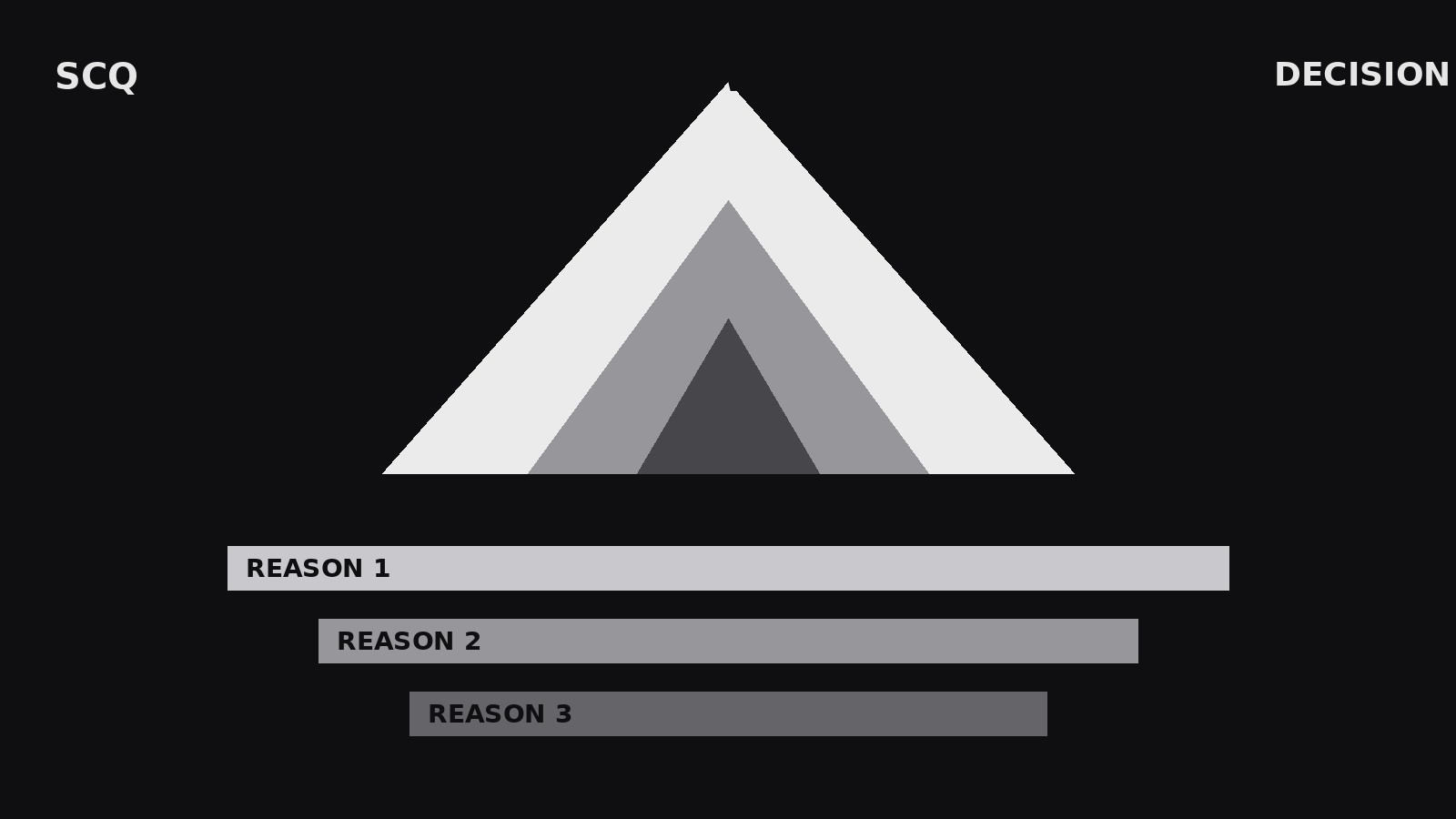
Write the SCQ before any slide: Situation (the agreed context, one sentence), Complication (what changed or what's at stake, one sentence), Question (the decision the audience must make, one sentence), and the Answer (your recommendation, one sentence). Example: "Sales grew 20% (S), but delivery costs grew 45% and margin fell 3 points (C). Should we reprice, cut service levels, or both (Q)? Reprice the bottom tier now and hold service levels (A)." If the answer isn't one sentence, you don't have a recommendation yet — go back to the analysis. - Build the argument tree (input: SCQ + answer → output: MECE argument tree)
Support the answer with 2–4 mutually exclusive, collectively exhaustive reasons — each one a complete assertion, not a topic ("Repricing the bottom tier recovers 2.1 points of margin" not "Pricing"). Under each reason, hang the 2–3 strongest pieces of evidence. Test the tree: if a reason overlaps another, merge them; if a piece of evidence fits under two reasons, it's in the wrong place or the reasons aren't clean. The tree is the deck's skeleton — every slide maps to one branch. - Write the slide headlines first (input: argument tree → output: headline outline)
Draft every slide as a headline sentence that states its message ("The bottom tier loses money on 40% of orders"), with the evidence as support beneath. A reader who reads only the headlines top-to-bottom should be able to follow the whole argument without looking at a single chart. If a headline says "Pricing analysis" or "Results," it's a label, not a message — rewrite it until it asserts something. Aim for 12–20 slides total, including title and appendix pointer.
Template preview
Consulting Storyline Deck — Starter Template
Answer first, reasons next, evidence last. 12–20 slides in the main deck; everything else goes to the appendix.
SCQ + Answer (write before any slide)
- Situation: {situation_one_sentence}
- Complication: {complication_one_sentence}
- Question: {question_one_sentence}
- Answer (recommendation, one sentence): {answer_one_sentence}
Argument tree (2–4 MECE reasons)
- Reason 1: {reason_1_assertion}
- Evidence: {evidence_1a} | {evidence_1b} | {evidence_1c}
- Reason 2: {reason_2_assertion}
- Evidence: {evidence_2a} | {evidence_2b} | {evidence_2c}
- Reason 3: {reason_3_assertion}


