Cobalt Serif Marketing Deck
A campaign or launch plan in one deck: audience, positioning, channels, calendar, budget, and proof.
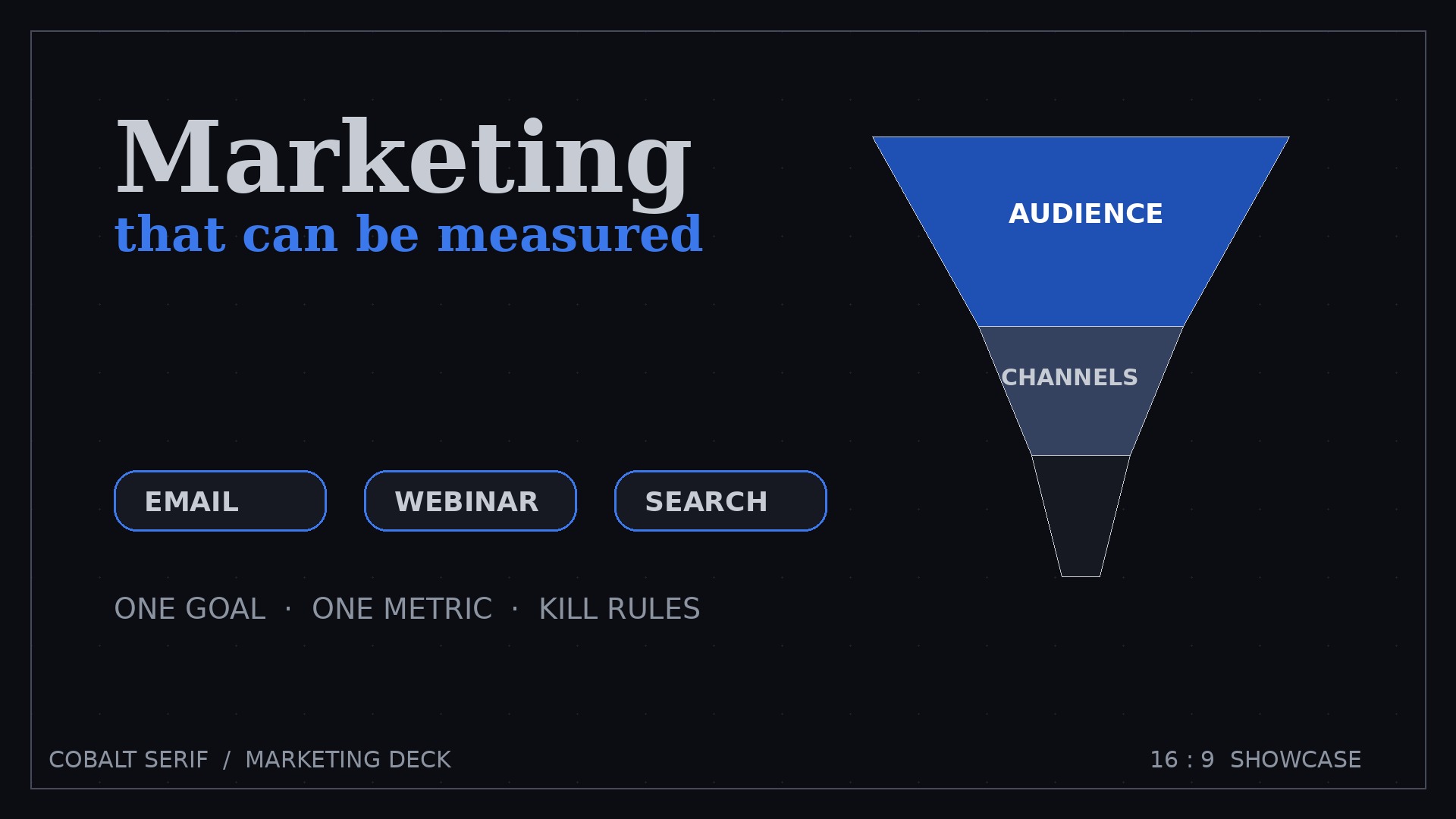
Builds a 10-14 slide marketing deck in the Cobalt Serif style: serif headlines, deep cobalt accents, silver-grey body type. One goal with one measurable metric, a positioning statement every slide serves, 2-3 channels with owners and dates, a budget that names what is not funded, and a measurement plan with kill rules.
Install it in 3 steps
No sign-up. No CLI tools. Pick your AI, copy one line, paste it over.
Prefer doing it yourself? Buy the skill ($4.99), download the ZIP from your checkout confirmation, unzip it into the directory shown above, restart your AI session — same result. Already bought it? Your AI assistant can download it for you.
What’s inside
One SKILL.md (the playbook) + one starter template. A preview:
Cobalt Serif Marketing Deck
When to use
- You're presenting a campaign plan to a client, boss, or team and need them to approve budget and scope
- You're planning a product launch and marketing needs one document everyone works from
- It's quarterly planning and you need to show what marketing will do, for whom, and how you'll know it worked
- You're an agency pitching a marketing proposal — strategy and deliverables in one deck
- Your last marketing deck was 40 slides of channel ideas with no goal, no budget, and no owner
Workflow
- Audience and goal (input: who you're reaching, what they should do → output: one goal + one primary metric)
Name the audience precisely — not "everyone", but "ops managers at 20–200 person logistics firms". Then pick one goal and one metric that proves it: "book 60 demo calls" beats "raise awareness". If the goal can't be measured, it can't be managed, and the deck will drift into activities with no finish line. - Positioning (input: product, audience, alternatives → output: positioning statement — problem, audience, promise, proof)
Write the positioning in four lines: the problem the audience already feels, who exactly it's for, the promise (one outcome, plainly stated), and the proof (a fact that makes the promise believable). Everything in the deck — every channel, every message — must trace back to this statement. If a slide doesn't serve the positioning, it gets cut. - Plan the work (input: positioning + constraints → output: channels, offers, calendar, budget)
Choose 2–3 channels you can actually run well with the team and budget you have — depth beats breadth. For each channel: the offer (what the audience gets), the asset needed (landing page, email sequence, ad set, event), the owner, and the date. Then lay it on a calendar and a budget table. A plan without dates and money is a wish list. - Design in Cobalt Serif (input: plan → output: styled deck — serif headlines, cobalt accents, one idea per slide)
Cobalt Serif rules: serif headlines that state the takeaway, deep cobalt accent bars and callouts for the numbers that matter, silver-grey body type, one chart or table per slide at most. The budget slide and the calendar slide get full-slide treatment — they are the slides the room will actually argue about, so they deserve the space.
Template preview
Cobalt Serif Marketing Deck — Template
Fill in goal, audience, and positioning first. Channels come last — they serve the positioning, not the other way round.
Goal + audience
Goal (one sentence): { } Primary metric + target + date: {metric} — {target} by {date} Audience (precisely): {not "everyone" — who exactly}
Positioning statement
- Problem the audience already feels: { }
- Who it's for: { }
- Promise (one outcome, plain words): { }
- Proof (a fact that makes the promise believable): { }
Slide-by-slide draft
1. Goal
{goal + primary metric + date}
2. Audience
{who, what they care about, where they already look}


