Cobalt Ribbon Profile Deck
A credibility deck that wins trust: who you are, what you do, and work with real outcomes.
Builds an 8-10 slide company or team profile deck in the Cobalt Ribbon style: deep cobalt, silver type, and a thin ribbon band on every slide. Covers who you are, what you do, selected work with honest outcomes, how you work, team, and contact — no fundraising ask, just trust.
Install it in 3 steps
No sign-up. No CLI tools. Pick your AI, copy one line, paste it over.
Prefer doing it yourself? Buy the skill ($4.99), download the ZIP from your checkout confirmation, unzip it into the directory shown above, restart your AI session — same result. Already bought it? Your AI assistant can download it for you.
What’s inside
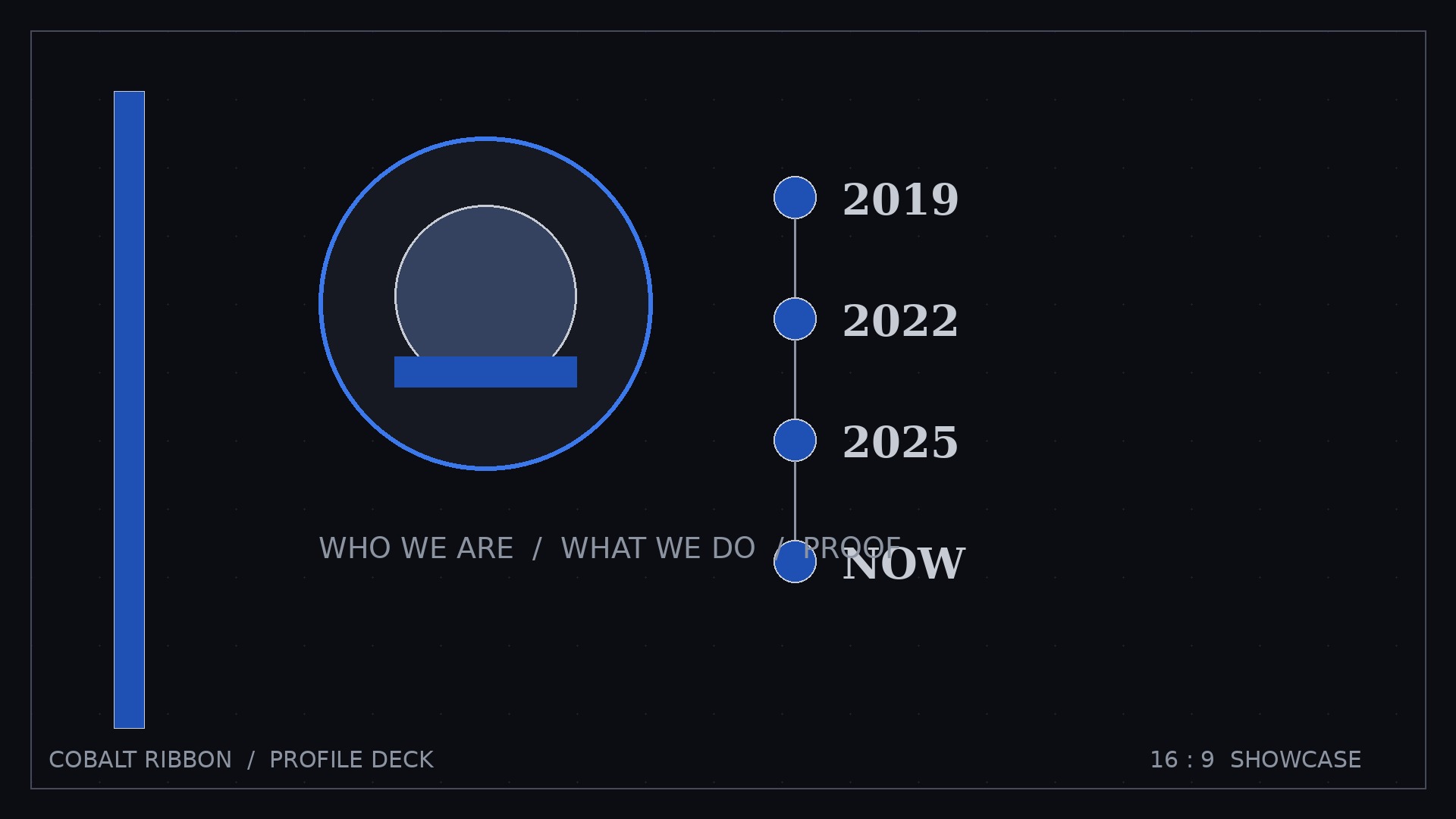
One SKILL.md (the playbook) + one starter template. A preview:
Cobalt Ribbon Profile Deck
When to use
- An RFP or procurement process asks for a company profile and you need one that reads as credible, not generic
- You're introducing your agency or studio to a prospective enterprise client in a first meeting
- Your team is presenting at a conference and needs a short "who we are" deck before the main talk
- A partner or reseller needs to explain your company to their customers accurately
- Your website's "About" page has grown stale and you want a deck version you can send to anyone
Workflow
- Define the reader and the decision (input: who reads it, what they decide → output: purpose line + what to leave out)
A profile deck is read by someone deciding whether to trust you. Name that person and their decision: "Procurement lead deciding whether to shortlist us." Then list what that reader does NOT need — fundraising history, internal org charts, pricing detail — and leave it out. A profile deck that tries to say everything says nothing. - Gather the proof (input: services, selected work, results, team bios → output: proof pack)
Collect: what you actually offer (services or products, plainly described), 3–5 pieces of selected work with real outcomes, and short team bios built on verifiable facts — roles, years, shipped work — not adjectives. Every result needs permission to share if it names a client. No permission, no client name: anonymize or drop it. - Structure the story (input: proof pack → output: 8–10 slide outline)
Fixed spine: Cover → Who we are → What we do → Selected work (2–3 slides) → How we work → Team → Contact. The order is deliberate: identity first, then capability, then proof, then people. Selected work follows one shape per example: the situation, what you did, the outcome — in that order, no exceptions. - Design in Cobalt Ribbon (input: outline → output: styled deck — cobalt field, silver type, ribbon band, one idea per slide)
Same visual system as the pitch deck — deep cobalt, silver type, one thin ribbon band per slide — but the mood is steadier: this deck reassures, it doesn't excite. Work examples get generous space for one image or diagram each. The ribbon band carries the section, so a reader flipping through can tell where they are at a glance. - Tailor per recipient (input: styled deck → output: recipient-specific version)
The core deck stays fixed; the tailoring layer changes: cover line naming the recipient, the 2–3 work examples closest to their industry, and the right contact person. Log each tailored version with date and recipient so you never send a deck that still says "Dear {Client}" — or worse, another client's name.
Output spec
Template preview
Cobalt Ribbon Profile Deck — Template
One master deck, tailored per recipient. Never edit the master for one recipient — copy, tailor, log.
Purpose line
Reader: {who reads this} | Decision they're making: { } Leave out: {fundraising / pricing detail / internal org / other: }
Proof pack
Slide-by-slide draft
1. Cover
{Company} — {one-line identity} | Prepared for {recipient, date}
2. Who we are
{2–3 sentences: size, location, since when, what you focus on}
3. What we do
- {Service 1 — one line, plain words}
- {Service 2 — one line}
- {Service 3 — one line}
4–6. Selected work (one per slide)
Situation: { } What we did: { }


