Citrus Loop Deck
A bright deck that opens, develops, and returns to one line — the loop closes.
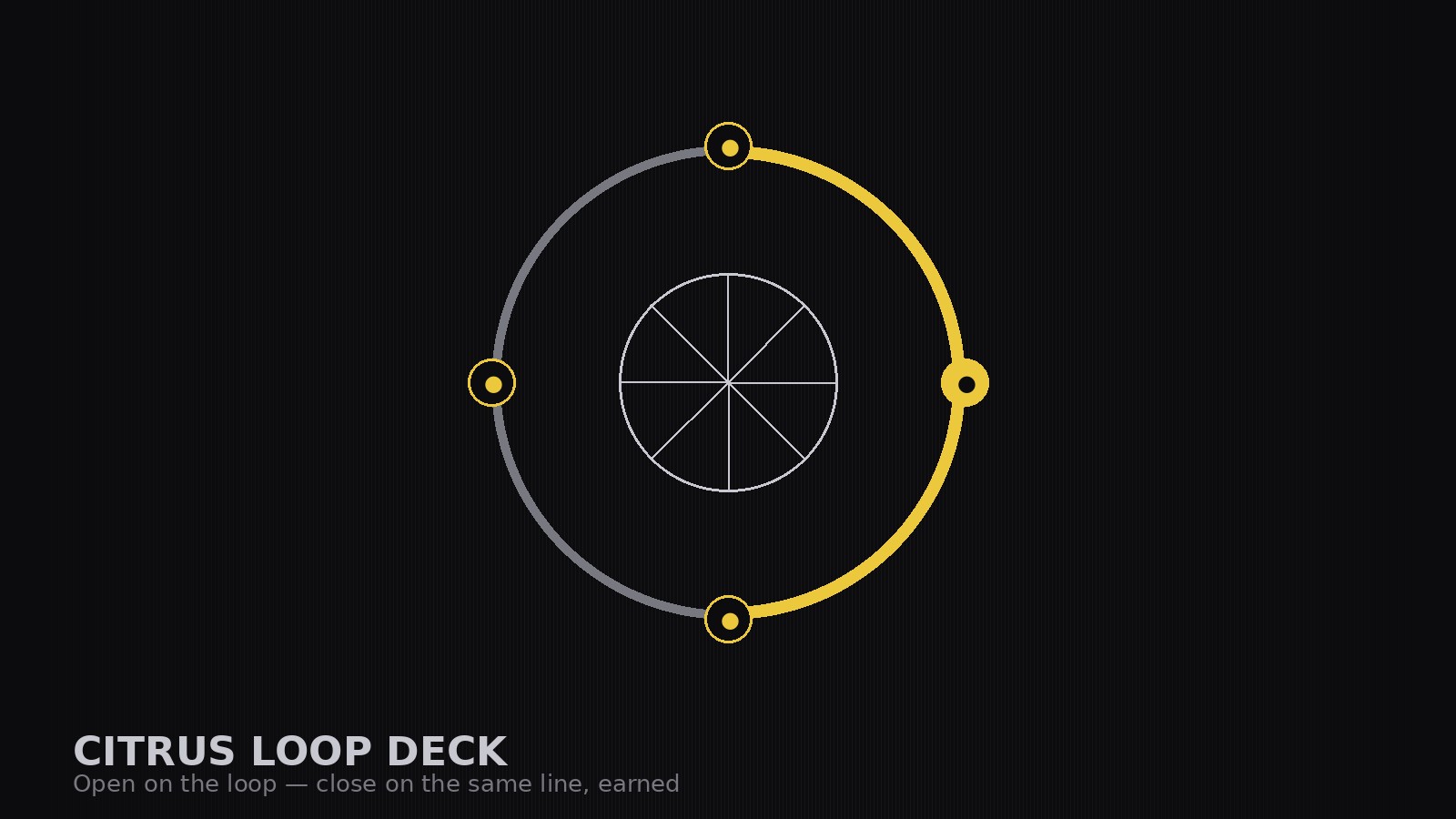
Builds a citrus-fresh presentation deck around a circular argument: a single loop sentence opens the deck, the evidence walks the loop's real order, and the closing slide restates the opening line word for word — now earned.
Install it in 3 steps
No sign-up. No CLI tools. Pick your AI, copy one line, paste it over.
Prefer doing it yourself? Buy the skill ($4.99), download the ZIP from your checkout confirmation, unzip it into the directory shown above, restart your AI session — same result. Already bought it? Your AI assistant can download it for you.
What’s inside
One SKILL.md (the playbook) + one starter template. A preview:
Citrus Loop Deck
When to use
- You are launching a product, campaign, or brand and want the deck to feel fresh, energetic, and memorable rather than corporate
- Your argument is circular by nature — a habit, a subscription, a flywheel, a season that comes around again — and a linear deck keeps flattening it
- You are pitching to an audience that has sat through five grey decks today and you need yours to be the one they remember
- You want a deck with a closing slide that echoes the opening slide, so the pitch lands as one complete thought
- Your current deck rambles: it ends wherever the slides ran out, not where the argument closes
Workflow
- Find the loop (input: pitch material → output: loop statement)
State the loop in one sentence: the idea that the deck opens with, develops, and returns to. "Fresh fruit, delivered weekly, so the week starts fresh" is a loop; "our product has five features" is a list. If you cannot state the loop in one sentence, the deck is not a loop deck yet — keep working until the return is obvious. - Set the system (input: loop statement → output: design rules)
Fix the system before laying out slides: a citrus palette (zest orange, lemon yellow, leaf green) on a light background with one dark ink color for text, one rounded display typeface for headlines, one plain face for body text, and a rule for the loop motif — a simple circular device (a ring, a wheel, a cycle diagram) that appears on the opening, transition, and closing slides. Bright colors with discipline: two citrus accents maximum per slide. - Structure the circle (input: loop + material → output: slide outline)
Order the deck as a circle, not a line: open on the loop (the promise, stated once, plainly), walk through the evidence in the order the loop actually runs (the problem, the product, the proof, the plan), then close by restating the opening line — same words, now earned. Aim for 8–12 slides. One idea per slide; if a slide doesn't move the loop forward, cut it. - Lay out for energy (input: outline → output: full deck)
Keep slides bright and airy: generous white space, short headlines, one visual per slide (a photo, a diagram, a single number at huge size). Use the loop motif as a progress thread — each section slide shows the ring with the current stage highlighted, so the audience always knows where they are in the circle. Proof slides carry one number, one context line, and the source.
Template preview
Citrus Loop Deck — Pitch Template
One pitch = one loop. Lock the loop sentence before laying out slides — it is the deck.
The pitch
Product / campaign / brand: {name} | Audience: {who} | Meeting date: {date} Loop statement (one sentence — opened with, developed, returned to): {sentence} The ask: {what you want them to agree to} Next step: {concrete next step + date}


