Brush Paper Deck
A handmade-feeling deck with ink-brush strokes and paper grain.
A handmade-style deck designer that builds presentations with ink-brush strokes, paper-grain texture, and warm off-white backgrounds for artists, studios, and craft brands.
Install it in 3 steps
No sign-up. No CLI tools. Pick your AI, copy one line, paste it over.
Prefer doing it yourself? Buy the skill ($4.99), download the ZIP from your checkout confirmation, unzip it into the directory shown above, restart your AI session — same result. Already bought it? Your AI assistant can download it for you.
What’s inside
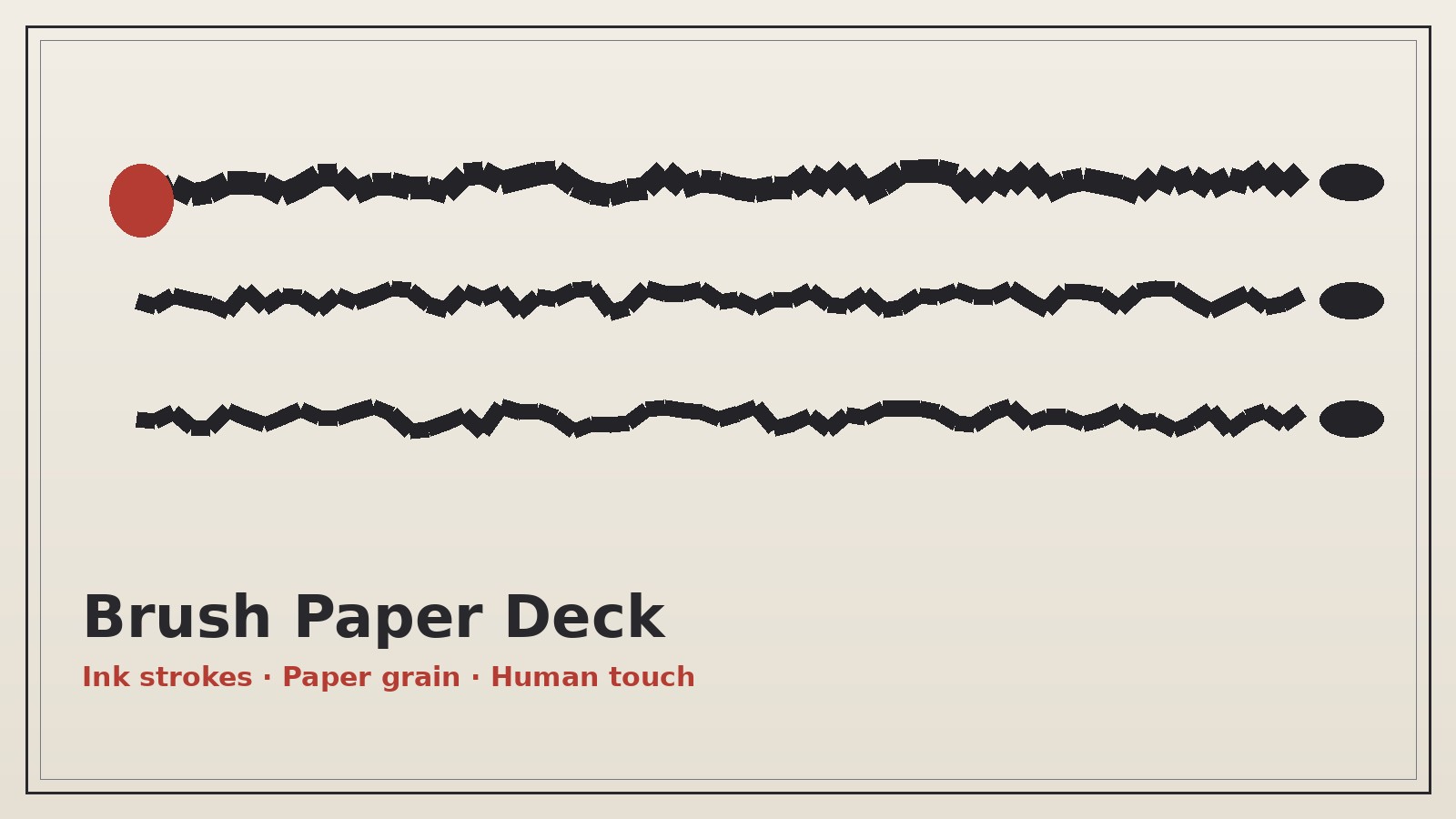
One SKILL.md (the playbook) + one starter template. A preview:
Brush Paper Deck
When to use
- An artist or studio is presenting a portfolio and a corporate template would kill the work
- A craft brand (ceramics, textiles, printmaking) needs a deck that feels like its products
- A creative proposal has to stand out in a stack of identical slide decks
- A workshop, exhibition, or residency pitch needs warmth the jury can feel in the first three slides
- A small business wants its sales deck to sound — and look — like a person, not a corporation
Workflow
- Gather the work (input: photos, portfolio pieces, or draft content → output: content brief)
Collect the real material: photos of the work (shot in natural light, not filtered), the story behind it, prices or terms if it's a sales deck, and the audience. A handmade deck lives or dies on real textures and real work — stock photos of "creativity" defeat the entire point. Pick the 5–10 strongest pieces; everything else is appendix or nothing. - Set the handmade system (input: content brief → output: style sheet)
Define the system in writing: paper background (warm off-white with subtle grain, never flat white), ink color (near-black with a hint of warmth, not pure #000), one accent (indigo, vermilion, or ochre — pick one), brush-stroke rules (headlines underlined by a single uneven stroke, dividers as one brush line, never clip-art splatters), and type (a human-feeling serif or hand-tuned sans for headlines, plain sans for body). One accent, one stroke style, no exceptions. - Draft the slide flow (input: style sheet + content brief → output: slide outline)
Order like a studio visit: enter (title with one brush stroke and one piece of work) → meet the maker (short story, one photo) → see the work (one piece per slide, with a sentence each) → how it works (process, materials, timeline) → the offer (prices, terms, or ask). One piece per slide — a grid of twelve thumbnails belongs in a catalogue, not a deck. - Build the slides (input: slide outline → output: styled deck)
Apply the system: full-bleed or large photos with paper margins, headlines with a single brush underline, body text short and plain-spoken, and brush dividers between sections. Keep every texture subtle — grain you notice is grain that's too loud. Captions carry the facts (title, medium, size, year) so the slides stay clean. - Print-check and proof (input: styled deck → output: presentation-ready deck)
Check the deck on a projector and, if it will ever be printed, on paper — brush textures that look rich on screen can turn muddy in print. Confirm photos are high enough resolution for full-bleed use, read every caption against the real work, and export both a presentation file and a PDF.
Output spec
Template preview
Brush Paper Deck — Template
One deck = one content brief + one style sheet. Fill both in before building slides.
Deck: {title}
Audience: {jury / client / buyers} | Purpose: {portfolio / proposal / sales}
Content brief
Real photos (natural light, unfiltered): {list — 5–10 strongest pieces}
Story (3 sentences max): {maker / studio story}
Terms (if sales deck): {prices / timeline / delivery}
Cut list: {pieces relegated to appendix or dropped}
Style sheet
- Paper: {warm off-white + subtle grain hex}
- Ink: {near-black with warm hint, hex}
- Accent (ONE): {indigo / vermilion / ochre — hex}


