Brand Story Deck
Your origin, mission, values, and proof in one memorable story.
A brand-storytelling deck builder that turns a company's origin, mission, values, voice, and proof into a narrative arc — world, spark, struggle, promise — that the whole team can retell.
Install it in 3 steps
No sign-up. No CLI tools. Pick your AI, copy one line, paste it over.
Prefer doing it yourself? Buy the skill ($4.99), download the ZIP from your checkout confirmation, unzip it into the directory shown above, restart your AI session — same result. Already bought it? Your AI assistant can download it for you.
What’s inside
One SKILL.md (the playbook) + one starter template. A preview:
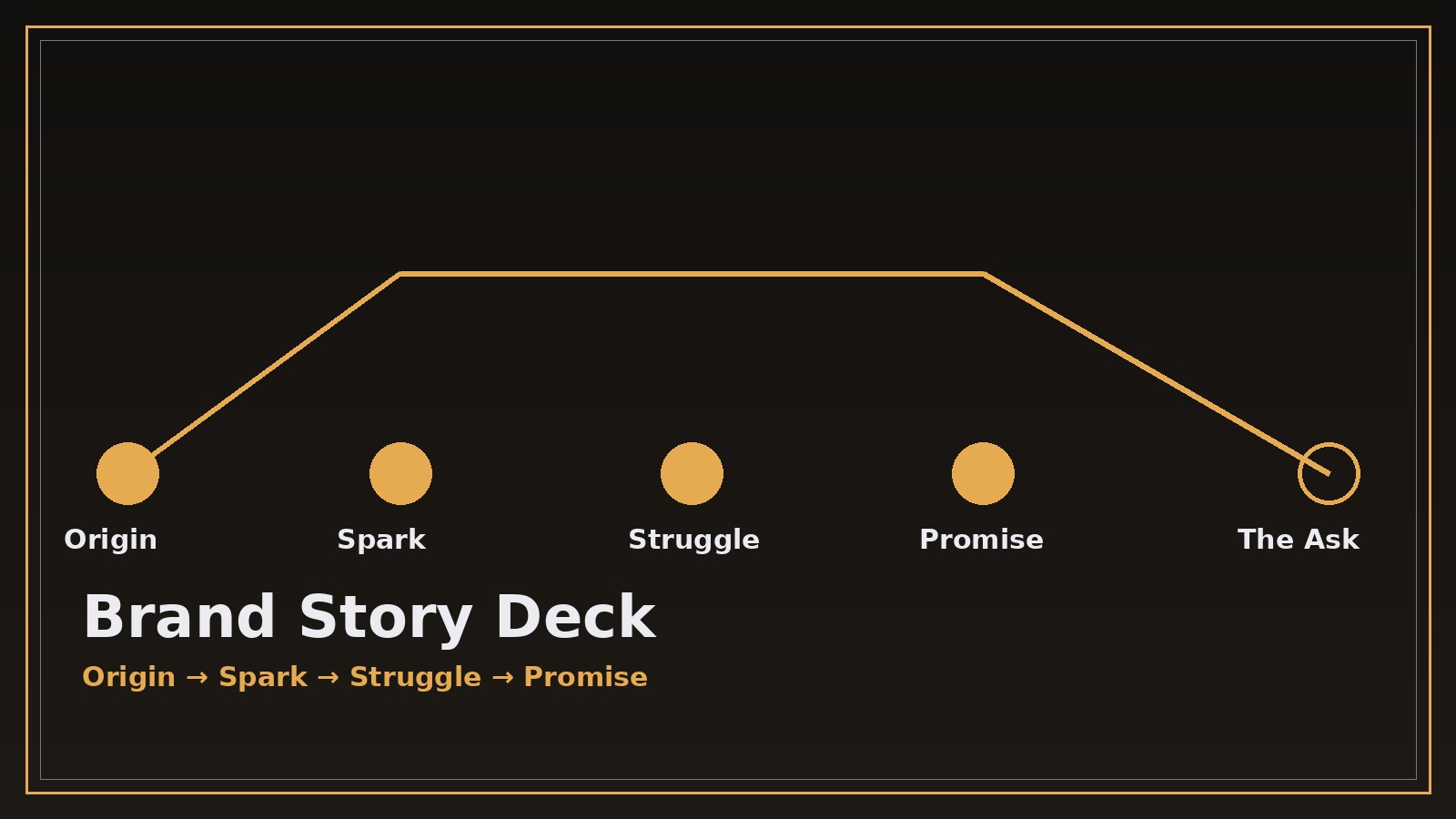
Brand Story Deck
When to use
- You're pitching investors and the numbers alone don't explain why this company exists
- A rebrand is launching and the team needs one shared story to tell customers
- New hires keep describing the company five different ways and you need a single source of truth
- A sales deck opens with features and prospects glaze over before slide three
- You're writing the About page, the pitch, and the keynote — and they should all agree with each other
Workflow
- Dig up the raw story (input: founder interviews, notes, or a rough About draft → output: story raw material)
Collect the unpolished truth: why the company started (the specific moment or frustration), who it serves, what it refuses to do, and the moments that shaped it — wins, failures, turning points. Record exact quotes where you can; a founder's real sentence beats a polished paragraph every time. No inventing origin stories — if a detail can't be confirmed, it stays out. - Find the narrative spine (input: story raw material → output: one-paragraph spine)
Compress the story into one paragraph with four beats: the world as it was (the problem people lived with) → the spark (what made you act) → the struggle (what was hard, honestly) → the promise (what you stand for now). If the struggle beat is missing, the story reads as advertising; put it back. This paragraph is the test — every slide must trace back to it. - Map the brand system (input: narrative spine → output: brand system sheet)
Spell out the working parts: mission (one sentence), values (3–5, each with a concrete behavior, not just a word), voice (how the brand sounds in three adjectives plus a do/don't pair), audience (who it's for and who it's not for), and proof (3–5 real facts, quotes, or numbers that back the story). A value without a behavior is a poster, not a value. - Build the deck (input: spine + brand system → output: styled deck)
Slide flow follows the spine: origin → problem → spark → struggle → mission → values (one per slide, with its behavior) → voice → audience → proof → the ask. Each slide carries one idea, one strong line, and room to breathe. Founder quotes go verbatim and attributed; stock-photo emotion is banned — use real photos, real product shots, or plain typography. - Test it on a stranger (input: styled deck → output: presentation-ready deck)
Show the deck to someone outside the company and ask them to retell the story in their own words. If they can't, the story is too complicated or too generic — simplify, don't decorate. Check that every claim on the proof slides is verifiable, and that the deck works both presented live and read alone as a PDF.
Output spec
Template preview
Brand Story Deck — Template
One deck = one narrative spine + one brand system sheet. Fill both in before building slides.
Brand: {name}
Story raw material
Origin moment (specific): {what happened, when, to whom}
Who it serves: {audience} | What it refuses to do: {refusals}
Turning points: {win / failure / pivot — with dates}
Verbatim quotes: "{quote}" — {who said it, when}
Narrative spine (one paragraph, four beats)
> World: {the problem people lived with} → Spark: {what made you act} → Struggle: {what was hard, honestly} → Promise: {what you stand for now}
Brand system sheet
Mission (one sentence): {mission}


