Slides Skills
キットそのものが物語の弧——着地点のあるデッキを。
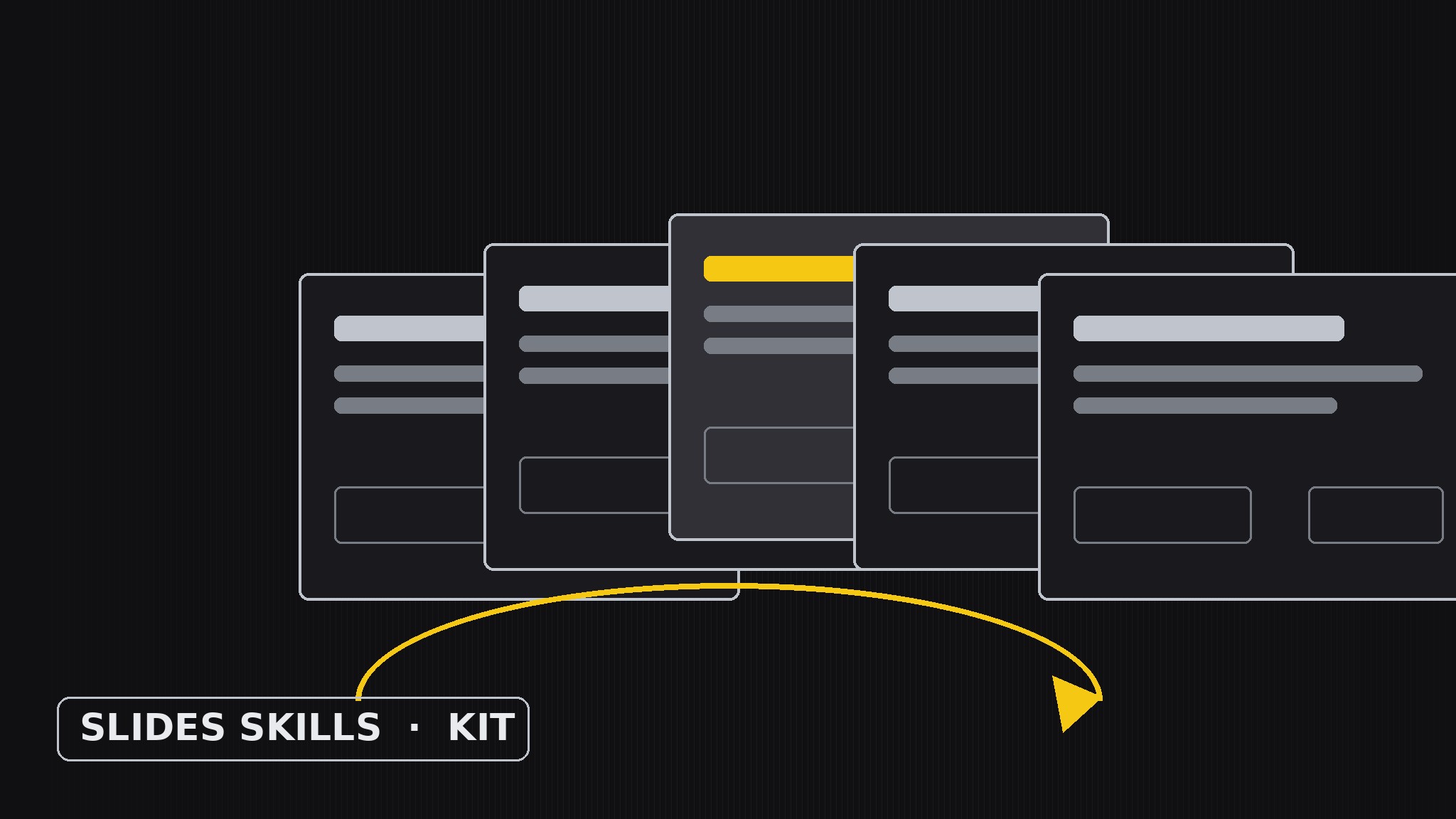
AIがデッキキットのビルダーになります——本物のプレゼンを届けるデッキスキルのまとまりあるキットを企画し、書き、組み立てます。デッキの種類やスライドのパターンごとに1スキル(ピッチ、報告、エディトリアル、キーノートなど)を割り当て、すべて同じ品質基準に保ち、最初のスライドから最後まで明確な弧を描くデッキへと構成します。
3ステップでインストール
登録不要。CLIツールも不要です。お使いのAIを選んで、1行コピーして貼るだけです。
ご自分で入れたい場合は、スキルを購入($4.99)し、購入完了画面からZIPをダウンロードして、上のディレクトリに展開し、AIのセッションを再起動してください。結果は同じです。すでに購入済みの場合は、AIアシスタントにダウンロードしてもらうこともできます。
パックの内容
SKILL.md(手順書)1点とスターターテンプレート1点が入っています。プレビューはこちらです:
Slides Skills
When to use
- You need several decks (pitch, report, keynote) and want them to feel like one organization's voice
- A team keeps rebuilding decks from a blank file, with every deck inventing its own structure
- You want a reusable kit: pick the deck type, assemble its arc from proven slide patterns, ship
- A talk, board report, or editorial presentation needs a clear arc, not just good-looking slides
- You are standardizing how your AI builds decks so every deck has one idea per slide and a real ending
Workflow
- Define the deck jobs (input: the talks and meetings on your calendar → output: kit brief)
Start audience-and-occasion-first: list the real decks this kit must produce and, for each, name the audience, the occasion, and the one outcome ("investors decide to take a meeting", "the board approves the budget", "the audience repeats the idea tomorrow"). Build the kit brief around those occasions — a pitch deck and a board report are different jobs and need different arcs, even if they share slide patterns. A kit with no named occasions drifts into generic templates; a kit built for three real occasions gets used on the fourth. - Inventory the skills (input: kit brief → output: deck inventory)
Give the kit two layers. Deck-type skills, one per occasion: Pitch (problem → solution → proof → ask), Report (question → evidence → recommendation), Editorial (story → tension → resolution), Keynote (hook → turns → takeaway), Workshop (concept → exercise → debrief). Then slide-pattern skills, the reusable building blocks every deck type draws on: Claim Slide (one sentence, one visual), Comparison (two options, one verdict), Evidence (one chart, one reading), Quote (one voice, large type), Agenda (the arc, in advance), and Closer (the ask, repeated). Keep the inventory small — if a pattern appears in only one deck, it may not deserve a skill. - Write each skill to the bar (input: deck inventory → output: skill specs)
Every skill gets the same spec shape: when to use it, its inputs (the content it needs — e.g. Pitch needs the problem, the solution, the proof, and the ask), its output (the deck or the slide, ready to present), and the shared quality bar. The bar is arc-honest: one idea per slide, headlines written as full-sentence claims (not labels), every deck has an arc with a beginning, a turn, and an ending, no slide survives if removing it changes nothing, and numbers are always sourced. Write the specs so a new deck type can join the kit by reusing the slide patterns, not by reinventing them. - Compose a deck (input: skill specs + deck brief → output: assembled deck)
Assemble by arc, not by template: pick the deck type for the occasion, lay out its arc in headlines alone (read them in order — they must tell the whole argument with the slides closed), then fill each beat with the right slide pattern — Claim for the turns, Evidence for the proof, Comparison for the decision, Closer for the ask. Enforce the kit's shared type, spacing, and accent rules across every slide so the deck reads as one voice. Cut ruthlessly: a deck that is two slides shorter and still makes its argument is a better deck. - Rehearse-check the kit (input: assembled deck → output: proven kit)
Prove the kit by rehearsing one real deck aloud, timed: does the arc land in the time allowed? Does every headline survive being spoken? Does the audience know what to do at the end? Note what broke — a deck type whose arc didn't fit the occasion, a pattern whose inputs were unclear, a slide that only works if the presenter explains it — and fix the kit, not just the deck. The kit is done when a second deck assembles faster than the first and a stranger can follow its arc without a presenter in the room.
テンプレートのプレビュー
Slides Skills — Kit-Building Template
The arc is the kit. Headlines alone must tell the argument.
Kit brief — decks this kit must produce
Deck inventory
Deck-type skills (one per occasion):
Slide-pattern skills (reusable blocks):
Skill spec (copy per skill)
Skill: {name} When to use: {___} Inputs: {___} Output: {the deck / the slide, ready to present} Quality bar: one idea per slide / headlines as full-sentence claims / real arc (beginning, turn, ending) / no passengers / numbers always sourced
Deck assembly
Deck: {name + type} Headline arc (read alone — tells the whole argument?):
- {claim headline}
- {claim headline}
スキルパック本体(SKILL.md とテンプレート)は英語で書かれています。