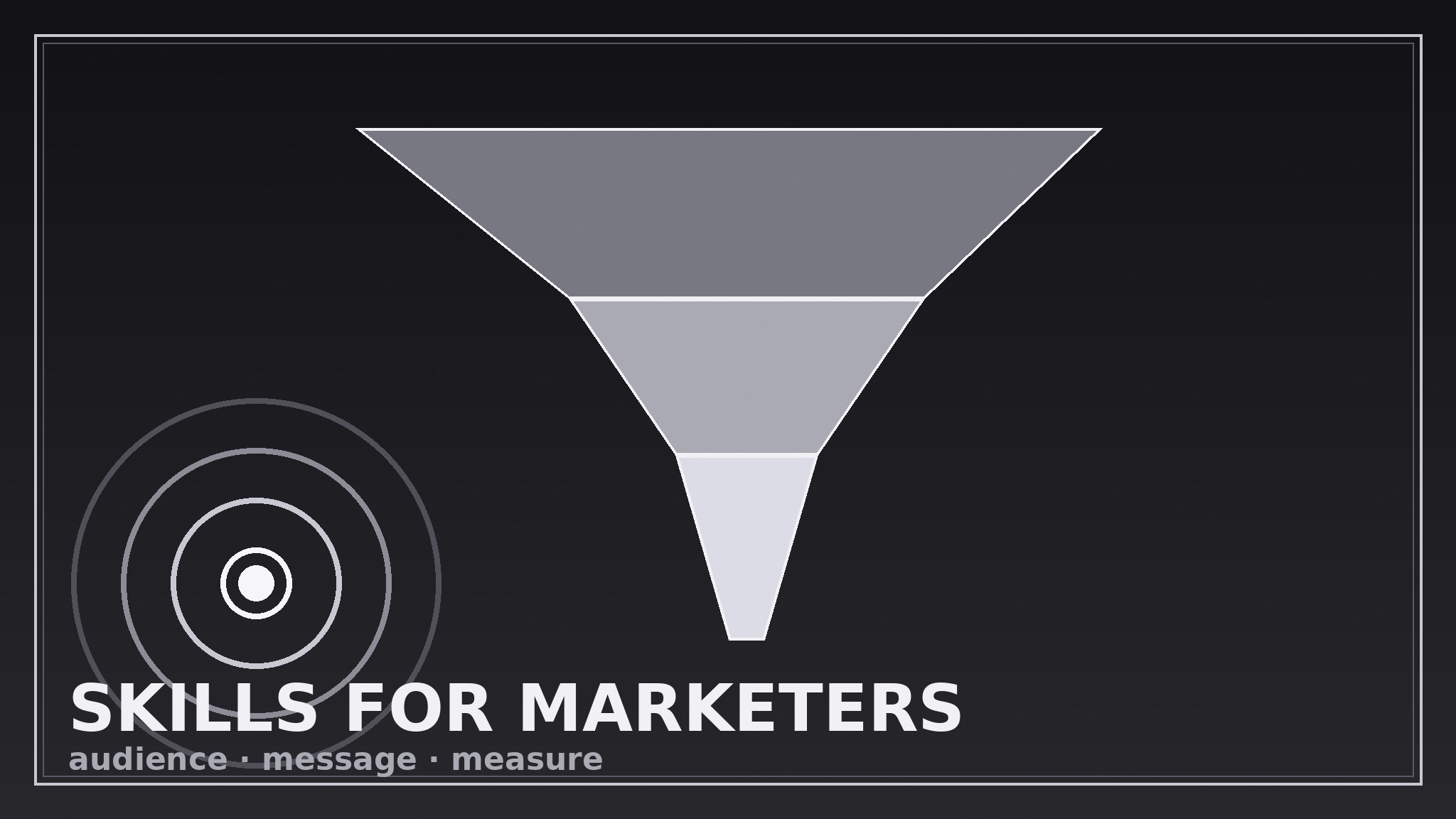
Skills for Marketers
キャンペーン全体のための1つのキット、オーディエンスから振り返りまで。
AIがキャンペーンキットのビルダーになります——キャンペーンの背骨に沿って9つのスキルを企画します。オーディエンスとメッセージングからチャンネル、アセット、計測まで、すべて同じ品質基準に保ち、1つのキャンペーンワークフローへと構成します。
3ステップでインストール
登録不要。CLIツールも不要です。お使いのAIを選んで、1行コピーして貼るだけです。
ご自分で入れたい場合は、スキルを購入($4.99)し、購入完了画面からZIPをダウンロードして、上のディレクトリに展開し、AIのセッションを再起動してください。結果は同じです。すでに購入済みの場合は、AIアシスタントにダウンロードしてもらうこともできます。
パックの内容
SKILL.md(手順書)1点とスターターテンプレート1点が入っています。プレビューはこちらです:
Skills for Marketers
When to use
- Your campaigns launch with assets before anyone has written down who they're for or what they'd have to believe
- Messaging changes every channel — the email promises one thing, the ad another, the landing page a third
- Measurement is a screenshot of a dashboard nobody interprets, so the next campaign repeats the last one's mistakes
- You want one kit that covers a whole campaign — audience, messaging, channels, assets, measurement, retro — to a single standard
- You're briefing freelancers or agencies and need the brief to carry the whole campaign logic, not just the deliverables
Workflow
- Audit a real campaign (input: your last 1–2 campaigns → output: campaign inventory)
Pick campaigns that actually ran and lay out everything they involved: audience notes, messaging, channel choices, assets produced, spend, results, and whatever retro happened (if any). Note where the campaign wobbled — assets made before messaging was settled, channels chosen because they were familiar rather than where the audience is, results reported without a verdict. The audit decides what the kit must contain; a kit built for an ideal campaign gets ignored the moment a deadline lands. - Scope the kit around the campaign funnel (input: campaign inventory → output: kit scope)
A marketer's kit has one spine: audience → messaging → channels → assets → measurement → retro, and the retro feeds the next campaign's audience work. Scope nine skills around that spine: audience persona builder, messaging house writer, channel planner, content calendar builder, ad copy variant writer, landing page briefer, email sequence writer, measurement dashboard designer, and campaign retro facilitator. Each skill owns exactly one artifact. Anything outside the spine — logo ideas, viral brainstorms — is a distraction; cut it. A kit that can't say "don't run this campaign yet" when the audience work is missing is a kit that just makes noise faster. - Set the quality bar (input: kit scope → output: quality standard)
Every skill in the kit must meet the same bar: every audience claim names its evidence (interview, survey, support ticket, analytics — or "assumption"); every message names the belief it must change and the proof offered; every channel choice names the audience behavior that justifies it; every measurement names its decision in advance ("if signups from this channel are below X, we pause it"). Write the bar as a checklist and run each skill's first output through it. A kit where the copy is sharp and the measurement is vibes will keep producing campaigns nobody can learn from. - Build the inventory in campaign order (input: quality standard → output: nine working skills)
Build in the order a campaign runs: audience persona first, then messaging house, channel plan, content calendar, ad copy variants, landing page brief, email sequence, measurement dashboard, retro facilitator. Test each skill on the audited campaign — rebuild that campaign's messaging house, re-plan its channels — because a kit tested on a hypothetical product produces hypothetical personas with no inconvenient facts. The test that matters: could a freelancer take the brief and produce assets that match the messaging without asking you three clarifying questions? - Compose the workflow and run one campaign end to end (input: nine skills → output: one finished campaign run)
Take one upcoming campaign and run it through the full chain: persona → messaging → channels → calendar → copy → landing brief → emails → dashboard → retro. Watch the two seams where marketing kits usually break: messaging-to-assets (copy that drifts from the agreed message) and measurement-to-retro (numbers collected, no verdict). Fix them by making each skill consume the previous skill's output — the ad copy must quote the messaging house's proof points, the retro must answer the dashboard's pre-stated decision questions — then the kit is one campaign workflow, not nine prompts in a folder.
テンプレートのプレビュー
Skills for Marketers — Kit Template
One kit = nine skills along the campaign spine. Fill this in from real campaigns that ran, then build in campaign order.
1. Campaign inventory (your last 1–2 campaigns)
Wobble pattern: {…}
2. Kit scope (nine skills, one artifact each)
Cut list (outside the spine): {e.g. logo ideas, viral brainstorms}
3. Quality standard (checklist — every skill's output must pass)
[ ] Every audience claim names its evidence: {interview / survey / support ticket / analytics / assumption} [ ] Every message names the belief it must change + the proof offered: {belief → proof}
スキルパック本体(SKILL.md とテンプレート)は英語で書かれています。