Content Creator Skills Kit
1つのアイデアから1週間分のコンテンツを——燃え尽きずに。
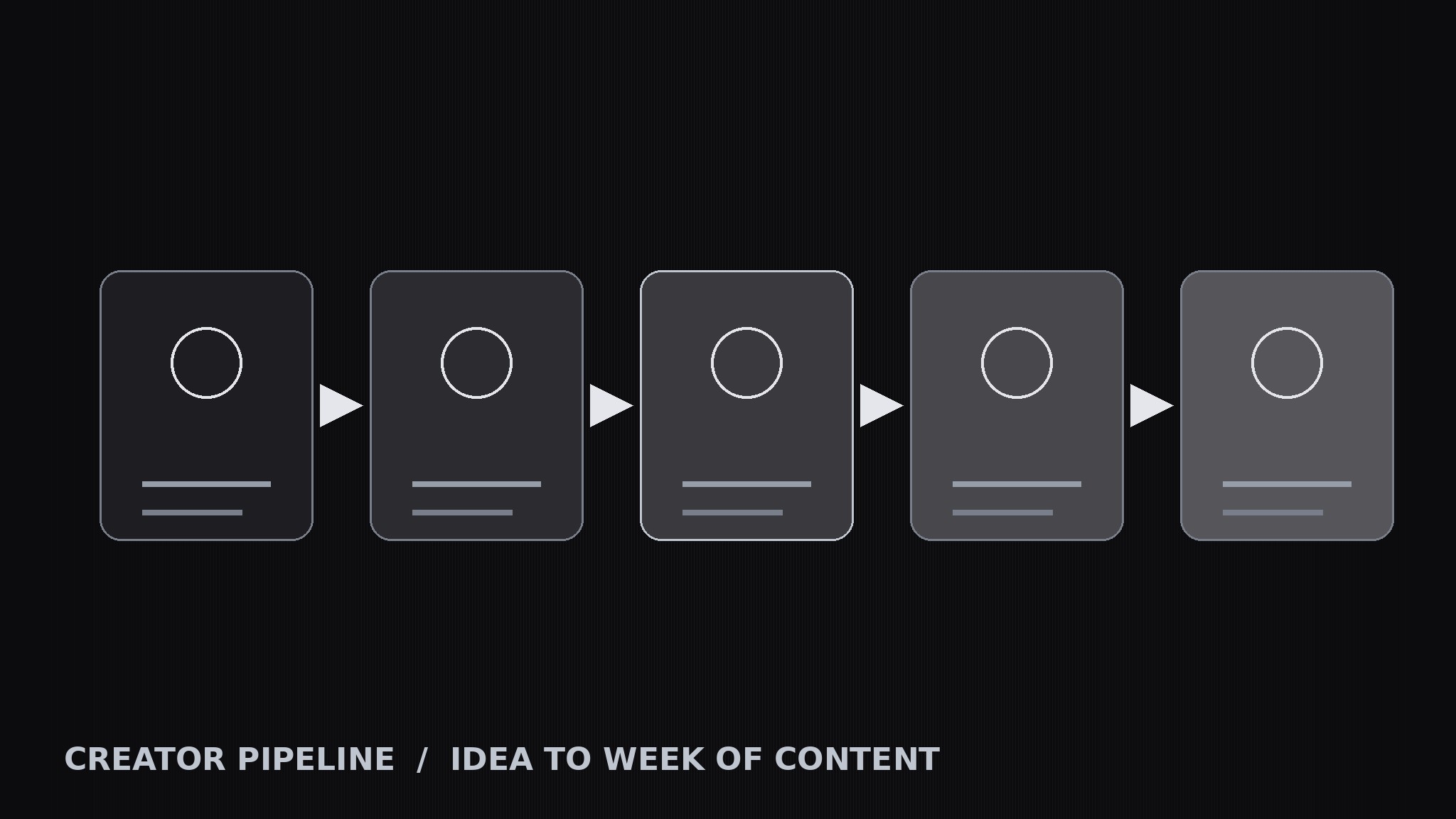
AIがコンテンツパイプラインのクルーになります——アイデアを蓄え、台本の前にリサーチし、繰り返し使える構成で脚本を書き、まとめて制作し、各作品を公開用にパッケージし、1つの作品を1週間分のコンテンツに再利用します。
3ステップでインストール
登録不要。CLIツールも不要です。お使いのAIを選んで、1行コピーして貼るだけです。
ご自分で入れたい場合は、スキルを購入($4.99)し、購入完了画面からZIPをダウンロードして、上のディレクトリに展開し、AIのセッションを再起動してください。結果は同じです。すでに購入済みの場合は、AIアシスタントにダウンロードしてもらうこともできます。
パックの内容
SKILL.md(手順書)1点とスターターテンプレート1点が入っています。プレビューはこちらです:
Content Creator Skills Kit
When to use
- You publish regularly — videos, posts, newsletters, shorts — and the bottleneck is the pipeline, not the talent
- You have ideas scattered across notes apps, screenshots, and half-written drafts, and choosing what to make next takes longer than making it
- Your pieces are one-and-done: a video goes up, gets its day, and dies, while the same material could have fed five more posts
- You want a repeatable structure for scripts so you stop staring at a blank page and stop rewriting the same intro six times
- You publish in bursts and then go quiet, and you want a batch rhythm that keeps the channel alive between big pieces
Workflow
- Bank ideas, pick one (input: idea bank → output: picked topic + angle)
Keep one idea bank — a single list, not five apps — where every idea lands with a one-line angle: not "video about sleep" but "why you wake up at 3 a.m., explained in 90 seconds." Once a week, pick one idea by two questions: can I make this well this week, and does it serve the audience I already have? One picked idea beats twenty maybes. - Research before scripting (input: picked topic → output: research note)
Gather the facts before a single script line: the core claim, the evidence behind it, the common misconceptions, and two or three concrete examples. Write the research note in plain sentences with sources noted. If you cannot state the claim in one sentence, you are not ready to script — you are ready to research for another twenty minutes. - Script to a structure (input: research note → output: script)
Every script follows the same skeleton: hook (the reason to stay, in the first ten seconds), promise (what the viewer gets), body (the claim, the evidence, the example — in that order), and close (the one thing to remember plus the next step). Structure is not formula for its own sake; it is what lets you write fast without losing the thread, and what lets a viewer follow you without effort. - Produce in batches (input: scripts → output: recorded / written pieces)
Batch by stage, not by piece: research all of the week's scripts in one sitting, record all of them in the next, edit them in the next. Context-switching is the tax; batching is how you stop paying it. A batch day produces three pieces in the time scattered days produce one — and the quality is steadier, because your head is in one mode at a time. - Publish with packaging (input: finished piece → output: published piece + packaging)
Packaging is part of the work, not the garnish: title, thumbnail or cover, first line, description, and tags — each written to make the same promise the piece keeps. Write two title options and pick the one that is more specific. A vague title promises nothing; a specific one promises exactly what the piece delivers, which is the only promise that earns a second click. - Repurpose one piece into five (input: published piece → output: five derivative pieces)
Mine the finished piece for derivatives: the strongest 60-second clip, a text post built from the core claim, a still or carousel from the best example, a short follow-up answering the most common comment, and a newsletter paragraph tying it to the week's theme. Repurposing is not reposting — each derivative is reshaped for its format and its audience, and each one points back to the original. - Review the week, keep what worked (input: week's pieces → output: next week's plan)
Once a week, look at what actually happened: which pieces held attention, which packaging pulled, which derivatives outperformed the original. Keep one thing that worked, drop one thing that did not, and carry the lesson into next week's pick. The pipeline improves by one change a week, not by a quarterly overhaul nobody finishes.
テンプレートのプレビュー
Content Creator — Weekly Pipeline Template
One week = one pick, one batch, five derivatives, one review.
Idea bank (one list — add freely, pick weekly)
This week's pick: {topic + angle} — Why this week: {can I make it well + does it serve my audience}
Research note
Core claim (one sentence): {claim}
Evidence: {what backs it up}
Common misconceptions: {what people get wrong}
Concrete examples: {2–3, with sources noted}
Sources: {where each fact came from}
Script (skeleton)
Hook (first 10 seconds): {reason to stay}
Promise: {what the viewer gets}
Body:
- Claim: {claim}
- Evidence: {evidence}
- Example: {example}
スキルパック本体(SKILL.md とテンプレート)は英語で書かれています。