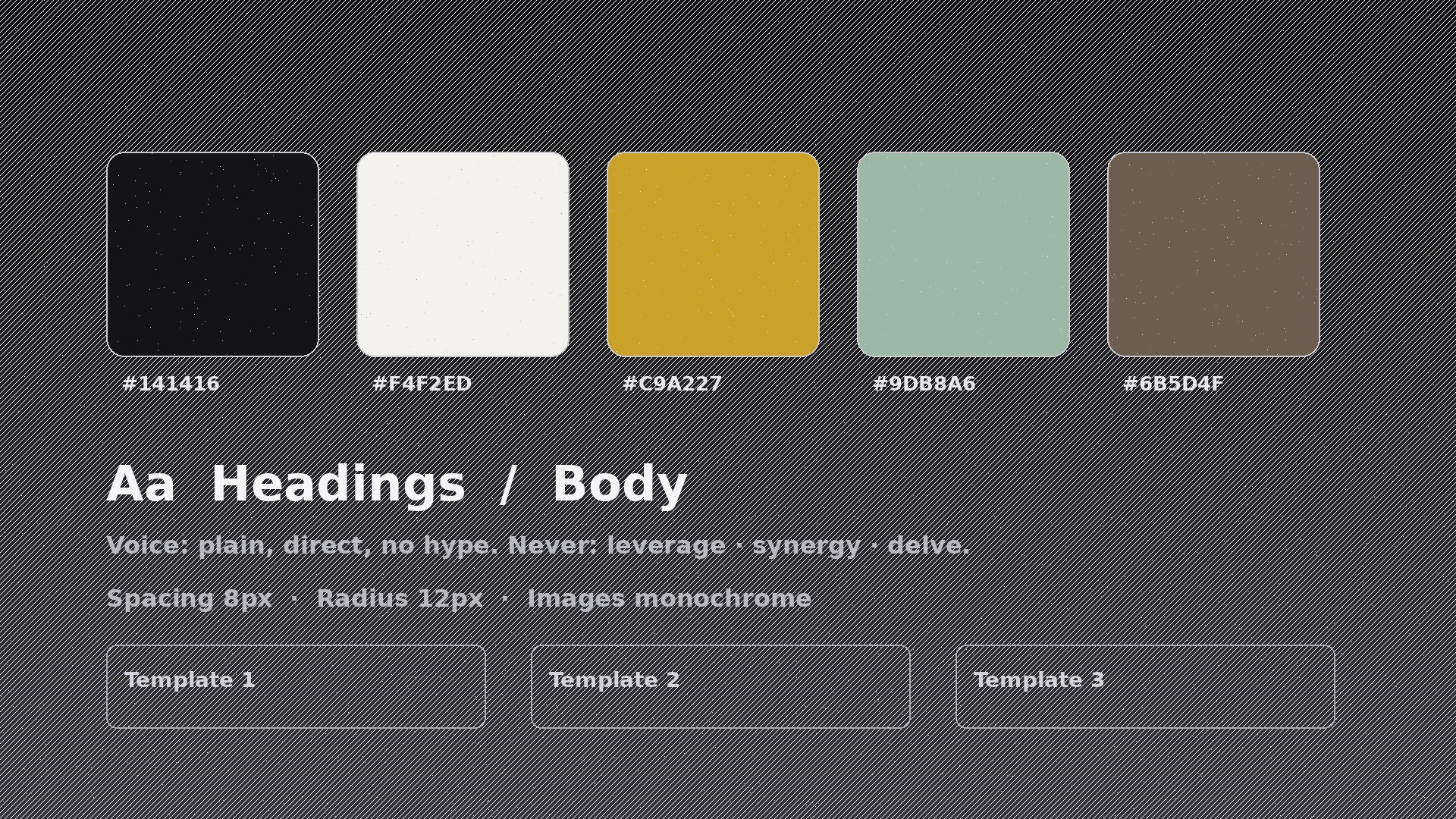
Brand Identity Kit
1つのシステムで、すべてのアセットが1社のものに見えます。
AIがブランドシステムキットのビルダーになります——まとまりあるアイデンティティキット(声、色、書体、ロゴの使い方、テンプレート)を企画し、それを定義し徹底するスキルを組み立て、各スキルが満たすべき基準を設定します。すべてのアセットが同じ会社から生まれたように見えます。
3ステップでインストール
登録不要。CLIツールも不要です。お使いのAIを選んで、1行コピーして貼るだけです。
ご自分で入れたい場合は、スキルを購入($4.99)し、購入完了画面からZIPをダウンロードして、上のディレクトリに展開し、AIのセッションを再起動してください。結果は同じです。すでに購入済みの場合は、AIアシスタントにダウンロードしてもらうこともできます。
パックの内容
SKILL.md(手順書)1点とスターターテンプレート1点が入っています。プレビューはこちらです:
Brand Identity Kit
When to use
- Your logo, site, decks, and social posts each look like they came from a different company
- You keep re-deciding colors, fonts, and tone for every new asset
- You want to hand design work to someone else (or to your AI) without the brand drifting
- Your brand exists as a logo file and a vibe, not as rules anyone can follow
- A rebrand, a new product line, or a first hire made the inconsistencies impossible to ignore
Workflow
- Scope the kit (input: your existing assets and audience → output: kit scope sheet)
Gather every asset currently in use — logo files, site, decks, invoices, social posts — and audit them against each other: which colors actually appear, which fonts, which tone. The scope sheet names what the kit covers (logo usage, color, type, voice, templates), the one audience the brand must read clearly to, and the brand's one-sentence personality ("precise but warm, never corporate"). A kit built without the audit just adds new rules on top of old contradictions. - Inventory the identity skills (input: scope sheet → output: skill inventory)
List the skills the kit needs, one per identity job: Voice (turns the personality sentence into do/say and don't/say lists with sentence patterns), Color (turns the audit into a locked palette — primaries, neutrals, one accent — with usage ratios and contrast rules), Type (turns the palette's mood into a type system: display face, body face, sizes, line-heights, and what never pairs), Logo usage (turns the logo files into clearspace, minimum-size, background, and misuse rules), Templates (turns the system into ready-to-use layouts for deck, document, social post, and email), Asset check (turns any finished asset into a pass/fail verdict against the whole system). If the kit has no asset-check skill, the system is a suggestion, not a standard. - Write the contract for each skill (input: skill inventory → output: per-skill input/output contracts)
For every skill, write the input, the output, and the pass bar. The pass bars are specificity bars: Voice — "a stranger can tell a brand sentence from a generic one in a blind test"; Color — "every color has a hex value, a job, and a maximum share of the page; no off-palette colors anywhere"; Type — "two faces maximum, sizes from a fixed scale, never stretched or outlined"; Logo usage — "misuse examples shown (don't stretch, don't recolor, don't crowd), each with the corrected version beside it"; Templates — "a new asset starts from a template, never from a blank page." Vague rules ("use colors tastefully") are how brands drift. - Build the system document (input: contracts → output: brand system doc + template pack)
Assemble one document that holds the whole system: tokens (the exact hex values, font names, spacing scale), rules (the do/don't for each token), templates (the four layouts, filled with real placeholder content so people see the system working), and the asset-check checklist. The system doc is the single source of truth — if it is not in the doc, it is not the brand. Keep it short enough that a new hire actually reads it: ten pages that get read beat fifty that do not. - Audit live assets and harden (input: system doc → output: hardened kit + fixes log)
Run the asset-check skill over ten real, recent assets. Log every failure by skill (voice drift in the newsletter, off-palette button on the pricing page, stretched logo in a partner deck), fix the assets, and fix the kit where the rules were unclear. A brand system is only real after it has corrected real work. Re-audit quarterly; brands drift through a thousand small exceptions, and each exception feels harmless alone.
テンプレートのプレビュー
Brand Identity Kit — System Pack
If it is not in this document, it is not the brand.
1. Kit scope sheet
Audience the brand must read clearly to: {one sentence} Brand personality (one sentence): {e.g. precise but warm, never corporate} Kit covers: logo usage / color / type / voice / templates Asset audit summary: {what actually appears today — colors, fonts, tone — and where they contradict each other}
2. Voice
Do / say: {pattern 1} | {pattern 2} | {pattern 3} Don't / say: {pattern 1} | {pattern 2} | {pattern 3} Sentence patterns: {example brand sentence} / {example brand sentence}
スキルパック本体(SKILL.md とテンプレート)は英語で書かれています。