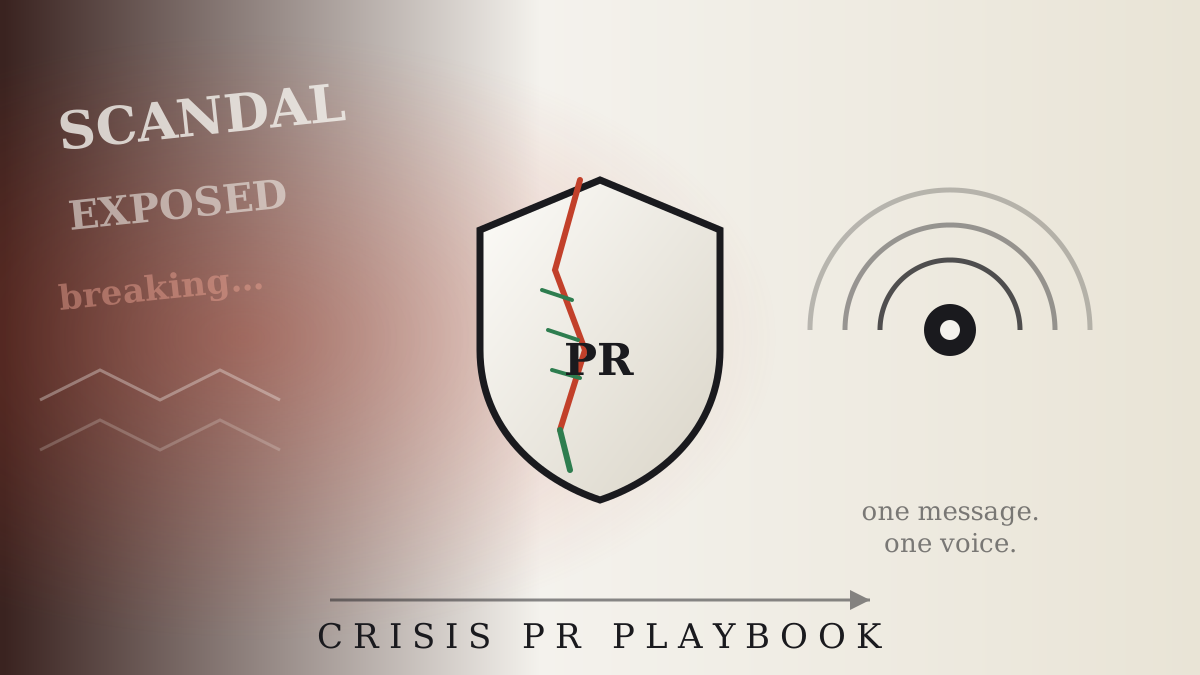
Crisis PR Playbook
Controlla la narrazione prima che controlli te
Gestione delle crisi di reputazione: il framework di risposta in 24 ore, quando essere trasparenti e quando stare in silenzio, protocolli di crisi sui social media, preparazione del portavoce e ricostruzione post-crisi. Per founder, personaggi pubblici e team di comunicazione sotto tiro.
Installala in 3 passaggi
Nessuna registrazione. Nessuno strumento da riga di comando. Scegli la tua AI, copia una riga e incollala.
Preferisci fare da te? Acquista la skill ($4.99), scarica lo ZIP dalla conferma d'acquisto, decomprimilo nella cartella mostrata sopra e riavvia la sessione della tua AI — stesso risultato. L'hai già acquistata? Il tuo assistente AI può scaricarla per te.
Cosa contiene
Un file SKILL.md (la guida operativa) + un modello di partenza. Un'anteprima:
Crisis PR Playbook
When to use
- A story is about to break and you need a response plan before it does —
a lawsuit, a leak, a layoff, a product failure, an executive's past resurfacing - Something just went public in the worst way:
a viral thread, an investigative piece, a video you can't unsee, a regulatory action - You are the founder/face of the company and every microphone is suddenly pointed at you
- Your social accounts are getting ratioed and your team is arguing about whether to post, delete, or go dark
- You need to decide whether radical transparency will defuse the story or hand your critics the rope
- The acute phase is over and you need to rebuild trust
without pretending it never happened
Workflow
- Assess and triage (input: the situation, raw → output: crisis grade)
Before you say a word in public, grade the crisis. Write down: what happened (facts only, sourced, no spin), who is affected and how badly, what evidence exists outside your control (documents, video, witnesses), and whether the story is growing or contained.
Grade it: Level 1 (embarrassing but not harmful — a bad tweet), Level 2 (harmful to some — a layoff handled badly, a data leak), Level 3 (existential — fraud, safety failures, criminal exposure).
Then answer the one question that decides everything: is there more bad news still to come out? If yes, your entire strategy must assume the worst version will surface, because it will.
A response built on the hope that "nobody will find the rest" is a second crisis waiting to happen. This step takes hours, not days — speed matters, but a response based on incomplete facts is just a faster way to be wrong.
- Choose your posture: transparent or quiet (input: crisis grade → output: the posture)
The two biggest mistakes in crisis PR are going loud when you should go quiet, and going quiet when the story demands answers.
Go transparent when: the facts are mostly known already, the harm is real and acknowledging it is the only credible move, or your silence is itself becoming the story.
Go quiet when: the facts are still unclear and a wrong statement will be quoted forever, legal exposure is real (say nothing your lawyer hasn't cleared), or the story is dying on its own and any statement restarts it.
Transparency is not a vibe — it's a decision with costs: every document you release, every camera you invite in, every account you hand to a manager creates material your critics will clip.
The inspiration for this playbook — the radical-transparency operation documented in *You Can See Everything* (2026, A24): cameras in the home, billboards, a run-by-proxy social presence — shows transparency as a deliberate weapon, not a reflex. Steal the deliberateness, not the theatrics.
And the middle option exists: limited transparency — answer the known questions fully, state clearly what you can't answer yet and when you will, then stop.
- Run the 24-hour framework (input: posture → output: hour-by-hour response)
The first 24 hours set the frame every later story will reference.
Hour 0–2: internal lockdown — no employee posts anything, designate one spokesperson, one decision-maker, one lawyer in the loop.
Hour 2–6: holding statement — acknowledge you are aware, state what you are doing (investigating, cooperating, fixing), give a time for the next update. A holding statement is not an admission; "we're aware and we're looking into it" buys you time without lying.
Hour 6–12: fact assembly — get the full timeline from step 1 into a form your spokesperson can defend.
Hour 12–24: the substantive response — the full statement, the Q&A, the corrective action.
Every hour without an acknowledgment, the void fills with speculation presented as fact, and you will spend weeks correcting the speculation instead of the story.
But speed never outranks accuracy: one corrected statement does more damage than six hours of "we're looking into it."
- Execute the social and spokesperson protocols (input: response plan → output: controlled channels)
Social media: freeze scheduled posts immediately — a promo tweet during a crisis reads as sociopathy.
One account speaks; everyone else's accounts go quiet or personal-only, no subtweets, no likes on critical threads, no quote-tweeting critics (that's free distribution for their argument).
Do not delete the post that started it unless it contains a factual error you are correcting on the record — deletions screenshot well and apologize badly; if you must delete, say what you deleted and why.
Spokesperson prep: one face, one voice, briefed on the full timeline including the bad parts, drilled on the three questions you most fear.
The rule for every answer: acknowledge what is true, correct what is false, and say "I don't know yet, here's when I will" for the rest — never fill a gap with a guess.
If you run the subject's account by proxy (a common transparency-play tactic), the posts must sound like the person, not like a comms team cosplaying authenticity — audiences smell the difference instantly.
- Avoid the Streisand trap (input: any suppression impulse → output: a suppression decision)
Every crisis team at some point wants to make the story go away: takedown requests, legal threats, pressuring platforms. Before you do, run the test: will this action create a bigger story than the story itself? If the answer is yes or maybe, don't do it.
Suing over a true story, threatening a journalist, or mass-reporting critics are the fastest known way to turn a Level 2 crisis into a Level 3.
The exceptions are narrow: genuinely false claims of fact (correct them with evidence, don't just threaten), non-consensual private material (remove it through proper channels), and imminent safety threats. Everything else gets answered, not suppressed.
Log every suppression action you consider and the reason you did or didn't take it — if it leaks later, "we considered and rejected it" is a defensible record.
- Rebuild after the acute phase (input: stabilized story → output: rebuild plan)
Rebuilding starts when the news cycle moves on, not when you feel ready.
Write the reckoning first: a public accounting of what happened, what you got wrong, and what changed — specific, not "we take this seriously."
Then the proof phase: the changes must be visible and verifiable (an audit published, a policy changed, a product fixed), because promises without evidence read as PR.
Then the record phase: create new, true, positive facts for the record — the boring work of being good at your job, documented. This is slow by design; trust rebuilds on a longer timeline than news cycles.
Do not do the victory lap: no "we've turned the page" press tour, no reputation-washing campaigns while victims are still in the story.
And keep the crisis file: everything from this playbook, archived, because the next crisis will rhyme with this one.
Anteprima del modello
Crisis PR Pack
Crisis triage (fill in the first hours, not days)
- What happened (facts only, sourced, no spin): […]
- Who is affected and how badly: […]
- Evidence outside your control (documents / video / witnesses): […]
- Story status: [growing / contained / dying]
- Crisis grade: [Level 1 — embarrassing / Level 2 — harmful / Level 3 — existential]
- Is there more bad news still to come out? [yes / no / unknown]
- If yes — assume the worst version will surface. Strategy must survive it.
Posture decision
- Posture: [transparent / quiet / limited transparency]
- Reasoning (written down): […]
24-hour framework
- Hour 0–2 — internal lockdown:
Il pacchetto della skill (SKILL.md + modello) è scritto in inglese.
Potrebbe piacerti anche
 Flussi di lavoro
Grok Bot Routine Rescue
Find which scheduled routine is eating your weekly pool — and kill it
 Presentazioni
Pitch Deck
10 slide che raccontano una sola storia — gli investitori restano fino all'ultima pagina
 Presentazioni
Work Report
Settimanale, mensile, review — prima la conclusione, si capisce in 3 minuti