Work Report
Settimanale, mensile, review — prima la conclusione, si capisce in 3 minuti
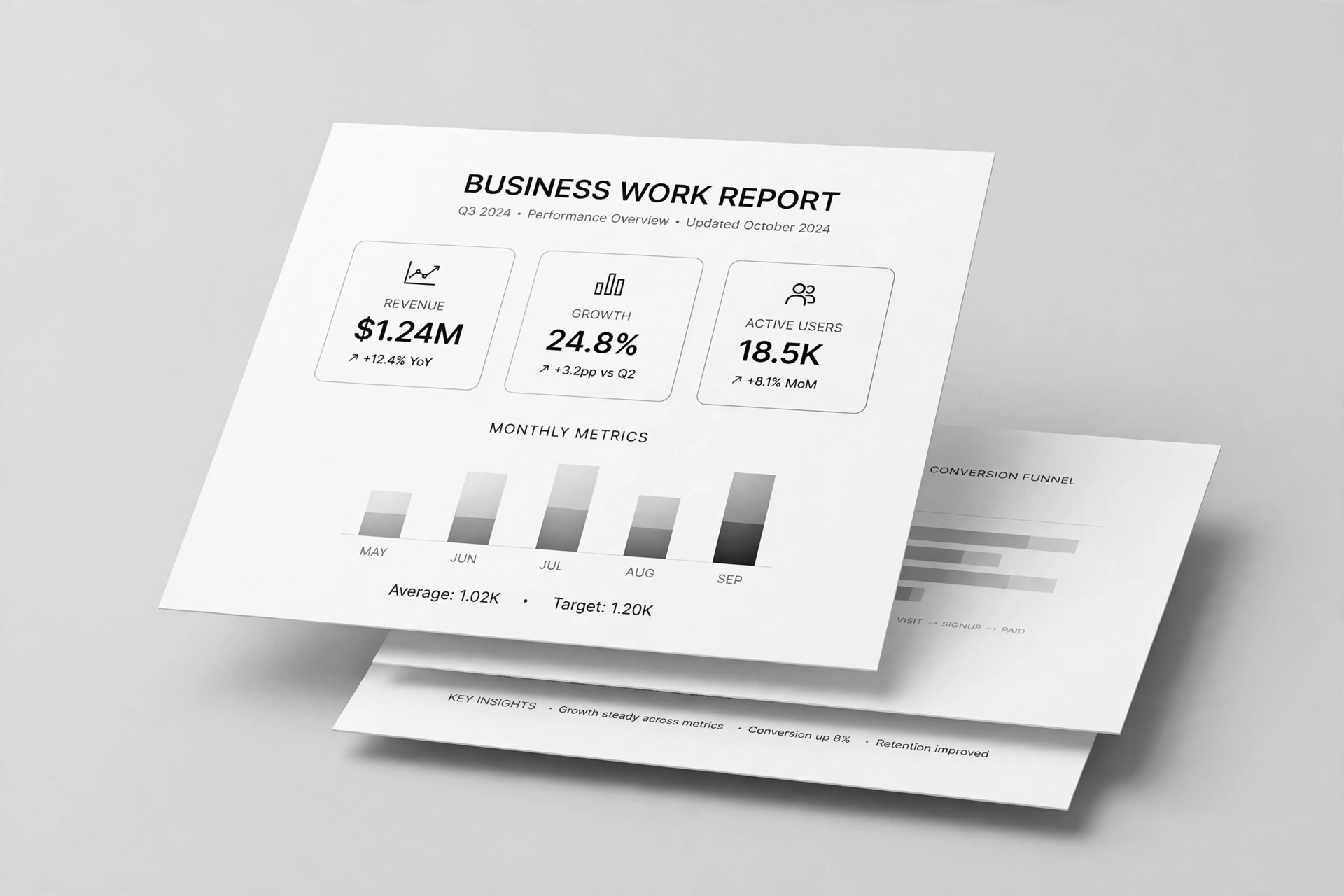
Report con il principio della piramide in tre lunghezze: settimanale, mensile e valutazione delle performance. Prima la conclusione, numeri invece di discorsi.
Installala in 3 passaggi
Nessuna registrazione. Nessuno strumento da riga di comando. Scegli la tua AI, copia una riga e incollala.
Preferisci fare da te? Acquista la skill ($4.99), scarica lo ZIP dalla conferma d'acquisto, decomprimilo nella cartella mostrata sopra e riavvia la sessione della tua AI — stesso risultato. L'hai già acquistata? Il tuo assistente AI può scaricarla per te.
Prove dal mondo reale
Persone vere hanno svolto proprio questo lavoro con agenti IA.
Coordinate background threads and send admin reminders
Leggi il caso →Caso d'usoRun data cleaning to executive summary with agent pipeline
Leggi il caso →Caso d'usoRun agents that work Jira tickets, review PRs and send updates
Leggi il caso →Cosa contiene
Un file SKILL.md (la guida operativa) + un modello di partenza. Un'anteprima:
Work Report
When to use
- Friday's weekly report is due, but it reads like a diary — even you can't stand it
- Month-end or quarter-end needs a work report that turns a month of work into a coherent story
- A promotion review or performance appraisal needs the "results, thinking, plan" three-act structure
- A project retrospective needs conclusion-first: say whether it worked before explaining why
- Your boss keeps saying "get to the point" and you need a "say it in 30 seconds" framework
Workflow
- Land the conclusion (input: raw work notes → output: one-sentence conclusion)
Force yourself to write one sentence first: "The single most important conclusion of this period is ___." A weekly report might say "Project A is 2 weeks behind because ___, and I've done ___ about it"; a review might say "I delivered ___, and the reason I exceeded expectations is ___." If you can't write this sentence, you haven't thought it through yet — think first, then write. - Build the skeleton (input: one-sentence conclusion → output: three-part outline)
Pyramid structure: the conclusion on top, up to 3 supporting arguments in the middle (results / progress / issues), data and facts at the base. No report gets more than 3 sub-points — merge or cut the rest. Pick the length first: 5-minute version (1 page), 15-minute version (5–8 pages), 30-minute version (10–15 pages). - Add the flesh (input: outline → output: complete first draft)
Write each point in three sentences: "what I did → what happened (data) → what it means." Results are written as "outcome + comparison" (month-over-month / year-over-year / target completion rate); issues as "symptom + root cause + actions taken or planned" — never raise a problem without a solution. - Align the numbers (input: first draft → output: final draft with consistent definitions)
Check every number: definitions unified (e.g. "order volume" means the same thing throughout), time ranges labeled clearly, percentages shown with their numerator and denominator. Numbers must reconcile with last period's report — explain any that don't. - Cut the fluff (input: final draft → output: trimmed version)
Delete three kinds of content: ① empty adjectives ("pushed hard", "achieved remarkable results") ② process details unrelated to the conclusion ③ saying the same thing twice. Keep only what supports the conclusion, per page and per paragraph. - Prepare for questions (input: trimmed version → output: Q&A prep)
For every issue and risk in the report, anticipate the 3–5 most likely follow-up questions from your boss or the reviewers, and write answer outlines. Prepare explanations for data anomalies in advance — don't get caught flat-footed.
Output spec
Anteprima del modello
Work Report Skeleton (pick one of three lengths)
> How to use: keep only the length that fits the occasion; delete the other two lengths and all "Fill-in tip" lines before using. > Iron rule: the first sentence of every paragraph / page must be the takeaway — never bury the conclusion at the end.
Tier A: 5-minute one-pager (weekly report / standup)
This period's one-sentence conclusion
Three supporting points (exactly 3 — merge or cut the rest)
- —— data:
- —— data:
- —— symptom, root cause, action
Next steps (max 3, each with a clear deliverable and deadline)
- —— deliverable, deadline
- —— deliverable, deadline
Il pacchetto della skill (SKILL.md + modello) è scritto in inglese.