Cozy Island Deck
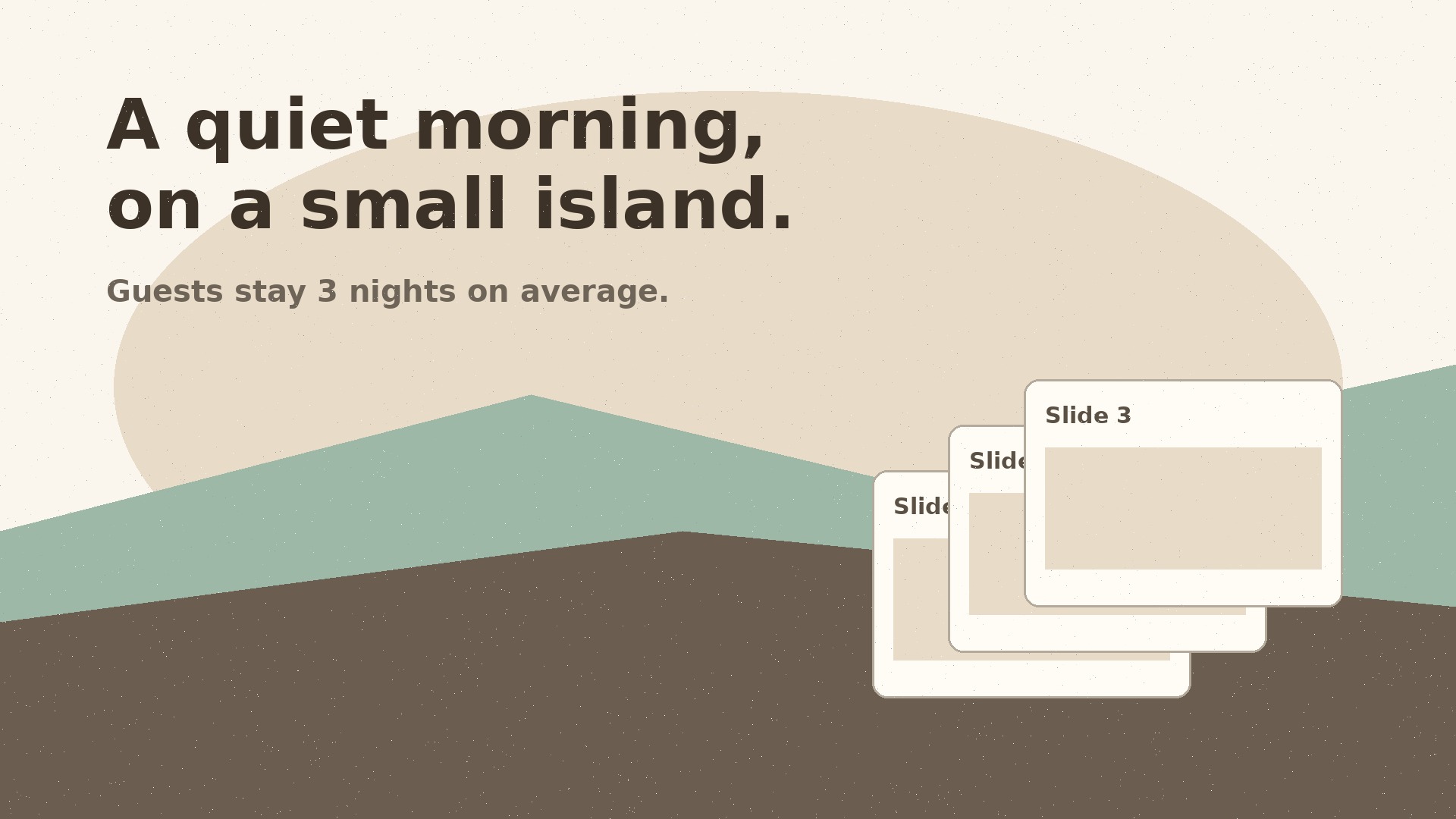
Slide che sanno di una mattina tranquilla su una piccola isola.
Progetta deck di presentazione con un tocco caldo, da ritiro: palette morbide di sabbia e vetro marino, spazi bianchi generosi, testi essenziali e un ritmo calmo che mantiene il pubblico rilassato e in ascolto.
Installala in 3 passaggi
Nessuna registrazione. Nessuno strumento da riga di comando. Scegli la tua AI, copia una riga e incollala.
Preferisci fare da te? Acquista la skill ($4.99), scarica lo ZIP dalla conferma d'acquisto, decomprimilo nella cartella mostrata sopra e riavvia la sessione della tua AI — stesso risultato. L'hai già acquistata? Il tuo assistente AI può scaricarla per te.
Cosa contiene
Un file SKILL.md (la guida operativa) + un modello di partenza. Un'anteprima:
Cozy Island Deck
When to use
- Your pitch deck feels cold and corporate, and you want the room to relax before you make the ask
- You're presenting a community, travel, hospitality, wellness, or lifestyle idea that deserves a warm visual tone
- Your workshop slides are dense walls of text and you need a calm, breathing layout people can follow
- You're giving a talk to a small audience and want slides that feel like a conversation, not a broadcast
- You need a deck template with a consistent cosy look across 10–30 slides
- Your existing deck has good content but the design fights it — harsh colours, cramped slides, no rhythm
Workflow
- Define the mood and the message (input: your topic + audience → output: mood brief)
Write one line for the feeling ("a quiet morning on a small island") and one line for the message ("our retreat is bookable today"). Every later choice serves those two lines. Pick the palette from the mood, not from your logo: soft sand, sea-glass green, warm cream, driftwood brown, one deep ocean accent for emphasis. If a colour would look wrong on a beach café menu, it doesn't belong in this deck. - Structure the story (input: your content → output: slide outline)
Lay out the arc before designing anything: opening image slide (one line, one image) → the situation (why this matters, 2–3 slides) → the idea (what you're proposing, 2–3 slides) → the evidence (numbers or stories, 2–3 slides) → the ask (one clear slide) → closing image slide. One idea per slide, always. A cosy deck is a slow walk, not a sprint — if your outline has 40 slides for a 15-minute talk, cut it now. - Set the slide system (input: mood brief → output: slide master)
Build one master: generous margins (at least 10% of slide width on each side), one serif or soft rounded sans for headings, one clean sans for body, large type (nothing below 20pt for body), one image treatment (soft, warm, slightly desaturated photos or gentle illustrations). Title slides get a full-bleed image with a translucent warm overlay; content slides get cream backgrounds with plenty of empty space. The master does the heavy lifting so individual slides stay consistent without effort. - Write sparse slide copy (input: outline + source material → output: slide text)
Cut every slide's text to what a listener can absorb in five seconds: a short headline that is a claim ("Guests stay 3 nights on average"), one or two supporting lines, and nothing else. Move explanations to your spoken words, not the slide. If a slide needs a paragraph, it needs to be two slides — or a handout. Numbers get the big-type treatment; a single large number on a calm slide lands harder than a table of ten. - Place imagery with breathing room (input: slide text + images → output: laid-out slides)
One image per slide at most, and never squeezed against text: image on one side, text on the other, with a clear gap. Prefer wide, calm images — horizons, shorelines, quiet interiors — over busy collages. Captions are one short line, not a paragraph. If you can't find a calm image for a slide, leave it text-only on cream: empty space is part of the cosy look, not a failure. - Pace and polish (input: laid-out slides → output: finished deck)
Read the deck end to end as an audience member: does the rhythm alternate (image slide → content → number → story) or does it drone? Are the transitions gentle (fade or none — no spins, bounces, or 3D flips)? Is the ask slide unmistakable? Rehearse once with a timer; cut any slide you skip while talking. Export at full resolution and check on the actual projector or screen — warm palettes wash out on dim projectors, so raise contrast slightly if needed.
Anteprima del modello
Cozy Island Deck — Starter Template
Fill in every {placeholder}, then build slides from this brief — not the other way round.
Mood brief
- Feeling (one line): {feeling_line, e.g. A quiet morning on a small island.}
- Message (one line): {message_line, e.g. Our retreat is bookable today.}
- Palette: Sand {sand_hex} · Cream {cream_hex} · Sea-glass {seaglass_hex} · Driftwood {driftwood_hex} · Deep ocean accent {ocean_hex}
Slide outline (one idea per slide)
- Opening image: {one_line + image_description}
- Situation: {slide_ideas, 2–3 slides}
- Idea: {slide_ideas, 2–3 slides}
- Evidence: {slide_ideas, 2–3 slides}
- Ask: {one_clear_ask}
- Closing image: {mirror_of_opening}
Il pacchetto della skill (SKILL.md + modello) è scritto in inglese.
Potrebbe piacerti anche
 Presentazioni
Pitch Deck
10 slide che raccontano una sola storia — gli investitori restano fino all'ultima pagina
 Presentazioni
Work Report
Settimanale, mensile, review — prima la conclusione, si capisce in 3 minuti
 Presentazioni
Academic Argument Deck
Una presentazione che argomenta — e risponde alle obiezioni.