Cobalt Serif Marketing Deck
Un piano di campagna o di lancio in un unico deck: pubblico, posizionamento, canali, calendario, budget e prove.
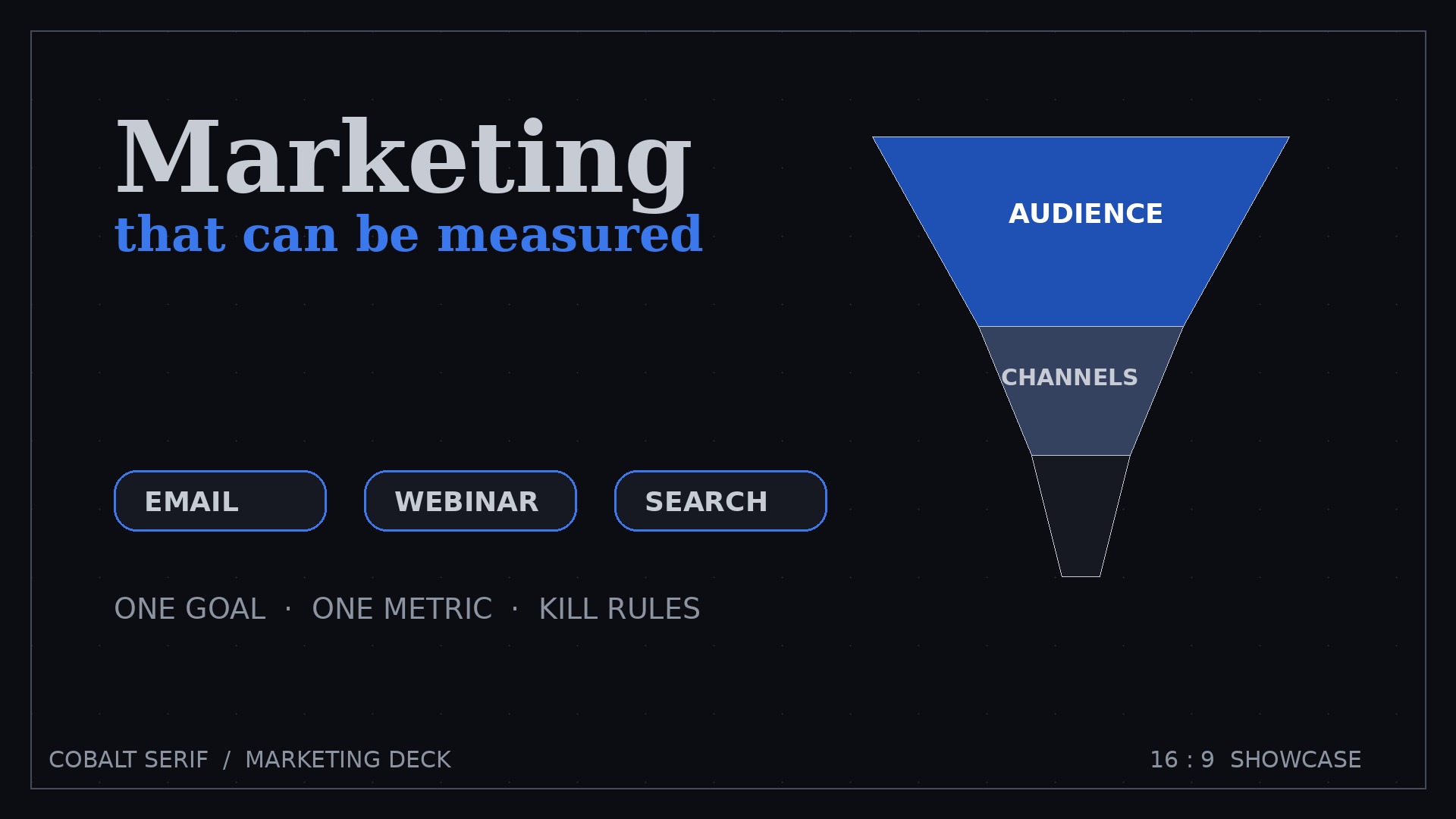
Crea un deck di marketing di 10-14 slide in stile Cobalt Serif: titoli con grazie, accenti blu cobalto intenso e testo grigio-argento. Un obiettivo con una metrica misurabile, un posizionamento al servizio di ogni slide, 2-3 canali con responsabili e date, un budget che dichiara cosa non viene finanziato e un piano di misurazione con regole di stop.
Installala in 3 passaggi
Nessuna registrazione. Nessuno strumento da riga di comando. Scegli la tua AI, copia una riga e incollala.
Preferisci fare da te? Acquista la skill ($4.99), scarica lo ZIP dalla conferma d'acquisto, decomprimilo nella cartella mostrata sopra e riavvia la sessione della tua AI — stesso risultato. L'hai già acquistata? Il tuo assistente AI può scaricarla per te.
Cosa contiene
Un file SKILL.md (la guida operativa) + un modello di partenza. Un'anteprima:
Cobalt Serif Marketing Deck
When to use
- You're presenting a campaign plan to a client, boss, or team and need them to approve budget and scope
- You're planning a product launch and marketing needs one document everyone works from
- It's quarterly planning and you need to show what marketing will do, for whom, and how you'll know it worked
- You're an agency pitching a marketing proposal — strategy and deliverables in one deck
- Your last marketing deck was 40 slides of channel ideas with no goal, no budget, and no owner
Workflow
- Audience and goal (input: who you're reaching, what they should do → output: one goal + one primary metric)
Name the audience precisely — not "everyone", but "ops managers at 20–200 person logistics firms". Then pick one goal and one metric that proves it: "book 60 demo calls" beats "raise awareness". If the goal can't be measured, it can't be managed, and the deck will drift into activities with no finish line. - Positioning (input: product, audience, alternatives → output: positioning statement — problem, audience, promise, proof)
Write the positioning in four lines: the problem the audience already feels, who exactly it's for, the promise (one outcome, plainly stated), and the proof (a fact that makes the promise believable). Everything in the deck — every channel, every message — must trace back to this statement. If a slide doesn't serve the positioning, it gets cut. - Plan the work (input: positioning + constraints → output: channels, offers, calendar, budget)
Choose 2–3 channels you can actually run well with the team and budget you have — depth beats breadth. For each channel: the offer (what the audience gets), the asset needed (landing page, email sequence, ad set, event), the owner, and the date. Then lay it on a calendar and a budget table. A plan without dates and money is a wish list. - Design in Cobalt Serif (input: plan → output: styled deck — serif headlines, cobalt accents, one idea per slide)
Cobalt Serif rules: serif headlines that state the takeaway, deep cobalt accent bars and callouts for the numbers that matter, silver-grey body type, one chart or table per slide at most. The budget slide and the calendar slide get full-slide treatment — they are the slides the room will actually argue about, so they deserve the space. - Set measurement (input: plan → output: measurement plan — metrics, targets, review cadence)
For each initiative: one metric, a target with a date, and who reports it. Add a review cadence — weekly check, monthly decision — and a kill rule: the condition under which an initiative gets paused ("if cost per demo exceeds $X for 2 weeks, pause and reallocate"). A deck with no kill rule is a deck that keeps spending on what doesn't work.
Anteprima del modello
Cobalt Serif Marketing Deck — Template
Fill in goal, audience, and positioning first. Channels come last — they serve the positioning, not the other way round.
Goal + audience
Goal (one sentence): { } Primary metric + target + date: {metric} — {target} by {date} Audience (precisely): {not "everyone" — who exactly}
Positioning statement
- Problem the audience already feels: { }
- Who it's for: { }
- Promise (one outcome, plain words): { }
- Proof (a fact that makes the promise believable): { }
Slide-by-slide draft
1. Goal
{goal + primary metric + date}
2. Audience
{who, what they care about, where they already look}
3. Positioning
Il pacchetto della skill (SKILL.md + modello) è scritto in inglese.
Potrebbe piacerti anche
 Presentazioni
Pitch Deck
10 slide che raccontano una sola storia — gli investitori restano fino all'ultima pagina
 Presentazioni
Work Report
Settimanale, mensile, review — prima la conclusione, si capisce in 3 minuti
 Presentazioni
Academic Argument Deck
Una presentazione che argomenta — e risponde alle obiezioni.