Cinematic Wilds Deck
Un pitch deck che fa sentire il luogo ai finanziatori prima ancora che leggano una parola.
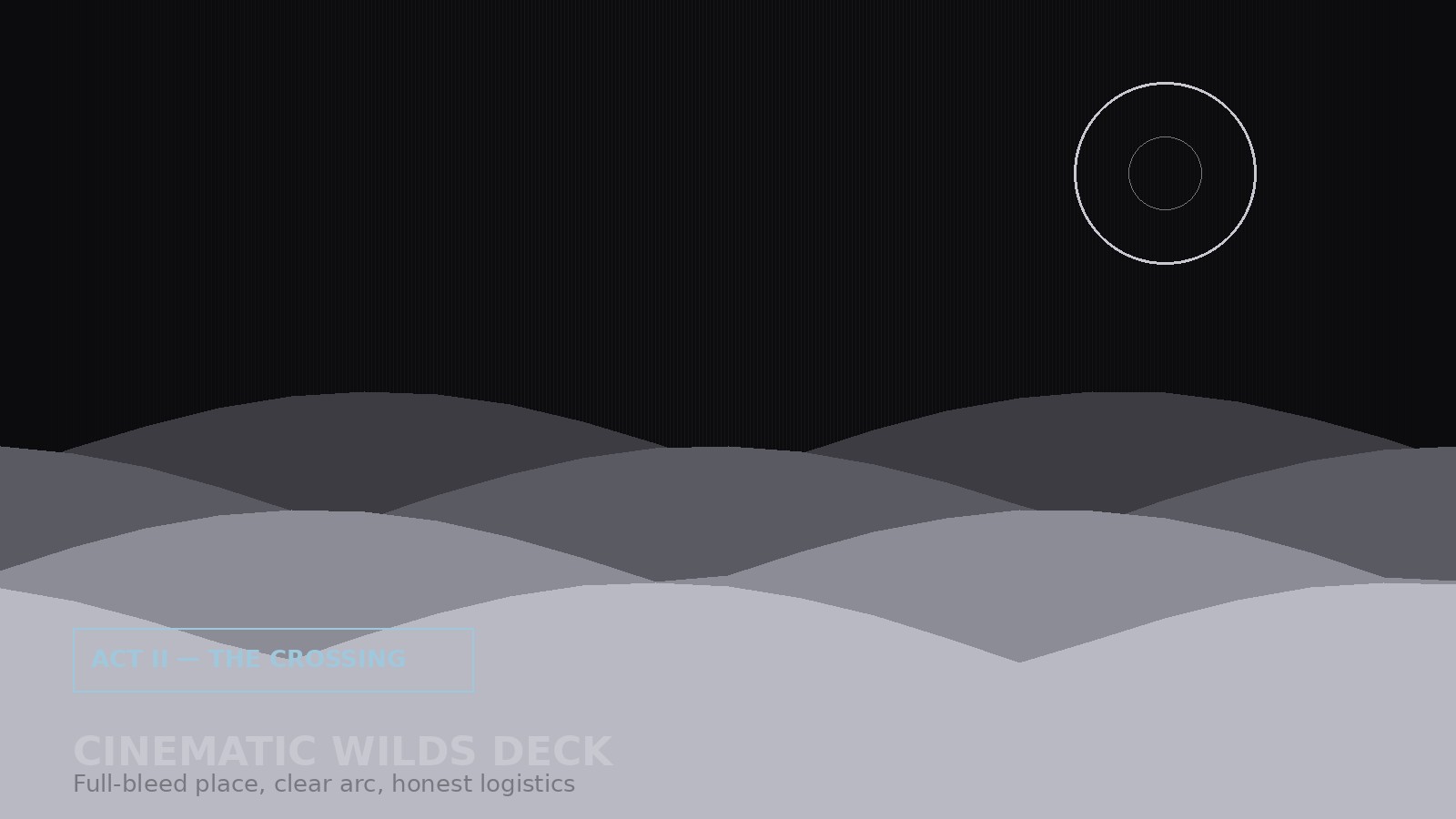
Crea un pitch deck cinematografico per storie di natura selvaggia e paesaggi: immagini a tutto schermo, un arco narrativo chiaro, logistica onesta su accessi, permessi e sicurezza, e didascalie che rendono ogni immagine credibile.
Installala in 3 passaggi
Nessuna registrazione. Nessuno strumento da riga di comando. Scegli la tua AI, copia una riga e incollala.
Preferisci fare da te? Acquista la skill ($4.99), scarica lo ZIP dalla conferma d'acquisto, decomprimilo nella cartella mostrata sopra e riavvia la sessione della tua AI — stesso risultato. L'hai già acquistata? Il tuo assistente AI può scaricarla per te.
Cosa contiene
Un file SKILL.md (la guida operativa) + un modello di partenza. Un'anteprima:
Cinematic Wilds Deck
When to use
- You are pitching a nature documentary, expedition film, or wildlife series and the deck has to make a funder feel the place before they read a word
- Your conservation project needs a deck that shows the landscape at stake, not just the budget line
- You are presenting an outdoor expedition or adventure brand and your current slides look like a gear catalogue
- You need to pitch a wild-location shoot to a client or broadcaster who will ask hard questions about access, safety, and permits
- Your existing deck is all text about nature — and nobody in the room can picture the place
Workflow
- Find the place's story (input: location, subject, and purpose → output: story spine)
Write the deck's spine as one sentence per act: the place as it is, the pressure or question hanging over it, and what the audience will understand by the end. A wild place is not a backdrop — it is the subject. If the spine works with any location swapped in, it is too generic; rewrite it until only this place fits it. - Set the visual system (input: story spine → output: design rules)
Fix the system before laying out slides: full-bleed landscape imagery as the default, one restrained display typeface for headlines, one plain face for body text, and a rule that text never sits on busy detail — it goes on darkened sky, water, shadow, or a solid panel. Pick a restrained accent color drawn from the landscape itself (glacier blue, lichen green, desert ochre) and use it sparingly for labels and the arc thread. - Structure the arc (input: spine + material → output: slide outline)
Order the deck as a journey, not a brochure: open on the place (one image, one line), introduce what lives or happens there, raise the stakes (the threat, the mystery, the expedition's crux), show how you will tell it, then close on what the audience is being asked to do. Aim for 10–14 slides. One idea per slide; let the images carry the emotion and the text carry the facts. - Lay out for the room (input: outline → output: full deck)
Give each spread room to breathe: one dominant image per slide, headlines short enough to read at a glance, and body text limited to what a presenter would actually say in one breath. Put the honest logistics on their own slides — access, season, permits, safety, crew footprint — presented as competence, not fine print. Every image gets a caption: where it was taken, and whether it is your own material or a reference. - Make the forward work (input: full deck → output: send-ready PDF)
Read the deck with no presenter in the room: does the arc still land as a forwarded PDF? Add slide titles that state each slide's point, a one-line arc thread (e.g., "Act II — the crossing") on each slide, and a final slide with the ask and the next step. Export, check it on a phone screen, and fix anything that only worked at presentation size.
Anteprima del modello
Cinematic Wilds Deck — Pitch Template
One place = one deck. The spine must fit only this place — if it works with any location swapped in, rewrite it.
The pitch
Place: {place} | Subject: {subject} | Audience / funder: {who} | The ask: {what you want} Story spine (one sentence per act):
- Act I — the place as it is: {sentence}
- Act II — the pressure or question: {sentence}
- Act III — what the audience will understand: {sentence}
Design system (fixed before layout — follow literally)
Slide outline (10–14 slides, one idea each)
Image log (every image captioned — no exceptions)
Il pacchetto della skill (SKILL.md + modello) è scritto in inglese.
Potrebbe piacerti anche
 Presentazioni
Pitch Deck
10 slide che raccontano una sola storia — gli investitori restano fino all'ultima pagina
 Presentazioni
Work Report
Settimanale, mensile, review — prima la conclusione, si capisce in 3 minuti
 Presentazioni
Academic Argument Deck
Una presentazione che argomenta — e risponde alle obiezioni.