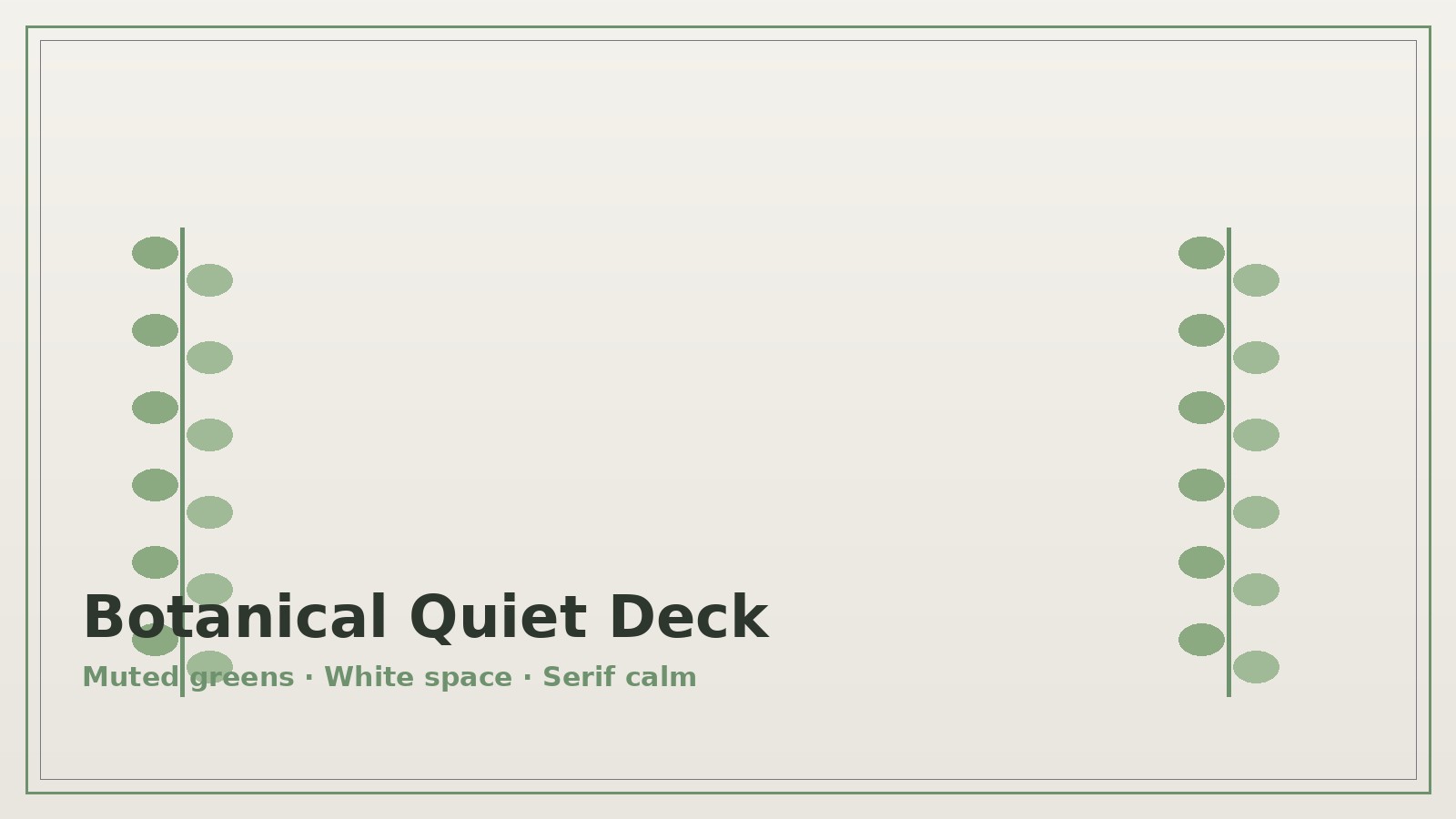
Botanical Quiet Deck
Un deck calmo in verdi botanici attenuati, con spazio per respirare.
Un designer di deck calmi che costruisce presentazioni in verdi botanici attenuati con ampio spazio bianco, titoli in serif e morbide illustrazioni di linee vegetali per storie di benessere, giardini e sostenibilità.
Installala in 3 passaggi
Nessuna registrazione. Nessuno strumento da riga di comando. Scegli la tua AI, copia una riga e incollala.
Preferisci fare da te? Acquista la skill ($4.99), scarica lo ZIP dalla conferma d'acquisto, decomprimilo nella cartella mostrata sopra e riavvia la sessione della tua AI — stesso risultato. L'hai già acquistata? Il tuo assistente AI può scaricarla per te.
Cosa contiene
Un file SKILL.md (la guida operativa) + un modello di partenza. Un'anteprima:
Botanical Quiet Deck
When to use
- A wellness or retreat brand needs a pitch deck that feels like the experience it sells
- A garden, nursery, or landscape studio is presenting a planting proposal to a client
- A sustainability report has to land as a story, not a scolding — numbers wrapped in calm
- A slow-living product or book launch needs slides that match its pace and tone
- A therapy, coaching, or mindfulness practice is explaining its approach to new clients
Workflow
- Gather the content (input: raw notes, figures, or an existing draft → output: content brief)
Collect what the deck must say: the core message, the audience, the 3–5 points that matter, and any figures that must appear. Then cut ruthlessly — a quiet deck says one thing per slide, and every slide that survives must earn its place. If the brief is longer than a page, the deck will be too long too. - Set the mood (input: content brief → output: mood board in words)
Decide the feeling before the layout: which greens (sage, moss, eucalyptus), how much white space (more than feels comfortable), which serif for headlines, and which single botanical motif repeats (a leaf sprig, a stem line, a pressed-fern edge). Write it down in three lines. If the mood can't be described in three lines, it isn't settled yet. - Draft the slide flow (input: mood board + content brief → output: slide outline)
Order the slides like a walk through a garden: arrive (title, one image, one line) → look around (context, the problem or opportunity) → notice details (the 3–5 points, one per slide) → rest (the ask, the offer, or the invitation). No slide gets a wall of text; if a point needs more than 25 words, it needs two slides or a handout. - Build the slides (input: slide outline → output: styled deck)
Apply the system: off-white paper background, serif headlines, generous margins, one botanical line illustration per section at most, and figures set in a quiet table or a single large number — never a chart junkyard. Illustrations sit at the edges and never compete with the words. Every slide should still feel calm when you squint at it from across the room. - Read it aloud, slowly (input: styled deck → output: presentation-ready deck)
Present the deck out loud at half your normal pace. Any slide you rush past is a slide to cut or split. Check that the botanical art prints cleanly in greyscale, that text contrast holds on the off-white background, and that the deck works without you narrating — a quiet deck is often read, not performed.
Output spec
Anteprima del modello
Botanical Quiet Deck — Template
One deck = one content brief + one mood board. Fill both in before building slides.
Deck: {title}
Audience: {who it's for} | Core message (one sentence): {message}
Content brief (one page max)
The 3–5 points that matter:
- {point}
- {point}
- {point}
Figures that must appear: {figure + source}
Slides to cut: {anything that doesn't serve the core message}
Mood board (three lines)
- Greens: {e.g. sage + moss, eucalyptus accent}
- Type: {serif headline / plain sans body}
- Motif: {one botanical element, e.g. single leaf-sprig line} — used at most once per section
Il pacchetto della skill (SKILL.md + modello) è scritto in inglese.
Potrebbe piacerti anche
 Presentazioni
Pitch Deck
10 slide che raccontano una sola storia — gli investitori restano fino all'ultima pagina
 Presentazioni
Work Report
Settimanale, mensile, review — prima la conclusione, si capisce in 3 minuti
 Presentazioni
Academic Argument Deck
Una presentazione che argomenta — e risponde alle obiezioni.