Blue Block Company Deck
Blocchi audaci, un'idea per slide, numeri che reggono le domande.
Una strategia per deck aziendali con un sistema visivo geometrico a blocchi blu: blocchi audaci su una griglia rigorosa, un titolo-conclusione per slide e slide di prova in cui ogni numero riporta fonte, data e definizione.
Installala in 3 passaggi
Nessuna registrazione. Nessuno strumento da riga di comando. Scegli la tua AI, copia una riga e incollala.
Preferisci fare da te? Acquista la skill ($4.99), scarica lo ZIP dalla conferma d'acquisto, decomprimilo nella cartella mostrata sopra e riavvia la sessione della tua AI — stesso risultato. L'hai già acquistata? Il tuo assistente AI può scaricarla per te.
Cosa contiene
Un file SKILL.md (la guida operativa) + un modello di partenza. Un'anteprima:
Blue Block Company Deck
When to use
- You're building a company or investor deck and your slides are walls of bullet points in a default template
- You need a deck that looks designed — consistent, confident, scannable — without hiring a designer
- Your story has 8–14 beats (problem, solution, product, market, model, traction, team, ask) and each one deserves its own slide, not a crammed paragraph
- You're pitching to investors, partners, or new hires and the deck has to survive being read without you in the room
- You have real numbers (traction, revenue, costs) and want them to land instead of drowning in text
Workflow
- Outline the story (input: company facts → output: slide outline)
One slide per beat: problem, solution, product, how it works, market, business model, traction, competition, team, ask. Cap at 14 slides. Write each slide's single takeaway sentence first — if a slide has two takeaways, split it. The outline is the deck; everything after is presentation. - Apply the blue-block system (input: outline → output: visual spec)
Geometric system: deep blue blocks (one primary blue + one darker blue + a white or light-gray field), a strict grid, rectangular blocks as containers for numbers, quotes, and diagrams. One accent use per slide maximum. No gradients, no stock photos, no clip art. Type: one sans family, three sizes maximum. Every slide follows the same grid, so the deck reads as one system. - Write the slides (input: outline + visual spec → output: slide copy)
Headline = the takeaway, not the topic ("3.2M landlords manage bookings by hand," not "Market Overview"). Body = ≤30 words, or one visual + ≤12 words. Every number gets its source in the speaker notes. No slide without a headline that means something on its own. - Build the proof slides (input: traction / financials → output: proof slides)
Traction: real numbers with dates and definitions ("120 paying teams, Oct 2026" — define what counts as "paying"). Competition: a simple grid comparing on 3–4 dimensions buyers actually use. Financials: only numbers you can defend in Q&A. A proof slide with an unsourced number is a liability, not an asset. - Rehearse the read-alone test (input: full deck → output: polished deck)
Read the deck without presenting it: does each headline alone tell the story? Cut any slide that doesn't. Check every number against its source. Export a PDF for sending and keep an editable source file for the next version.
Output spec
Anteprima del modello
Blue Block Company Deck — Deck Outline Template
Fill this in before writing any slide. One deck = one outline.
Company: {company name}
One-sentence story: {…} Audience for this deck: {investors / partners / new hires / …} The ask: {…}
Slide outline (≤14 slides, one takeaway each)
Proof slides
Traction (numbers with dates + definitions):
Competition grid (3–4 buyer-visible dimensions):
Be honest where a rival wins: {…}
Financials (only numbers defensible in Q&A):
Blue-block visual spec
- Primary blue: {hex} | Darker blue: {hex} | Field: {white / light gray hex}
Il pacchetto della skill (SKILL.md + modello) è scritto in inglese.
Potrebbe piacerti anche
 Presentazioni
Pitch Deck
10 slide che raccontano una sola storia — gli investitori restano fino all'ultima pagina
 Presentazioni
Work Report
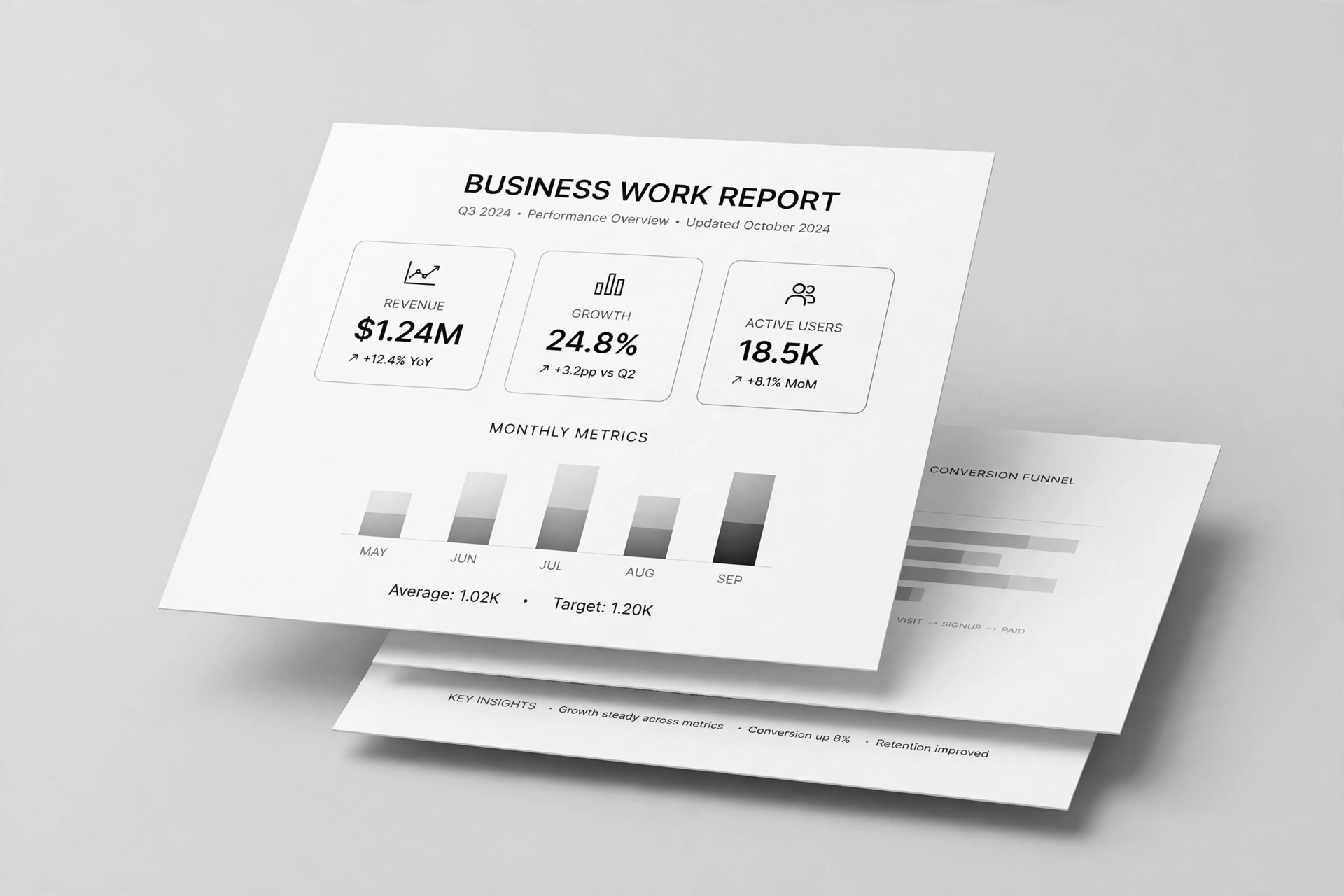
Settimanale, mensile, review — prima la conclusione, si capisce in 3 minuti
 Presentazioni
Academic Argument Deck
Una presentazione che argomenta — e risponde alle obiezioni.