Agent-Economy Stack Mapper
Mappa dove gli agenti toccano la tua attività
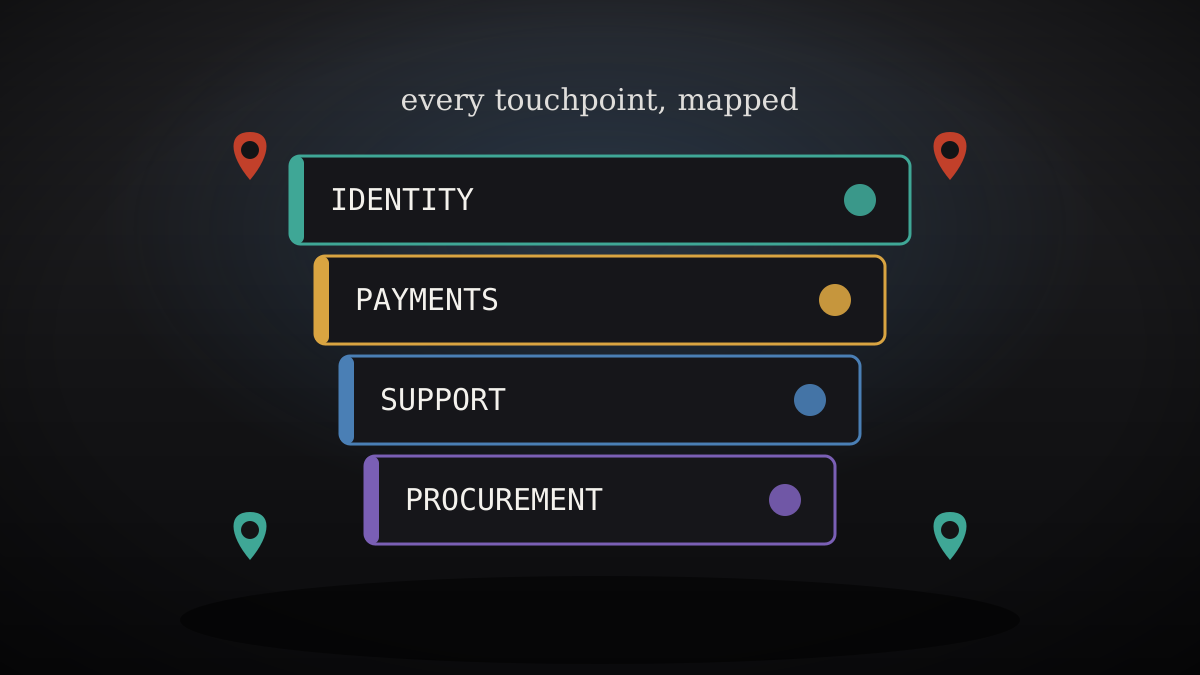
Inventaria ogni punto di contatto in cui gli agenti AI incontrano la tua attività — scoperta, acquisto, supporto, acquisti aziendali — assegna un punteggio di prontezza per gli agenti, abbina l'infrastruttura di fiducia (costruisci/compra/aspetta) e pubblica la tua policy sugli agenti.
Installala in 3 passaggi
Nessuna registrazione. Nessuno strumento da riga di comando. Scegli la tua AI, copia una riga e incollala.
Preferisci fare da te? Acquista la skill ($4.99), scarica lo ZIP dalla conferma d'acquisto, decomprimilo nella cartella mostrata sopra e riavvia la sessione della tua AI — stesso risultato. L'hai già acquistata? Il tuo assistente AI può scaricarla per te.
Cosa contiene
Un file SKILL.md (la guida operativa) + un modello di partenza. Un'anteprima:
Agent-Economy Stack Mapper
When to use
- Customers' agents are already interacting with your business (or will be next quarter) and you have no map of where.
- You're deciding where to invest in agent-readiness: identity, payments, APIs, support.
- Leadership asks "what's our agent strategy" and you want an answer grounded in your actual touchpoints.
- You're a vendor selling into the agent economy and need to speak your buyer's language.
Workflow
- List the touchpoints (input: your business → output: touchpoint inventory)
Walk the customer journey and mark everywhere an agent could act: discovery (agents comparing your product), purchase (agents buying), support (agents filing tickets), procurement (agents negotiating renewals), identity (agents proving humanity), and post-purchase (agents managing subscriptions, returns). Include the touchpoints you don't control — review sites, marketplaces, social — where agents already summarize you. - Classify each touchpoint (input: inventory → output: classified map)
Tag each: who sends the agent (your customer? a third party? you?), what it can do there today (read-only? transact? modify?), and what's at stake (money, data, reputation, legal). The high-stakes transacting touchpoints are your investment priority; the read-only ones are your monitoring priority. - Score agent-readiness (input: classified map → output: readiness scores)
Per touchpoint, score 1–5 on: machine-readable (can an agent parse your offering without a human?), identity-aware (can you tell a verified-human-backed agent from a bot?), transactable (can an agent complete the action with proper authorization?), and observable (do you log agent interactions separately from human ones?). Anything scoring under 3 on identity-aware is where fraud will arrive first. - Match trust infrastructure (input: scores → output: infrastructure plan)
For each priority touchpoint, name the infrastructure: delegated identity proofs (so agents prove a human principal), scoped payment credentials (so agents spend within bounds), structured APIs or agent protocols (so agents don't screen-scrape), and audit trails (so every agent action is attributable). Mark build vs buy vs wait per item — not everything needs building this quarter. - Write the agent policy (input: plan → output: one-page policy)
Your public stance, in plain language: which agents you welcome, what they may do, how they identify themselves, what happens to unverified bots (rate-limited? blocked? served read-only?), and where to get credentials. Publish it — the agent economy rewards the businesses agents can understand. - Set the review cadence (input: everything → output: quarterly review)
Agent capabilities move quarterly; your map must too. Each quarter: re-score readiness, check the fraud signals (bot traffic share, disputed agent orders, support tickets filed by agents), and move one touchpoint up the maturity ladder. The map is a living doc, not a deck.
Anteprima del modello
Agent-Economy Stack Worksheet
Map where agents touch your business — then decide what each touchpoint needs.
1. Touchpoint inventory
2. Classify
Investment priority = high-stakes + transacting. Monitoring priority = read-only.
3. Readiness scores (1–5)
Under 3 on identity-aware = where fraud arrives first.
4. Infrastructure plan
5. One-page agent policy (publish it)
- Which agents you welcome:
- What they may do:
- How they identify themselves:
- Unverified bots get (rate-limited / blocked / read-only):
- Where to get credentials:
6. Quarterly review
- Re-score readiness: date
- Fraud signals (bot traffic share, disputed agent orders, agent-filed tickets):
Il pacchetto della skill (SKILL.md + modello) è scritto in inglese.