Social Media Kit
Eine Posting-Maschine, die Sie auch im sechsten Monat noch betreiben können.
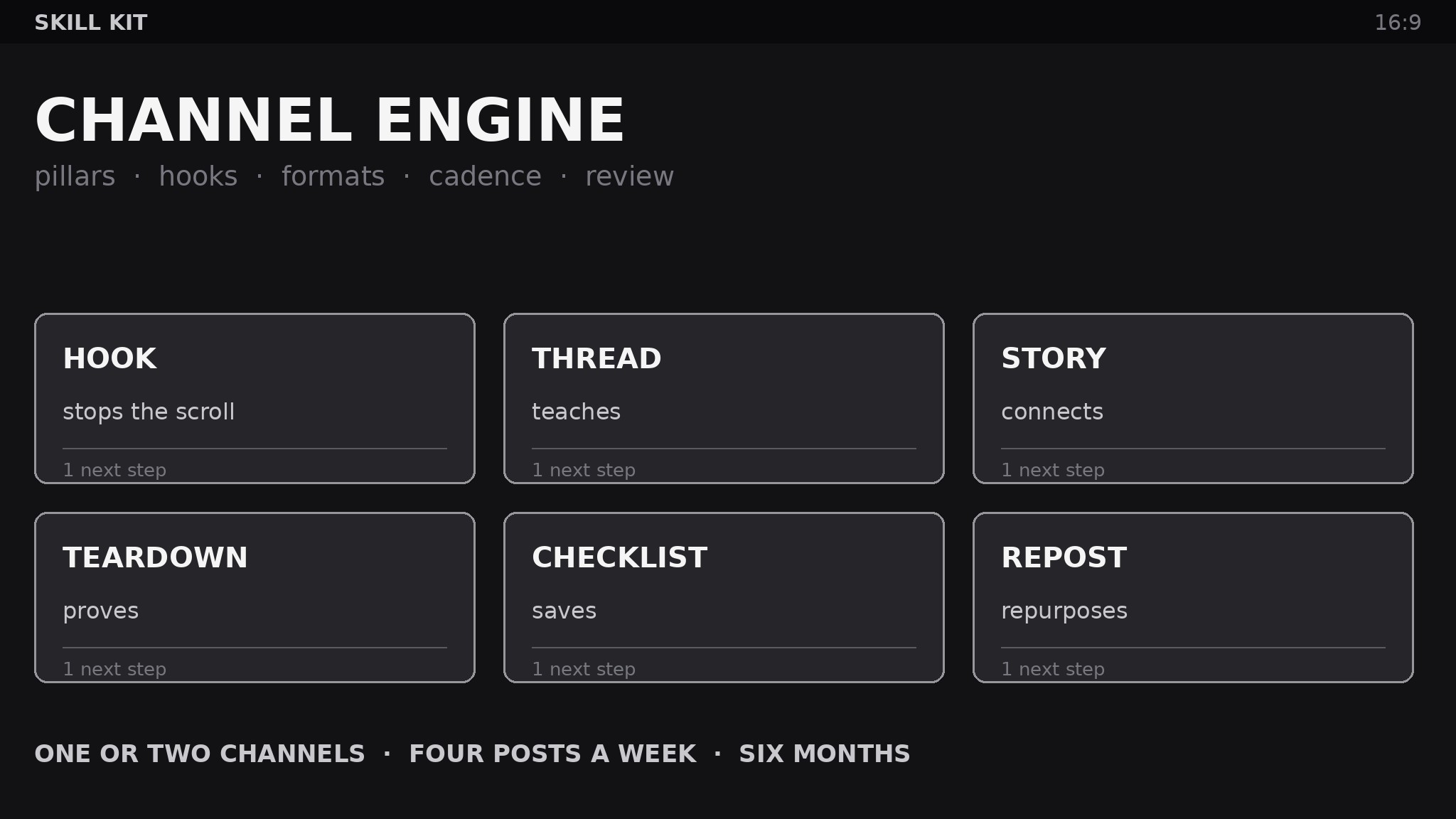
Verwandelt Ihre KI in einen Builder für eine Kanal-Content-Maschine — plant ein nachhaltiges Kit für einen oder zwei Kanäle (Hooks, Formate, Takt, Wiederverwertung, Engagement) und setzt die Latte, die jeder Skill überspringen muss, damit das Posten konstant bleibt, ohne die Person dahinter auszubrennen.
In 3 Schritten installieren
Keine Anmeldung. Keine CLI-Tools. Wählen Sie Ihre AI, kopieren Sie eine Zeile und fügen Sie sie ein.
Lieber selbst machen? Kaufen Sie den Skill ($4.99), laden Sie die ZIP-Datei aus Ihrer Kaufbestätigung herunter, entpacken Sie sie in das oben angezeigte Verzeichnis und starten Sie Ihre AI-Sitzung neu — gleiches Ergebnis. Haben Sie ihn schon gekauft? Ihr AI-Assistent kann ihn für Sie herunterladen.
Was ist enthalten
Eine SKILL.md (die Anleitung) + eine Startvorlage. Eine Vorschau:
Social Media Kit
When to use
- You post in bursts, then go silent for weeks, and the algorithm forgets you exist
- Every post starts from a blank screen and takes an hour you do not have
- You are on five channels, doing all of them badly, instead of one or two done well
- Your posts get polite likes from friends and silence from the audience you actually want
- You want to hand posting to someone else (or to your AI) without the account turning robotic
Workflow
- Scope the kit (input: your audience and capacity → output: kit scope sheet)
Pick one or two channels — the ones where your actual audience already is — and name the honest weekly capacity: how many posts you can sustain for six months, not for one enthusiastic week. The scope sheet also names the audience (who, in one sentence), the account's job (what a follower should get from it), and the three content pillars that every post must hang on. Pillars are the kit's immune system: if a post idea fits none of them, it does not get made. A kit scoped to five channels at daily cadence is a plan for burnout with extra steps. - Inventory the engine skills (input: scope sheet → output: skill inventory)
List the skills the engine needs, one per job: Pillar ideas (turns a pillar into a month of post ideas with angles, not just topics), Hooks (turns an idea into five opening lines in the channel's native shape — first line, first three seconds, first frame), Formats (turns a hook + idea into a finished post in one of the kit's fixed formats: teaching thread, before/after, checklist, story, teardown), Repurpose (turns one strong post into channel-native derivatives without re-creating it), Engagement (turns comments and replies into on-voice responses and follow-up post ideas), Review (turns a month of posts into a keep/stop/start verdict per format and pillar). Fixed formats are the point: deciding the format every time is what makes posting take an hour. - Write the contract for each skill (input: skill inventory → output: per-skill input/output contracts)
For every skill, write the input, the output, and the pass bar. The pass bars are channel-native bars: Hooks — "a stranger scrolling past stops and can say what the post will give them, in under three seconds"; Formats — "every post ends with one clear next step or question, never two"; Repurpose — "each derivative is rewritten for its channel, never copy-pasted (a thread is not a caption)"; Engagement — "replies sound like the account owner on their best day, never like a bot thanking someone for their comment"; Review — "every verdict names the numbers behind it (saves, replies, follows per post), not vibes." A kit with no review skill is a treadmill: it keeps you posting without ever telling you what works. - Build the cadence system (input: contracts → output: kit playbook + calendar template)
Fix the weekly cadence (e.g. two teaching posts, one story, one teardown, one repurposed cut) and the batching rhythm: one session a week to draft, one to schedule, daily five-minute engagement windows. Provide templates: idea card, hook bank, format skeletons, calendar row, monthly review sheet. The calendar is the engine's flywheel — ideas enter at the top, scheduled posts come out the bottom, review findings feed back into next month's ideas. If the kit cannot show a full month at a glance, it is not a system yet. - Run one month and harden (input: playbook → output: hardened kit + fixes log)
Run the kit for a full month at the scoped cadence, then run the Review skill honestly: which formats earned replies and saves, which pillars fell flat, where batching broke down. Cut one format, strengthen one pillar, fix the template that nobody filled in. Log it all. A kit that survives its first honest review is a kit that will survive six months; a kit that never gets reviewed is a kit that slowly becomes posting for its own sake.
Vorschau der Startvorlage
Social Media Kit — Engine Pack
One or two channels, done well. Fixed formats. One month visible at a glance.
1. Kit scope sheet
Channels: {channel 1} | {channel 2} Honest weekly capacity: {posts per week, sustainable for six months} Audience (one sentence): {who} The account's job: {what a follower should get from it} Pillars: 1. {pillar} | 2. {pillar} | 3. {pillar} Rule: a post idea that fits no pillar does not get made.
2. Idea card
Pillar: {pillar} Idea: {one line} Angle: {the specific take, not just the topic} Format: {teaching thread / before-after / checklist / story / teardown}
3. Hook bank (five per idea)
Das Skill-Paket selbst (SKILL.md + Vorlage) ist auf Englisch verfasst.