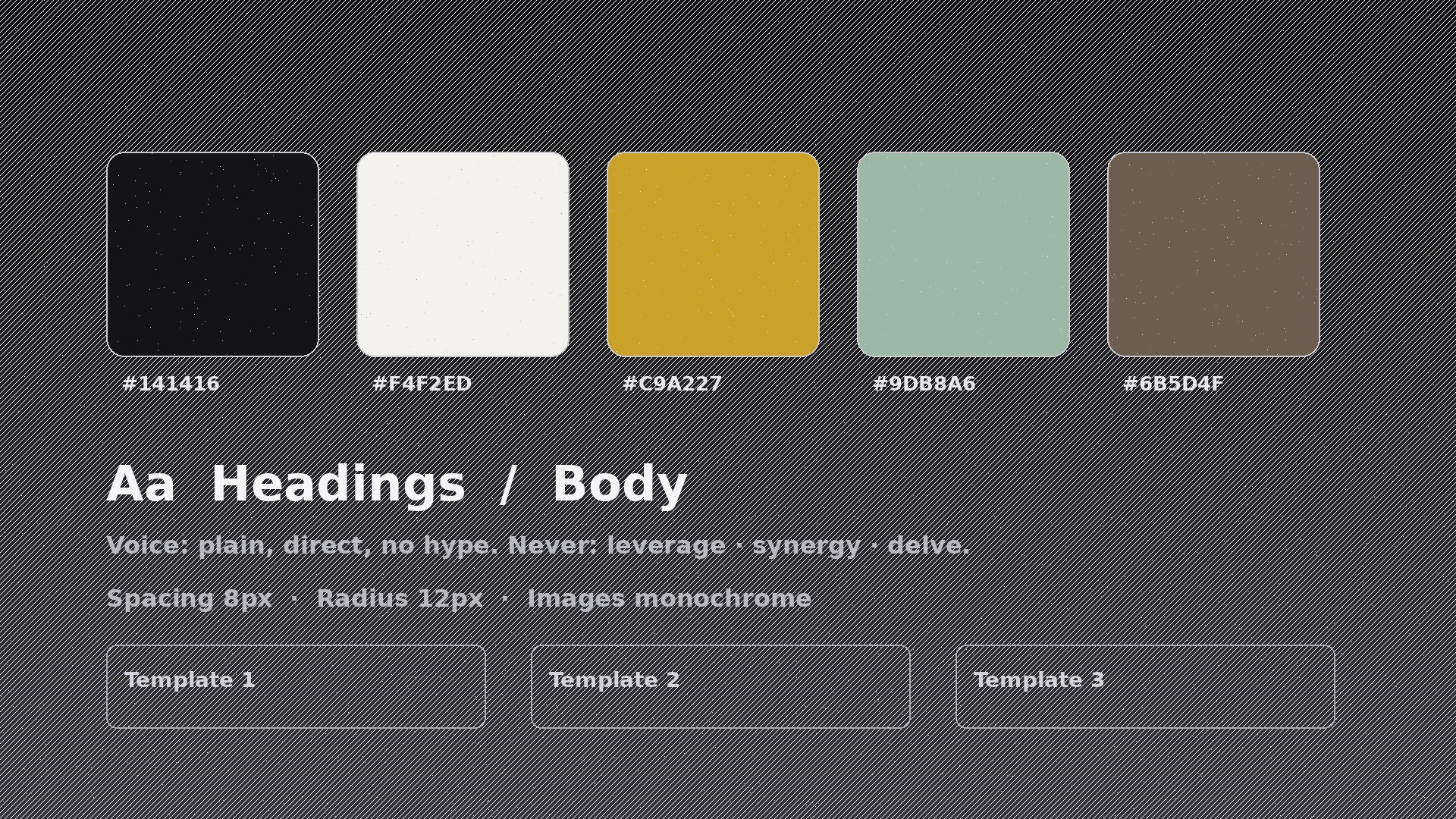
Slides Skills
Der Spannungsbogen ist das Kit — Decks, die irgendwo ankommen.
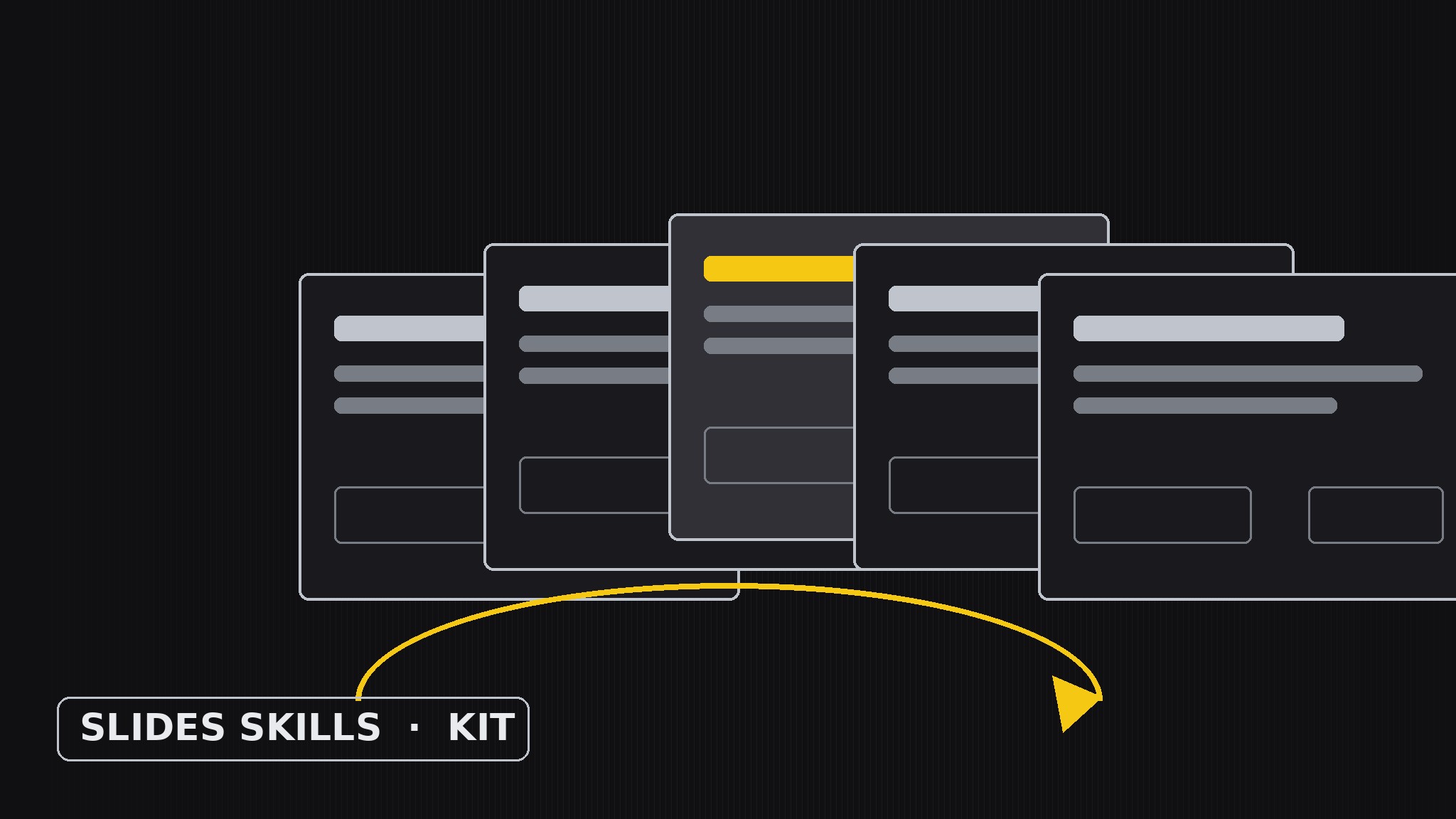
Verwandelt Ihre KI in einen Deck-Kit-Builder — plant, schreibt und fügt ein stimmiges Kit von Deck-Skills zusammen, die echte Präsentationen liefern: ein Skill pro Deck-Typ und Folienmuster (Pitch, Bericht, Editorial, Keynote und mehr), jeder auf demselben Qualitätsniveau, die sich zu Decks mit klarem Bogen von der ersten bis zur letzten Folie zusammensetzen.
In 3 Schritten installieren
Keine Anmeldung. Keine CLI-Tools. Wählen Sie Ihre AI, kopieren Sie eine Zeile und fügen Sie sie ein.
Lieber selbst machen? Kaufen Sie den Skill ($4.99), laden Sie die ZIP-Datei aus Ihrer Kaufbestätigung herunter, entpacken Sie sie in das oben angezeigte Verzeichnis und starten Sie Ihre AI-Sitzung neu — gleiches Ergebnis. Haben Sie ihn schon gekauft? Ihr AI-Assistent kann ihn für Sie herunterladen.
Was ist enthalten
Eine SKILL.md (die Anleitung) + eine Startvorlage. Eine Vorschau:
Slides Skills
When to use
- You need several decks (pitch, report, keynote) and want them to feel like one organization's voice
- A team keeps rebuilding decks from a blank file, with every deck inventing its own structure
- You want a reusable kit: pick the deck type, assemble its arc from proven slide patterns, ship
- A talk, board report, or editorial presentation needs a clear arc, not just good-looking slides
- You are standardizing how your AI builds decks so every deck has one idea per slide and a real ending
Workflow
- Define the deck jobs (input: the talks and meetings on your calendar → output: kit brief)
Start audience-and-occasion-first: list the real decks this kit must produce and, for each, name the audience, the occasion, and the one outcome ("investors decide to take a meeting", "the board approves the budget", "the audience repeats the idea tomorrow"). Build the kit brief around those occasions — a pitch deck and a board report are different jobs and need different arcs, even if they share slide patterns. A kit with no named occasions drifts into generic templates; a kit built for three real occasions gets used on the fourth. - Inventory the skills (input: kit brief → output: deck inventory)
Give the kit two layers. Deck-type skills, one per occasion: Pitch (problem → solution → proof → ask), Report (question → evidence → recommendation), Editorial (story → tension → resolution), Keynote (hook → turns → takeaway), Workshop (concept → exercise → debrief). Then slide-pattern skills, the reusable building blocks every deck type draws on: Claim Slide (one sentence, one visual), Comparison (two options, one verdict), Evidence (one chart, one reading), Quote (one voice, large type), Agenda (the arc, in advance), and Closer (the ask, repeated). Keep the inventory small — if a pattern appears in only one deck, it may not deserve a skill. - Write each skill to the bar (input: deck inventory → output: skill specs)
Every skill gets the same spec shape: when to use it, its inputs (the content it needs — e.g. Pitch needs the problem, the solution, the proof, and the ask), its output (the deck or the slide, ready to present), and the shared quality bar. The bar is arc-honest: one idea per slide, headlines written as full-sentence claims (not labels), every deck has an arc with a beginning, a turn, and an ending, no slide survives if removing it changes nothing, and numbers are always sourced. Write the specs so a new deck type can join the kit by reusing the slide patterns, not by reinventing them. - Compose a deck (input: skill specs + deck brief → output: assembled deck)
Assemble by arc, not by template: pick the deck type for the occasion, lay out its arc in headlines alone (read them in order — they must tell the whole argument with the slides closed), then fill each beat with the right slide pattern — Claim for the turns, Evidence for the proof, Comparison for the decision, Closer for the ask. Enforce the kit's shared type, spacing, and accent rules across every slide so the deck reads as one voice. Cut ruthlessly: a deck that is two slides shorter and still makes its argument is a better deck. - Rehearse-check the kit (input: assembled deck → output: proven kit)
Prove the kit by rehearsing one real deck aloud, timed: does the arc land in the time allowed? Does every headline survive being spoken? Does the audience know what to do at the end? Note what broke — a deck type whose arc didn't fit the occasion, a pattern whose inputs were unclear, a slide that only works if the presenter explains it — and fix the kit, not just the deck. The kit is done when a second deck assembles faster than the first and a stranger can follow its arc without a presenter in the room.
Vorschau der Startvorlage
Slides Skills — Kit-Building Template
The arc is the kit. Headlines alone must tell the argument.
Kit brief — decks this kit must produce
Deck inventory
Deck-type skills (one per occasion):
Slide-pattern skills (reusable blocks):
Skill spec (copy per skill)
Skill: {name} When to use: {___} Inputs: {___} Output: {the deck / the slide, ready to present} Quality bar: one idea per slide / headlines as full-sentence claims / real arc (beginning, turn, ending) / no passengers / numbers always sourced
Deck assembly
Deck: {name + type} Headline arc (read alone — tells the whole argument?):
- {claim headline}
- {claim headline}
Das Skill-Paket selbst (SKILL.md + Vorlage) ist auf Englisch verfasst.