Content Publishing Kit
Eine Publishing-Pipeline, die pünktlich liefert, jedes Mal.
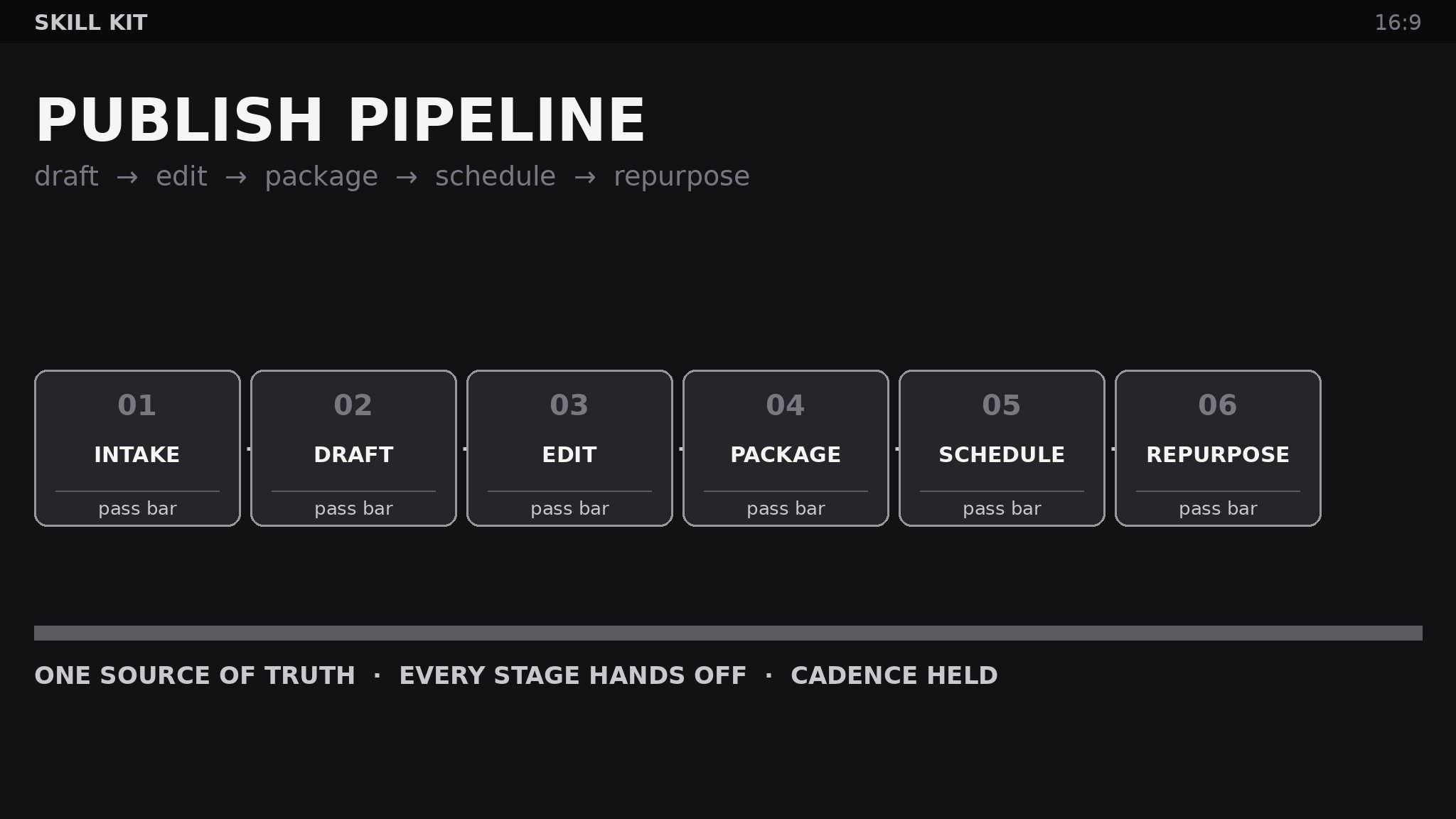
Verwandelt Ihre KI in einen Publishing-Kit-Builder — plant eine wiederholbare Publishing-Pipeline für Ihre Kanäle, fügt das Kit von Skills zusammen, das sie braucht (Entwurf, Redaktion, Verpackung, Planung, Wiederverwertung), und setzt die Qualitätslatte, die jeder Skill überspringen muss, damit jeder Post pünktlich und in Ihrer Stimme erscheint.
In 3 Schritten installieren
Keine Anmeldung. Keine CLI-Tools. Wählen Sie Ihre AI, kopieren Sie eine Zeile und fügen Sie sie ein.
Lieber selbst machen? Kaufen Sie den Skill ($4.99), laden Sie die ZIP-Datei aus Ihrer Kaufbestätigung herunter, entpacken Sie sie in das oben angezeigte Verzeichnis und starten Sie Ihre AI-Sitzung neu — gleiches Ergebnis. Haben Sie ihn schon gekauft? Ihr AI-Assistent kann ihn für Sie herunterladen.
Was ist enthalten
Eine SKILL.md (die Anleitung) + eine Startvorlage. Eine Vorschau:
Content Publishing Kit
When to use
- You publish regularly but every post feels rebuilt from scratch — new doc, new checklist, new decisions
- Your content lives in five tools and nobody can say what the next post is, who owns it, or when it ships
- You want to hand publishing to someone else (or to your AI) without quality collapsing
- You already have drafts piling up but no pipeline that turns them into scheduled, packaged posts
- Your posts go out inconsistently — bursts, then silence — because there is no cadence, only good intentions
Workflow
- Scope the kit (input: your channels and cadence → output: kit scope sheet)
Name the channels the kit covers (blog, newsletter, one social channel — not all of them), the publishing cadence each channel must hold (e.g. blog weekly, newsletter biweekly), and who does what: who drafts, who edits, who approves, who hits publish. A kit with no named owner per stage is a wish list. The scope sheet also fixes the voice rules in one paragraph: who you write for, what you never say, and the sentence length you default to. Everything downstream is judged against this sheet. - Inventory the pipeline skills (input: scope sheet → output: skill inventory)
List the skills the pipeline needs, one per stage, and no more: Idea intake (turns raw notes into a pitched idea with an angle), Draft (turns a pitch into a structured first draft), Edit (turns a draft into a publishable piece against the voice rules), Package (turns a finished piece into title, thumbnail or hero image brief, meta description, and tags), Schedule (turns packaged pieces into a dated calendar with owners and deadlines), Repurpose (turns one published piece into channel-native derivatives). If a stage has no skill, the pipeline stops there — that is usually why publishing stalls. - Write the contract for each skill (input: skill inventory → output: per-skill input/output contracts)
For every skill in the inventory, write three lines: what it takes in (exact input, e.g. "pitch + source notes + voice rules"), what it hands over (exact output, e.g. "800–1200 word draft with headline options and pull quotes marked"), and its pass bar (e.g. "no sentence over 25 words without a reason, every claim traceable to a source note"). A skill without a pass bar cannot be judged, so it cannot be trusted. This is the step most kits skip, and the reason most kits rot. - Build the pipeline document (input: contracts → output: pipeline doc + template pack)
Assemble one document that runs the whole pipeline end to end: the stage order, the handoff format between stages, the template for each stage (idea card, draft skeleton, edit checklist, packaging sheet, calendar row, repurpose map), and the single source of truth — one folder or doc where the canonical version of each piece lives. The pipeline doc is what a new person (or a new AI session) reads to run publishing without asking you anything. - Run one full cycle and harden (input: pipeline doc → output: hardened kit + fixes log)
Push one real piece through every stage, timed, and log every place the pipeline broke: a template field nobody filled in, a handoff that lost information, an edit pass that took twice as long as budgeted. Fix the templates and contracts, not the people. A kit is only real after one full cycle — before that it is a plan. Schedule a monthly kit review: retire stages nobody uses, tighten the pass bars that let weak pieces through.
Vorschau der Startvorlage
Content Publishing Kit — Pipeline Pack
One kit, one pipeline. Fill in the scope sheet once; every piece then runs through the same stages.
1. Kit scope sheet
Channels covered: {channel 1 + cadence} | {channel 2 + cadence} Owners: Draft: {name} | Edit: {name} | Approve: {name} | Publish: {name} Voice rules (one paragraph): {who you write for, what you never say, default sentence length} Single source of truth: {folder / doc link where canonical versions live}
2. Idea card
Idea: {one line} Angle: {what makes this piece different from the obvious take} Pillar / channel: {pillar} | {channel} Source notes: {links, quotes, data the draft may use}
Das Skill-Paket selbst (SKILL.md + Vorlage) ist auf Englisch verfasst.