Client Reporting Kit
Jeder Bericht endet in einer Entscheidung, nicht in einem Schulterzucken.
Verwandelt Ihre KI in einen Client-Report-Kit-Builder — plant ein Reporting-Kit rund um Kennzahlen, auf die sich Ihr Kunde tatsächlich geeinigt hat, fügt die Skills zusammen, die es braucht (Kennzahlen-Snapshot, Erzählung, Deck, nächste Schritte, Lieferung), und setzt die Latte, die jeder überspringen muss, damit jeder Bericht in einer Entscheidung endet, nicht in einem Schulterzucken.
In 3 Schritten installieren
Keine Anmeldung. Keine CLI-Tools. Wählen Sie Ihre AI, kopieren Sie eine Zeile und fügen Sie sie ein.
Lieber selbst machen? Kaufen Sie den Skill ($4.99), laden Sie die ZIP-Datei aus Ihrer Kaufbestätigung herunter, entpacken Sie sie in das oben angezeigte Verzeichnis und starten Sie Ihre AI-Sitzung neu — gleiches Ergebnis. Haben Sie ihn schon gekauft? Ihr AI-Assistent kann ihn für Sie herunterladen.
Was ist enthalten
Eine SKILL.md (die Anleitung) + eine Startvorlage. Eine Vorschau:
Client Reporting Kit
When to use
- Your client reports take a day to build and get a "thanks!" — no decision, no reply, no action
- Every report is rebuilt from scratch because there is no template, no agreed metrics, no standard
- You dread reporting week because it means re-deciding what to show, how to show it, and what it means
- Your reports are full of charts the client never asked for and short on the one number they care about
- You want a kit that turns reporting from a monthly scramble into a repeatable, decision-producing routine
Workflow
- Scope the kit (input: client, contract, goals → output: kit scope sheet)
Agree the metrics before the first report is ever built: three to five numbers, each tied to a goal the client named, each with an owner and a definition nobody can argue about ("qualified leads = form submissions from the contact page, excluding internal test entries"). The scope sheet also names the report's cadence (weekly, monthly), its reader (the one person whose decision it must inform), and its job in one sentence: "this report tells the client what happened, what it means, and what we do next." A report whose metrics were never agreed is a report that gets argued about instead of acted on. - Inventory the reporting skills (input: scope sheet → output: skill inventory)
List the skills the kit needs, one per reporting job: Metrics snapshot (turns raw data into the agreed numbers, each with its definition, its period, and its comparison — last period and same period last year where it means something), Narrative (turns the numbers into plain-language story: what moved, why it moved, what did not move and why that is fine), Deck (turns narrative + numbers into a readable report: one idea per page, every chart labeled with its takeaway), Next steps (turns the narrative into two to four proposed actions, each with an owner, a cost, and an expected effect), Appendix (turns everything else into an appendix — raw tables, method notes, definitions — so the main report stays short without hiding anything), Delivery (turns the finished report into the send: a short email with the headline, the decision needed, and the deadline for it). If the kit has no next-steps skill, the report is a history lesson: interesting, then filed. - Write the contract for each skill (input: skill inventory → output: per-skill input/output contracts)
For every skill, write the input, the output, and the pass bar. The pass bars are decision bars: Metrics snapshot — "every number carries its definition, its period, and its comparison; no number appears without all three"; Narrative — "a non-expert client can explain what happened after one read, without calling you"; Deck — "every chart's takeaway is written on the chart itself — a chart that needs you in the room to explain it is a failed chart"; Next steps — "every action names an owner, a cost, and what happens if we do nothing; no action is 'monitor' or 'keep an eye on'"; Appendix — "anything a skeptical reader would ask for is findable in under a minute"; Delivery — "the email asks for exactly one decision, with a deadline." - Build the report template (input: contracts → output: kit playbook + report template)
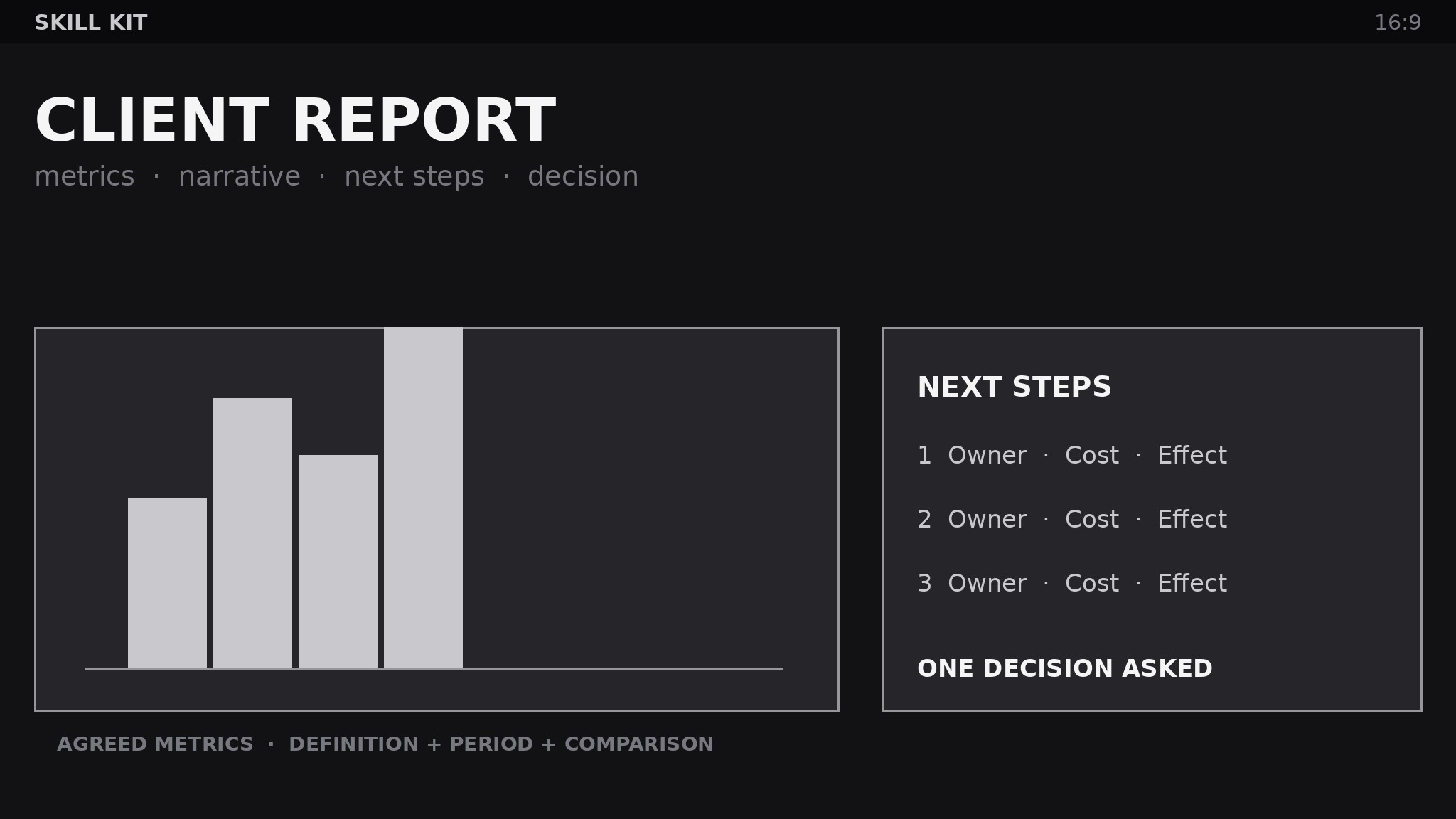
Assemble one template that runs the whole report: cover (headline result + decision needed), snapshot (the agreed metrics, one table), narrative (what moved, why, what did not), next steps (actions with owners and costs), appendix (raw data, definitions, method). Fix the length ceiling (e.g. six pages plus appendix) — a report that can grow without limit will grow without limit. Provide the skeleton with real placeholder content so the first report starts from a shape, not a blank page. - Run one real report and harden (input: playbook → output: hardened kit + fixes log)
Produce the first report with the kit, send it, and log what actually happened: did the client decide, what did they ask that the report did not answer, which section did they skip, which chart confused them. Fix the template and the contracts, not the client. A kit is only real after one report has produced (or failed to produce) a decision. Review the agreed metrics every quarter — goals move, and a report measuring last quarter's goals is a report about someone else's business.
Vorschau der Startvorlage
Client Reporting Kit — Report Pack
One report, one decision. Metrics agreed before the first number is ever pulled.
1. Kit scope sheet
Client: {name} | Reader (one person whose decision this informs): {name, role} Cadence: {weekly / monthly} | Length ceiling: {e.g. 6 pages + appendix} The report's job (one sentence): This report tells the client what happened, what it means, and what we do next.
Agreed metrics (3–5, each with definition + owner):
2. Metrics snapshot
Rule: no number appears without its definition, its period, and its comparison.
3. Narrative
What moved: {what changed + why} Why it moved: {cause, stated plainly}
Das Skill-Paket selbst (SKILL.md + Vorlage) ist auf Englisch verfasst.