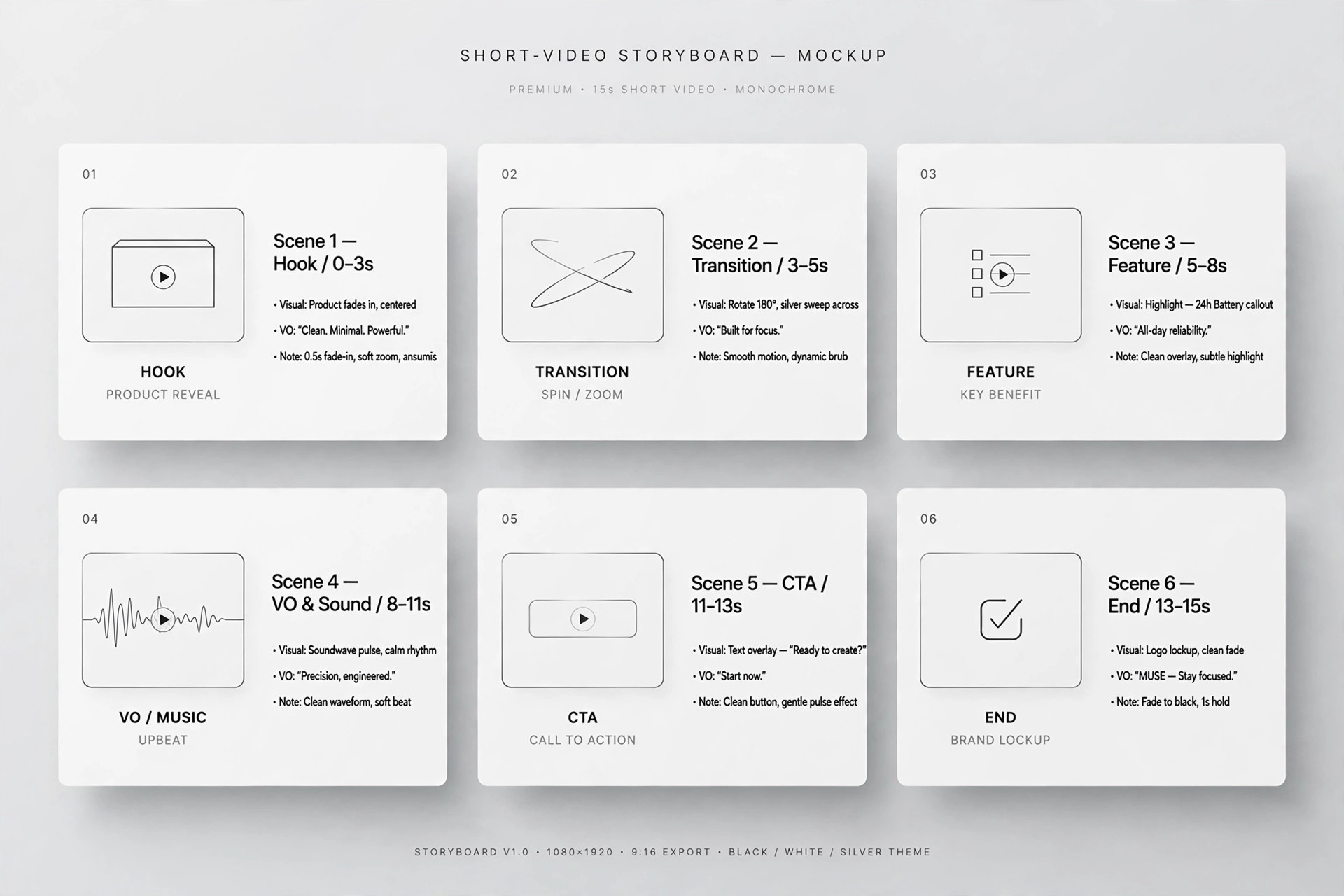
Wording Choice
2つの表現が対決——弱い方に取り消し線が入り、強い方が確定します。
コピーの判断を横並びの対決として演出します。両案は対等に始まり、敗者に取り消し線が入り、勝者が確定し、一行の理由がその仕組みを名付けます。ペアの選定、判定のタイミング、理由行、ペアを連ねてレッスンにする方法をカバーします。
3ステップでインストール
登録不要。CLIツールも不要です。お使いのAIを選んで、1行コピーして貼るだけです。
ご自分で入れたい場合は、スキルを購入($4.99)し、購入完了画面からZIPをダウンロードして、上のディレクトリに展開し、AIのセッションを再起動してください。結果は同じです。すでに購入済みの場合は、AIアシスタントにダウンロードしてもらうこともできます。
パックの内容
SKILL.md(手順書)1点とスターターテンプレート1点が入っています。プレビューはこちらです:
Wording Choice
When to use
- Your video teaches writing, naming, messaging, or communication, and the lesson lives in the difference between two phrasings
- You are deciding a headline, a button label, a title, or a slogan on camera and want the audience to see the reasoning, not just the verdict
- A script review, a copy teardown, or a brand-naming session needs a visual language for "this one, not that one"
- The difference between two options is subtle — one word, one verb, one framing — and spoken explanation alone would blur it
- You want a repeatable comparison beat: the same side-by-side duel can run through a whole video, one pair at a time
Workflow
- Find the real pairs (input: draft copy / script → output: 3–7 wording pairs)
Pull genuine alternatives from the actual draft — pairs you really debated, not straw men you invented to knock down. Each pair must differ in exactly one decision: one verb ("Get" vs "Unlock"), one framing ("Save time" vs "Stop wasting time"), one specificity ("Better results" vs "12% more signups"), one audience ("For teams" vs "For solo founders"). If a pair differs in three ways at once, split it into three pairs or the audience cannot tell which change mattered. Aim for 3–7 pairs per video: fewer than 3 is not a pattern, more than 7 turns the video into a list. For each pair, write the one-sentence reason the winner wins — not "it sounds better", but the mechanism: "specific number beats vague promise", "active verb beats passive noun", "the reader's word beats the company's word". - Stage the duel (input: wording pairs → output: side-by-side layout)
Lay the two options out as a duel, not a list: Option A on the left, Option B on the right, same typeface, same size (6–8% of frame height), same neutral color at the start, separated by a thin divider or a "VS" marker. Keep each option to 1–6 words — longer lines wrap, break the symmetry, and turn the duel into a paragraph comparison. Both options start equal: no color, no size advantage, no hint which one wins. The audience should feel the tension of a fair fight for the first beat. If the options are different lengths, center each in its own half so the layout stays balanced — never let the longer option look more important just because it takes up more space. - Run the verdict (input: staged pair → output: timed verdict animation)
Give the audience 1.5–2.5 s to read both options and form their own opinion before the verdict — the pause is what makes the reveal satisfying. Then run the verdict in three beats: (a) the losing option gets crossed out over 0.4–0.6 s — a hand-drawn strike line that draws left to right, with a soft scratch sound, and the text dims to 35–45% opacity; (b) a 0.3 s beat of silence where the loser sits crossed out; (c) the winner locks in — it brightens to full, scales 100% → 104% and back over 0.3 s, and gains the accent color, with a clean click or chime sound. The strike line must visibly draw across the loser: a line that fades in reads as a formatting change, a line that draws reads as a judgment. Never reverse the order — a winner announced before the loser is crossed out feels rigged, because the audience never got to compare. - Show the reason (input: verdict → output: one-line reason under the winner)
The verdict without the reason is just taste; the reason is the lesson. After the winner locks in, fade in the one-sentence reason under it (0.4 s fade, 3–4% frame height, muted color): "Specific number beats vague promise." The reason must name the mechanism, not restate the winner — "Unlock is stronger than Get" teaches nothing, "Active verb beats vague verb" teaches a rule the viewer can reuse. Hold the full state — crossed-out loser, locked-in winner, reason line — for 2–3 s so the viewer can absorb the rule. If the video is a lesson, consider a 0.5 s "rule card" beat where the reason line alone grows slightly (100% → 105%) to mark it as the takeaway before moving on. - Chain the pairs into a lesson (input: judged pairs → output: full comparison sequence)
Run the pairs in a deliberate order: start with the clearest, most obvious win (builds the audience's confidence in the game), put the subtlest or most surprising pair in the middle (the peak of attention), and end with the pair that matters most to the video's conclusion. Keep the exact same staging, timing, and sounds for every pair — the audience learns the format once and then spends every round on the words, not the packaging. Between pairs, clear the stage completely for 0.3–0.5 s (fade to neutral) so the next pair starts fresh; carrying the previous winner into the next duel muddies both. At the end, show a 2–3 s recap: all winners stacked in a single list, no losers, no reasons — the video's final copy, assembled from its own verdicts, as a proof that the process produced something.
テンプレートのプレビュー
Wording Choice — Build Template
One decision per duel. Fill in the pairs from the real draft before staging anything.
Video: {title} | Pairs: {3–7}
Pairs (each differs in EXACTLY ONE decision)
Straw-man check: every pair is a real alternative debated in the draft? [ ] Order: {clearest win first → subtlest in the middle → most important last}
Staging (identical for every pair)
Layout: {side by side / stacked for vertical} | Divider: {thin line / VS marker} Typeface: {one family} | Size: {6–8% of frame height} | Start color: {same neutral for both} Option length: {1–6 words each} | Halves balanced: [ ] (center each in its half)
スキルパック本体(SKILL.md とテンプレート)は英語で書かれています。