AI Services Market › スキルファクトリー › ワークフロー › Resume Screener
$4.99 · サインイン不要v1.0.0– 回表示
Resume Screener
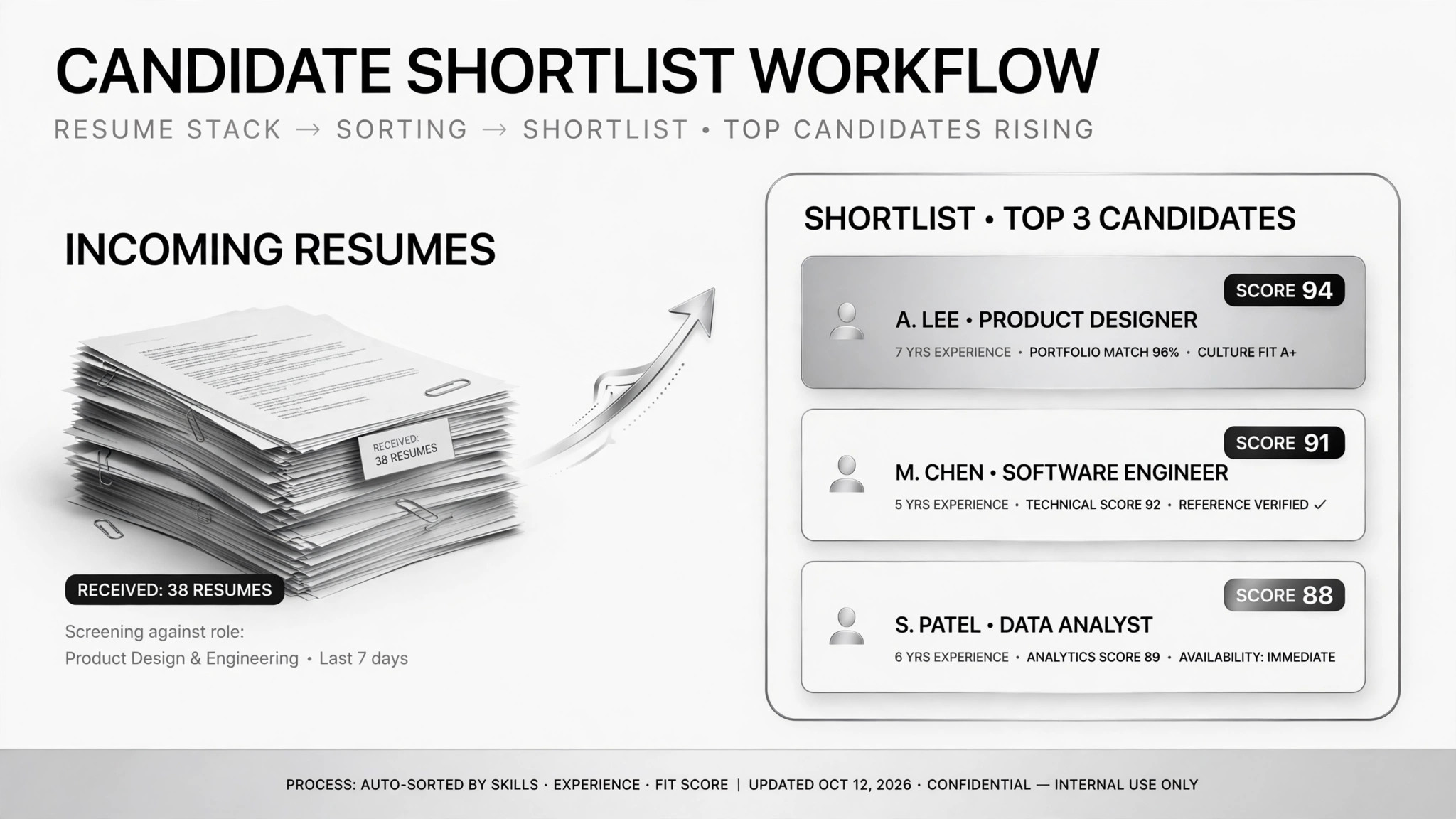
履歴書を入れるだけ——順位付きのショートリストが返ってきます
履歴書の山を入れると、スコア付きの理由とともに順位付けされたショートリストが返ってきます。あなたが読むのは最終候補だけ、最終的な採用判断もあなたが行います。
こんな方におすすめ
採用マネージャー、リクルーター
所要時間
1バッチあたり約20分
レベル
初心者向け
3ステップでインストール
登録不要。CLIツールも不要です。お使いのAIを選んで、1行コピーして貼るだけです。
ご自分で入れたい場合は、スキルを購入($4.99)し、購入完了画面からZIPをダウンロードして、上のディレクトリに展開し、AIのセッションを再起動してください。結果は同じです。すでに購入済みの場合は、AIアシスタントにダウンロードしてもらうこともできます。
実際の活用事例
実際のユーザーがAIエージェントで、まさにこの仕事をやり遂げた事例です。
活用事例
Screen candidates and summarize resumes with AI
事例を読む →活用事例Screen job applications and summarize in a digest
事例を読む →活用事例Screen 115 job candidates with parallel agents
事例を読む →パックの内容
SKILL.md(手順書)1点とスターターテンプレート1点が入っています。プレビューはこちらです:
Resume Screener
When to use
- You have 50+ applications for one role and no time to read them all
- You need a consistent, written scoring rubric applied to every candidate equally
- Hiring runs on a schedule and you want a digest of new applicants each cycle
- You want public evidence (GitHub, portfolios, published work) checked against resume claims
- Your team needs a defensible shortlist with reasons attached to each name
Workflow
- Write the rubric (input: job description → output: scoring rubric)
Turn the job description into must-have and nice-to-have criteria with weights — e.g. "5+ years backend: required; fintech experience: nice-to-have." This is the most important step: a sloppy rubric produces a sloppy shortlist. Include how borderline cases should be flagged, not just how winners score. - Collect the pile (input: applications → output: resume set)
Gather all resumes into one place: a folder, an inbox, or a scheduled pull from your ATS. One candidate, one file or record — name them consistently so nothing gets lost or double-counted. - Score every candidate (input: rubric + resume set → output: scored candidates)
Parse each resume for name, years of experience, and key skills, then score it against your rubric. Where public evidence exists (GitHub, portfolio, writing), check the claims against it — a resume line with evidence behind it scores higher than one without. Every score carries a one-line reason. - Challenge the top (input: scored candidates → output: defended ranking)
Before finalizing, pressure-test the top of the list: have a second pass argue against the highest scores. Is the evidence real, or is the resume just well-written? Force a real score distribution so "everyone looks good" can't happen. This step is what separates a ranking from a rubber stamp. - Flag the uncertain (input: ranked list → output: shortlist + flags)
Deliver a ranked shortlist where every candidate has a score and a reason. Borderline cases get explicit flags — "strong portfolio, but only 3 years experience vs. required 5" — so you can decide whether the rule bends. Nothing ambiguous gets silently dropped or silently promoted. - You decide (input: shortlist → output: interview list)
You review the shortlist and make the interview call. The AI never contacts candidates directly — interview invites and rejection notes get your approval first. Final hiring decisions stay with humans, always.
Output spec
テンプレートのプレビュー
Resume Screener — Rubric & Shortlist Template
Write the rubric before reading a single resume. The rubric decides the shortlist, not your mood on page 60.
Job: {title} — {date}
Scoring rubric
Borderline rule: {e.g. strong portfolio can bend the years requirement — flag, don't drop}
Scored candidates
Ranked shortlist
Flagged (borderline) — decided by me, not the machine
- {name} — {score}: {why uncertain, e.g. "strong portfolio but 3 yrs vs. 5 required — decide if the bar bends"}
Interview list
- {name} — {reason invited}
- {name} — {reason invited}
Checklist — before the shortlist ships
スキルパック本体(SKILL.md とテンプレート)は英語で書かれています。