AI Services Market › スキルファクトリー › ワークフロー › Investigative Dossier
$4.99 · サインイン不要v1.0.0– 回表示
Investigative Dossier
公開された断片から全体像を組み立てます。
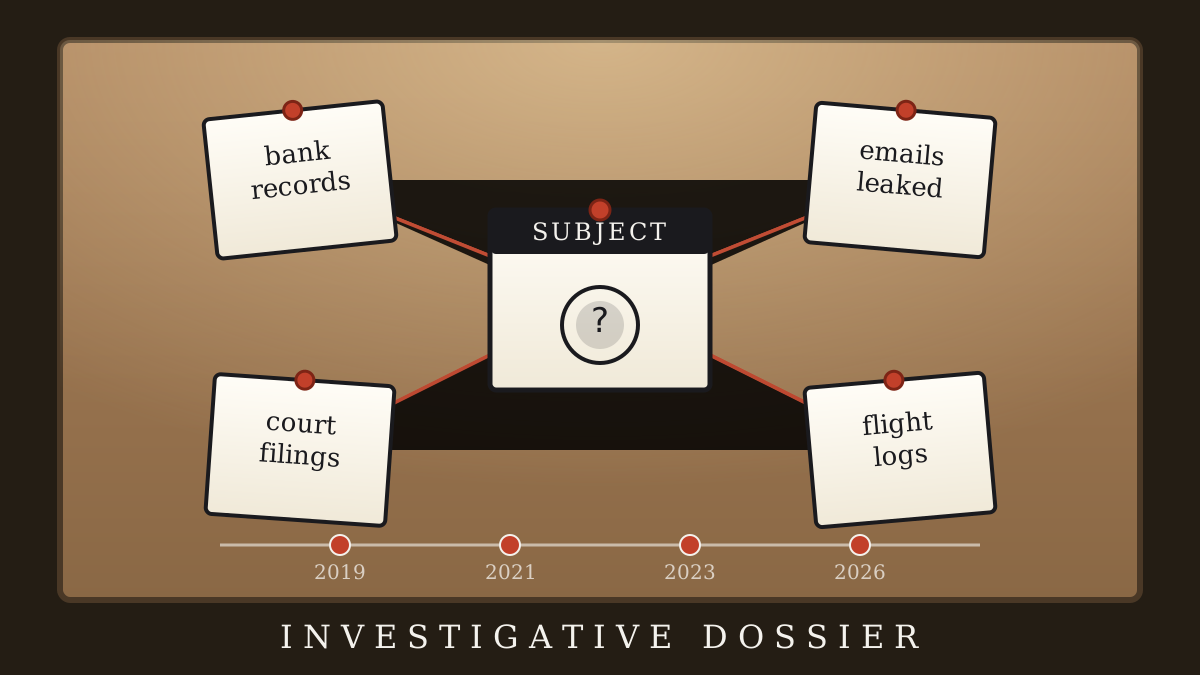
公開情報から調査ドシエを構築します。OSINTの収集、タイムラインの構築、情報源の三角測量、お金の流れの追跡を行い、倫理的なガードレール(公開情報のみ、ハッキングなし)を備えます。ジャーナリスト、研究者、デューデリジェンスアナリストのためのものです。
こんな方におすすめ
ジャーナリスト、研究者、アナリスト、強烈な好奇心を持つ方
所要時間
ドシエごとに約1時間
レベル
上級
3ステップでインストール
登録不要。CLIツールも不要です。お使いのAIを選んで、1行コピーして貼るだけです。
ご自分で入れたい場合は、スキルを購入($4.99)し、購入完了画面からZIPをダウンロードして、上のディレクトリに展開し、AIのセッションを再起動してください。結果は同じです。すでに購入済みの場合は、AIアシスタントにダウンロードしてもらうこともできます。
パックの内容
SKILL.md(手順書)1点とスターターテンプレート1点が入っています。プレビューはこちらです:
Investigative Dossier
When to use
- You're a journalist chasing a story where the pieces are scattered across public records, old posts,
filings, and interviews — and nobody has put them together yet - You're doing due diligence on a company, founder, or counterparty: what's on the record, what do
their own words say, where do the stories conflict - You're a researcher mapping how a deal, scandal, or controversy actually unfolded — billboard
campaigns, social-media stunts, secret profit arrangements — from what was said and done in public - You're vetting a claim someone made about themselves: resume lines, "sold the company" stories,
funding announcements, awards that don't exist - You're preparing for an interview with a difficult subject and need every public contradiction of
theirs in one document before you sit down - You're an analyst writing a background memo on a person or entity where accuracy matters more than
speed — the kind of file a newsroom or a board would actually rely on - You're a citizen researcher or student learning to separate verified fact from viral rumor on a
contested topic, and you want a method instead of a thread
Workflow
- The Question (input: a topic or hunch → output: one-page investigation brief)
Write the question before collecting anything. Not "look into X" — a real question: "Did Company
A conceal the terms of its 2024 licensing deal?" or "What is the actual employment history behind
Founder B's public biography?" Then add:
- Scope: the people and entities involved, named explicitly. If a name isn't on this list,
it's out. - Time window: the dates that matter. Open-ended investigations never end; bounded ones do.
- Success criteria: what "answered" looks like — "a company-by-company table of officerships,
each row source-cited." - Out of scope: say it in writing — family members, unrelated business lines, speculation
about motives. The out-of-scope list is what keeps a dossier from becoming a fishing expedition. - A dossier built on a vague question becomes a pile, not a file — this brief is what every later
step answers to. If the question changes mid-investigation (it will), revise the brief and date the
revision. Never let the question drift silently.
- Collection (input: brief → output: evidence inventory)
Collect only what is public or on the record. Work through the source ladder from strongest to
weakest:
- Primary documents: corporate filings, court records, regulatory disclosures, property and
trademark registries, campaign-finance data, archived official pages. These anchor everything. - The subject's own words: their posts, interviews, press releases, books, testimony,
investor decks. People contradict themselves more often than enemies contradict them — their own
archive is usually the richest source in the file. - Secondary reporting: reputable outlets' reporting, each logged with its own sourcing note
(did the outlet see the document, or is it citing another outlet?). - Context material: industry data, expert background, historical timelines — useful for
interpretation, never for claims. - Log every item the moment you find it: what it is, where it came from, the exact URL or record
number, and the date you captured it. Screenshot or archive anything that could disappear — the
internet forgets on schedule, and public figures delete on purpose. A claim with a dead link is an
uncorroborated claim. - Hard boundaries: nothing behind a login you don't own, nothing obtained by deception or
pretexting, nothing hacked or leaked through illicit means, no private messages you weren't a party
to. If a source can't be cited openly, it doesn't go in the file. If you're unsure whether a source
is legitimate, it stays out until you're sure.
- Timeline (input: evidence inventory → output: chronological event map)
Lay every dated fact on one timeline — one row per event, in order, no commentary yet. Public
statement on March 3, filing on March 14, contradictory post on April 2. Then:
- Mark each entry with its source, so the reader can see at a glance which dates rest on solid
filings and which rest on a single post. - Flag divergences explicitly: anywhere the subject's public story and the paper trail visibly
separate, mark it with a ⚑. This is where documentaries find their spine — the divergence is usually
the story. - Note the silences too: long gaps where a normally vocal subject went quiet, filings that should
exist but don't, periods where the record thins. Absences are data. - Keep two layers if the case is complex: a public-facing timeline (what was said and done in the
open) and a records timeline (what the documents show). Laying them side by side is where
contradictions become undeniable.
- Triangulation (input: timeline + inventory → output: confidence-graded claims)
Turn observations into claims — one claim per row — and grade every claim with a fixed rubric:
- Confirmed: three independent sources, or one primary document that directly establishes it.
This is the only grade that can carry a headline. - Probable: two independent sources pointing the same way. Usable with attribution and the
evidence shown. - Uncorroborated: a single source. Keep it in the file, label it honestly, and never build
another claim on top of it alone. - Disputed: sources contradict each other. Present both sides, strongest evidence first, and
name the contradiction instead of smoothing it over. - Independence is the whole game: three outlets quoting the same press release is one source, not
three. A subject's own claim repeated by ten outlets is still the subject's own claim. Count sources
by origin, not by headline. - For each claim, write the "steelman against": what's the most innocent explanation consistent
with the evidence? If you can't articulate it, you haven't understood the evidence yet. Claims that
survive their steelman are the ones worth keeping.
- Gap Analysis (input: graded claims → output: unknowns ledger + fill plan)
Write down what you still don't know — explicitly, in one ledger, no matter how embarrassing the
gaps are. "Unknown: who authorized the payment." "Unknown: whether the second entity was ever
registered." "Unknown: what the subject did between 2019 and 2021." For each gap, decide:
- Fillable by more collection: loop back to step 2 with a targeted search plan (which
registry, which archive, which records request). - Answerable only on the record: an interview request, a public-records/FOIA-style request, a
direct question to the subject. Write the exact ask. - Unanswerable from public sources: mark it as such and stop. Chasing unanswerable gaps is
how investigations turn into conspiracy boards. - An honest unknowns section is what separates a dossier from a hit piece. It also tells you when
to stop: when the remaining gaps can't be filled legally or ethically, the dossier is done — and the
gaps say so, in writing, instead of being quietly dropped.
- Assembly (input: brief + inventory + timeline + claims + unknowns → output: the dossier)
Assemble the file in this order, and don't improvise the structure — readers of dossiers
(editors, lawyers, boards) expect to find things in the same place every time:
- Executive summary (one page): findings first, each with its confidence grade, then the
one-paragraph bottom line. If the reader stops here, they still know what you found and how sure you
are. - Question and method: what was asked, what was searched, what was excluded, and the revision
history of the brief. Method transparency is what makes the findings checkable. - Timeline: the spine of the file, source-marked, divergences flagged.
- Key findings: ordered by confidence (confirmed first), each claim with its evidence
attached and its steelman-against noted. - Unknowns ledger: the fill plan and the unanswerables, stated plainly.
- Source inventory: every source with a reliability note — primary document, subject's own
statement, secondary reporting, single-source. - Ethics statement: what was and wasn't used, and what the dossier cannot prove.
- Write findings as what the evidence supports — "records show X," not "X is guilty of Y."
Adjectives are not evidence: if "shady," "explosive," or "bombshell" is doing the work, the evidence
isn't.
テンプレートのプレビュー
Investigative Dossier Pack
Investigation brief
- Question (one precise sentence): […]
- Scope — people/entities involved: […]
- Time window: […]
- What "answered" looks like: […]
- Explicitly out of scope: […]
Evidence inventory
_Archive or screenshot anything that could be deleted — a claim with a dead link is uncorroborated._
Timeline
- [date] — [event] — source: […]
- [date] — [event] — source: […]
- ⚑ Divergence flagged: [public claim vs. record — dates, sources]
Claims register
- [Confirmed / Probable / Uncorroborated / Disputed]: [claim]
- Support: (1) […] (2) […]
- Note: […]
- […]: [claim]
- Support: […]
スキルパック本体(SKILL.md とテンプレート)は英語で書かれています。