AI Services Market › スキルファクトリー › 動画 › Dual Tendency Scales
$4.99 · サインイン不要v1.0.0– 回表示
Dual Tendency Scales
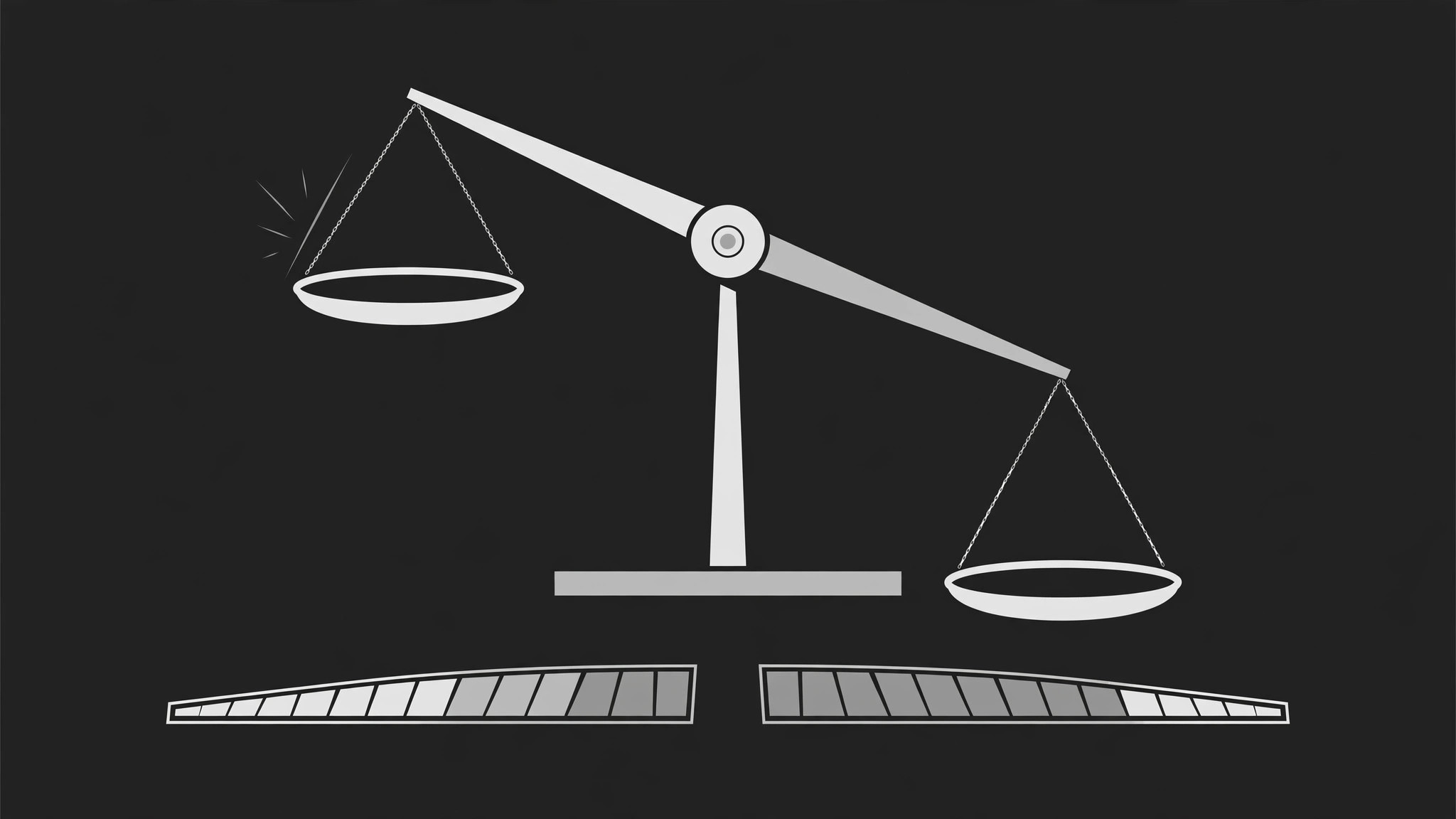
一方が上がれば他方が下がります——トレードオフを物理的にします。
対立する2つの傾向を、同じ拍で互いに逆向きに動く連動した天秤として示し、任意で全範囲のスイープと結論の保持を付けます。両方が同時に勝てないトレードオフのために作られています。
こんな方におすすめ
トレードオフや二者択一の意思決定を提示する解説動画制作者の方
所要時間
1〜2時間
レベル
中級
3ステップでインストール
登録不要。CLIツールも不要です。お使いのAIを選んで、1行コピーして貼るだけです。
ご自分で入れたい場合は、スキルを購入($4.99)し、購入完了画面からZIPをダウンロードして、上のディレクトリに展開し、AIのセッションを再起動してください。結果は同じです。すでに購入済みの場合は、AIアシスタントにダウンロードしてもらうこともできます。
パックの内容
SKILL.md(手順書)1点とスターターテンプレート1点が入っています。プレビューはこちらです:
Dual Tendency Scales
When to use
- An explainer presents a trade-off (speed vs. quality, cost vs. control, risk vs. reward) and a bullet list makes it sound like both sides can win
- A decision video shows what happens as one priority grows — the other must visibly shrink
- A comparison needs the audience to feel the tension between two tendencies, not just read two labels
- A "you can't have both" argument needs a visual that proves the constraint
Workflow
- Name the two tendencies (input: your trade-off → output: tendency pair)
Write each tendency as a 1–3 word label with a direction: "{Tendency A} ↑" and "{Tendency B} ↓", or neutral labels with the motion doing the talking. The pair must be genuinely opposed — raising A must plausibly lower B in the world you're describing. If both can rise together, this is the wrong pattern; use a side-by-side comparison instead. Give each tendency a short example ("Speed: ship in a week", "Quality: zero-defect review"). - Build the scales (input: tendency pair → output: scale composition)
Two scales, one per tendency, presented as a pair: balance beams, vertical gauges, or opposing sliders on one shared axis. Both scales share one visual language (same bar style, same scale length) so their positions are directly comparable. Start both at a neutral midpoint — the "before" state where neither tendency dominates. Keep the composition symmetric; asymmetry before any motion starts reads as a conclusion you've already drawn. - Move them against each other (input: scales → output: opposed motion)
The core move: as scale A rises, scale B falls by the same amount, in the same beat. Animate both in one keyframe block (~0.8–1.0s, ease-in-out) so the opposition is simultaneous — sequential moves (A up, pause, B down) read as two separate facts, not one trade-off. The linkage must be visible: a shared pivot, a connecting beam, or a center marker that stays fixed while both ends move. End positions must be readable at a glance — no squinting to tell which side is up. - Show the range (input: opposed motion → output: sweep pass)
Optionally, sweep the balance from one extreme to the other and back: A-dominant → midpoint → B-dominant, one continuous sweep (~2–2.5s, ease-in-out at each turn). This is the "feel the whole trade-off" beat. Use it when the video's point is that the balance is a choice, not when the video argues for one specific balance — a sweep that ends mid-argument undercuts the argument. - Land on the verdict (input: sweep or single move → output: finished motion)
End by holding the scales at the position your argument endorses (A-heavy, B-heavy, or balanced), 1.5–2.5s. Add a one-line verdict label beneath ("You pay for speed with quality" — your words, ≤10 words). The verdict describes the trade-off shown; it does not introduce a third tendency. Cut from this hold — never let the scales drift back to neutral after the verdict, or the argument un-makes itself.
テンプレートのプレビュー
Dual Tendency Scales — Motion Brief Template
Two tendencies, one constraint. Fill this in before keyframing.
Trade-off: {what is being traded, one line}
Genuinely opposed check: raising {A} plausibly lowers {B} because {reason}. If both can rise together, use a side-by-side comparison instead — not this pattern.
Tendency pair
Linkage ratio: {1:1 equal-and-opposite / 1:{n} — a little more {A} costs a lot of {B}}
Scales
- Form: {balance beams / vertical gauges / opposing sliders on one axis}
- Shared language: same bar style, same scale length — positions directly comparable
- Start: both at neutral midpoint, symmetric composition
Opposed motion
スキルパック本体(SKILL.md とテンプレート)は英語で書かれています。