AI Services Market › スキルファクトリー › 動画 › Convergence to Evidence
$4.99 · サインイン不要v1.0.0– 回表示
Convergence to Evidence
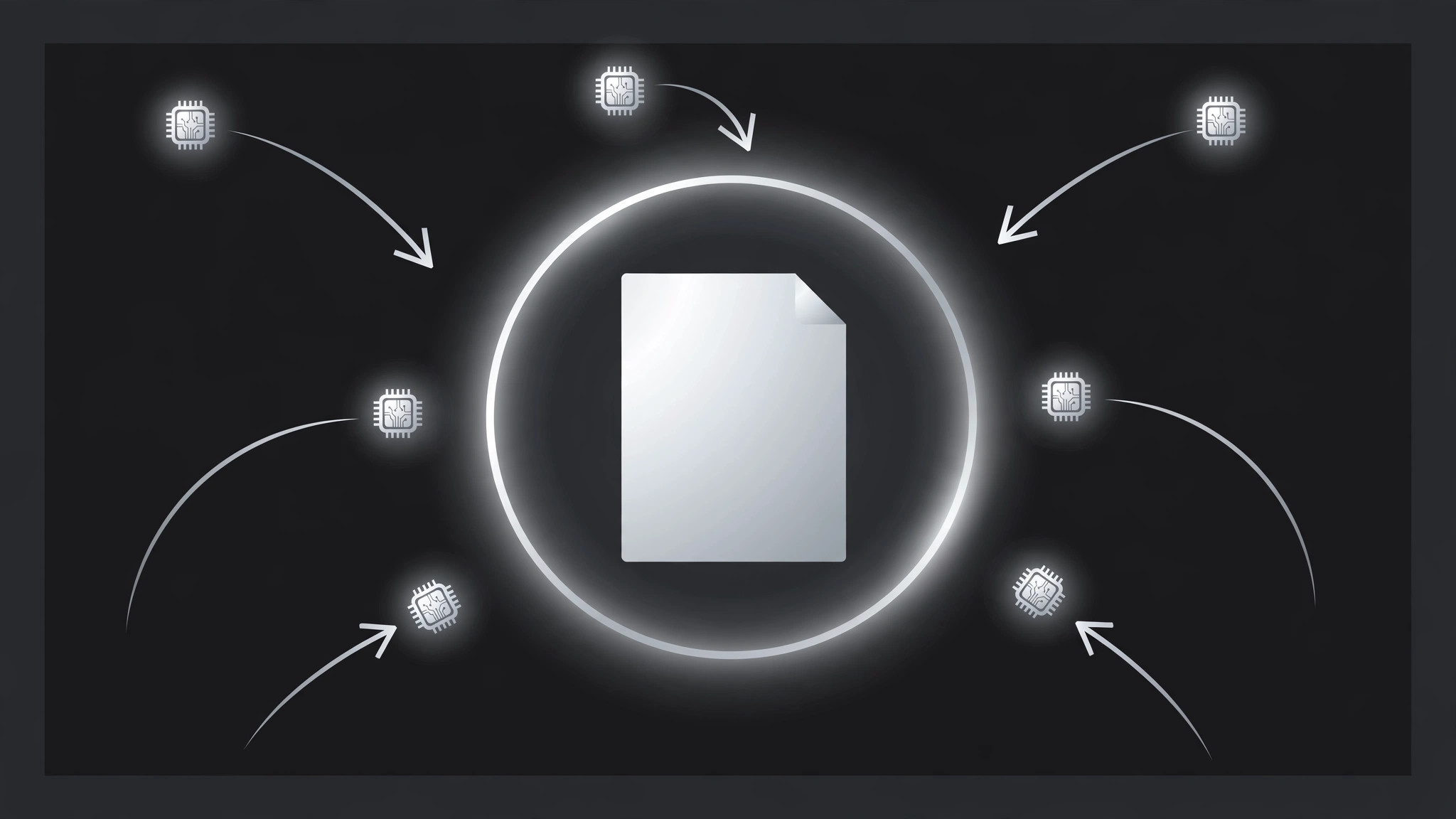
散らかった手がかりが飛び込みます。1つの結論が着地します。
散らかった主張、手がかり、データポイントが曲線の軌道で端から飛び込み、1つの証拠に収束し、それが結論として着地します——議論がまとまる視覚的な形です。
こんな方におすすめ
結論の瞬間を稼いだものに感じさせる必要のある解説・ドキュメンタリー制作者、アナリスト、プレゼンターの方
所要時間
最初の収束まで約30分
レベル
中級
3ステップでインストール
登録不要。CLIツールも不要です。お使いのAIを選んで、1行コピーして貼るだけです。
ご自分で入れたい場合は、スキルを購入($4.99)し、購入完了画面からZIPをダウンロードして、上のディレクトリに展開し、AIのセッションを再起動してください。結果は同じです。すでに購入済みの場合は、AIアシスタントにダウンロードしてもらうこともできます。
パックの内容
SKILL.md(手順書)1点とスターターテンプレート1点が入っています。プレビューはこちらです:
Convergence to Evidence
When to use
- An explainer or investigation has several threads and needs a "they all point here" moment
- A verdict or conclusion must feel earned, because the audience watched the pieces come together
- A documentary or essay needs to turn a pile of clues into one decisive exhibit
- A pitch or report must show that multiple independent signals agree on one finding
- A true-crime, history, or science story reaches its turning point: the moment scattered facts become proof
- You have 3–6 supporting points and one central piece of evidence they all support
Workflow
- Name the evidence and the tributaries (input: your argument → output: convergence plan)
Write the central evidence first, in one sentence: the quote, the document, the measurement, the exhibit. Then list 3–6 tributaries — the claims, clues, or data points that point at it. Each tributary gets ≤8 words ("Three witnesses, same time", "Sensor logged 41.2°C"). If a tributary does not actually support the evidence, cut it now — convergence only works when every incoming piece genuinely points the same way. The evidence sentence must be checkable on screen (a visible quote, figure, or document), not a vague claim. - Place the tributaries around the frame (input: convergence plan → output: layout)
The evidence lands centre-screen as a card. The tributaries start at the frame edges — top-left, top-right, left, right, bottom-left, bottom-right — small chips or short text lines, dimmed to 70% opacity. Give each tributary a distinct start position and a distinct flight path angle; two tributaries flying the same line look like a duplicate. Keep the centre empty at the start: the convergence needs somewhere to go, and an empty centre creates the pull. - Choreograph the flight (input: layout → output: timing map)
Total duration 4–6 seconds. Tributaries fly in staggered: one every 250–350ms, each travelling 1.2–1.8 seconds along a slightly curved path toward the centre. The curve matters — a straight-line rush feels mechanical, a gentle arc (control point offset 40–80px perpendicular to the direct line) feels pulled, like gravity. Easing: ease-in cubic for the first third (accelerating inward), then ease-out for the final approach (decelerating into the landing). The evidence card itself stays hidden until the first tributary is halfway in. - Set keyframes for flight and landing (input: timing map → output: keyframe spec)
Tributary keyframes: 0% — at edge position, scale 0.9, opacity 0.7, blur 2px; 50% — mid-path, scale 0.95, opacity 0.9, blur 0; 85% — just short of centre, scale 1.0, opacity 1; 100% — absorbed: scale 0.6, opacity 0, as if swallowed by the centre point. On each absorption, the centre flashes a 150ms accent pulse (a ring expanding 20px and fading) and a faint tick sound if audio is on. Then the evidence card scales in: 0% scale 0.8 opacity 0 → 60% scale 1.04 opacity 1 → 100% scale 1.0, over 450ms with ease-out back. - Reveal the evidence as the verdict (input: keyframe spec → output: finished motion)
The evidence card holds centre-screen for at least 1.5 seconds — this is the payoff, and rushing it wastes the whole build. Inside the card: the evidence itself in large type (the quote, the figure, the document snippet), plus a one-line verdict beneath it ("The timeline holds."). Add a thin ring or bracket graphic around the card that draws itself on during the hold, clockwise, over 600ms — the visual seal on the conclusion. Then either hold for reading or dissolve the tributary chips entirely so only the evidence remains. - Check the logic reads at full speed (input: finished motion → output: verified animation)
Watch at real speed with the sound off: can you read each tributary as it flies, see it land in the centre, and read the evidence card without rewinding? If the tributaries are unreadable in flight, slow the flight or shorten the text. Check the final frame: does it show the evidence and the verdict, and nothing else competing for attention? If a stray chip is still visible, it must fade out during the hold.
テンプレートのプレビュー
Convergence to Evidence — Starter Template
Fill in every {placeholder}. Every tributary must genuinely support the evidence — cut any that does not.
Convergence plan
- Central evidence (one sentence, checkable on screen): {quote / figure / document}
- Verdict line (beneath the evidence): {one line, e.g. The timeline holds.}
- Tributaries (3–6, ≤8 words each):
- {tributary} — start position: {edge + corner}
- {tributary} — start position: {edge + corner}
- {tributary} — start position: {edge + corner}
- {tributary} — start position: {edge + corner}
- {tributary} — start position: {edge + corner} (add/remove rows to match count)
Layout
スキルパック本体(SKILL.md とテンプレート)は英語で書かれています。